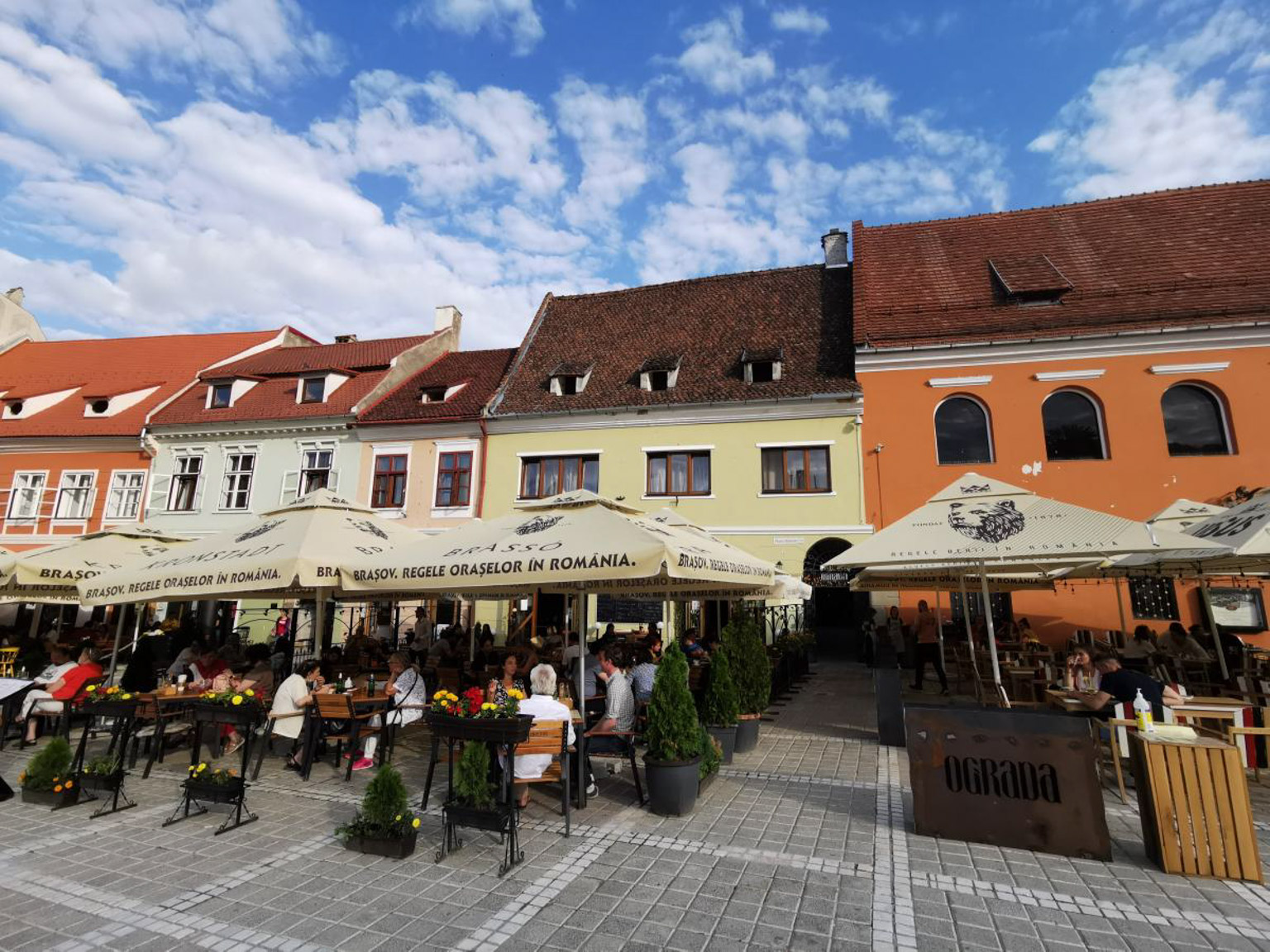
In the past, the centers for selling products, especially those made by shoemakers and cobblers, were called "bridges". Because mostly cobblers, also called "batuși", sold their goods in this building, the building was named the Batușilor Bridge.
The Hirscher House was built between 1541-1547 by Apollonia, the widow of Lukas Hirscher, the mayor of Brașov. He is remembered under the name of Lucaci Hârjilă in Coresi's prints, as a supporter of Romanian printing. The Hirscher House is a valuable architectural monument of the city and was built on the model of the old warehouses of the great cities of Western Europe.
An old legend says that the magistrate's widow's only daughter died and was buried with many jewels and valuables. The cemetery guard, wanting to rob the dead woman, dug her up at night, but the girl, who was only fainting, woke up. The guard took her home to his mother, who happily had the Merchants' House built, which she donated to the city. Its construction cost as much as the price of 1000 oxen from Șara Bârsei.
On the ground floor of the merchants' house were the "vaults", that is, the shops. The guilds rented space in the two halls upstairs to arrange their wares. The wine cellar in the basement, over 400 years old, is impressive. The stone vaults of the cellar are covered with a blackened crust of salts, which resembles a thick grain.
The merchants' house is impressive in its large dimensions. It has the shape of a quadrangle with sides of 70 meters by 20 meters and runs around two inner courtyards.
In the 19th century, the main facade of the merchants' house was modified. A staircase was also built on the long side, the western one. This side, where the "vaults" were, is doubled along the entire length of the facade by a portico supported by 15 massive stone columns. Some of the columns are even from monolithic blocks, having profiled bases in the Renaissance style.
Between 1957 and 1961, the building underwent extensive restoration work, which largely returned it to its original appearance. In the place of the former merchant's house, a restaurant, "Cerbul Carpatin", was built, which is highly appreciated by foreign tourists for its originality.
Source: Brașov and surroundings (Ministry of Tourism, 1978)