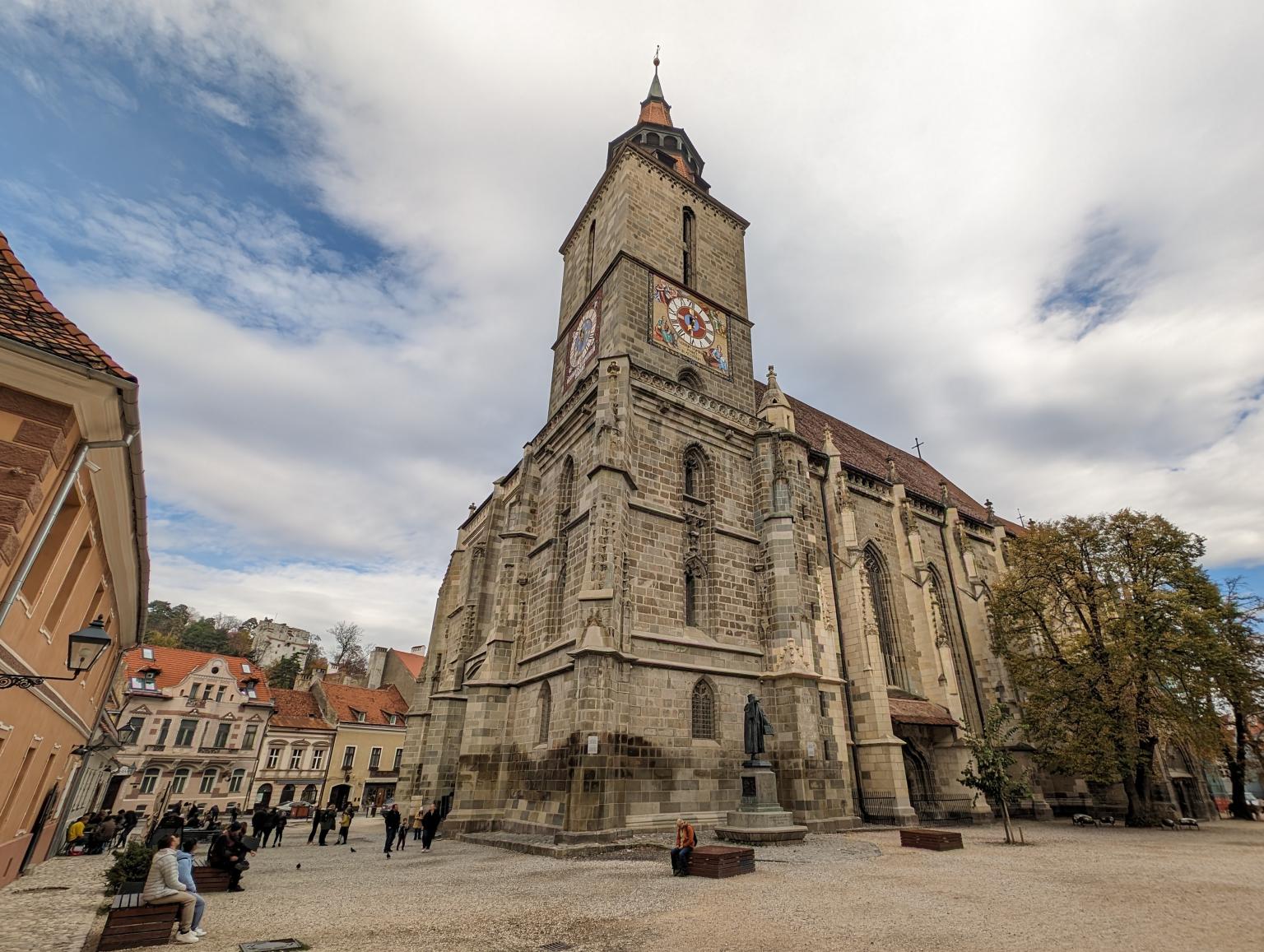
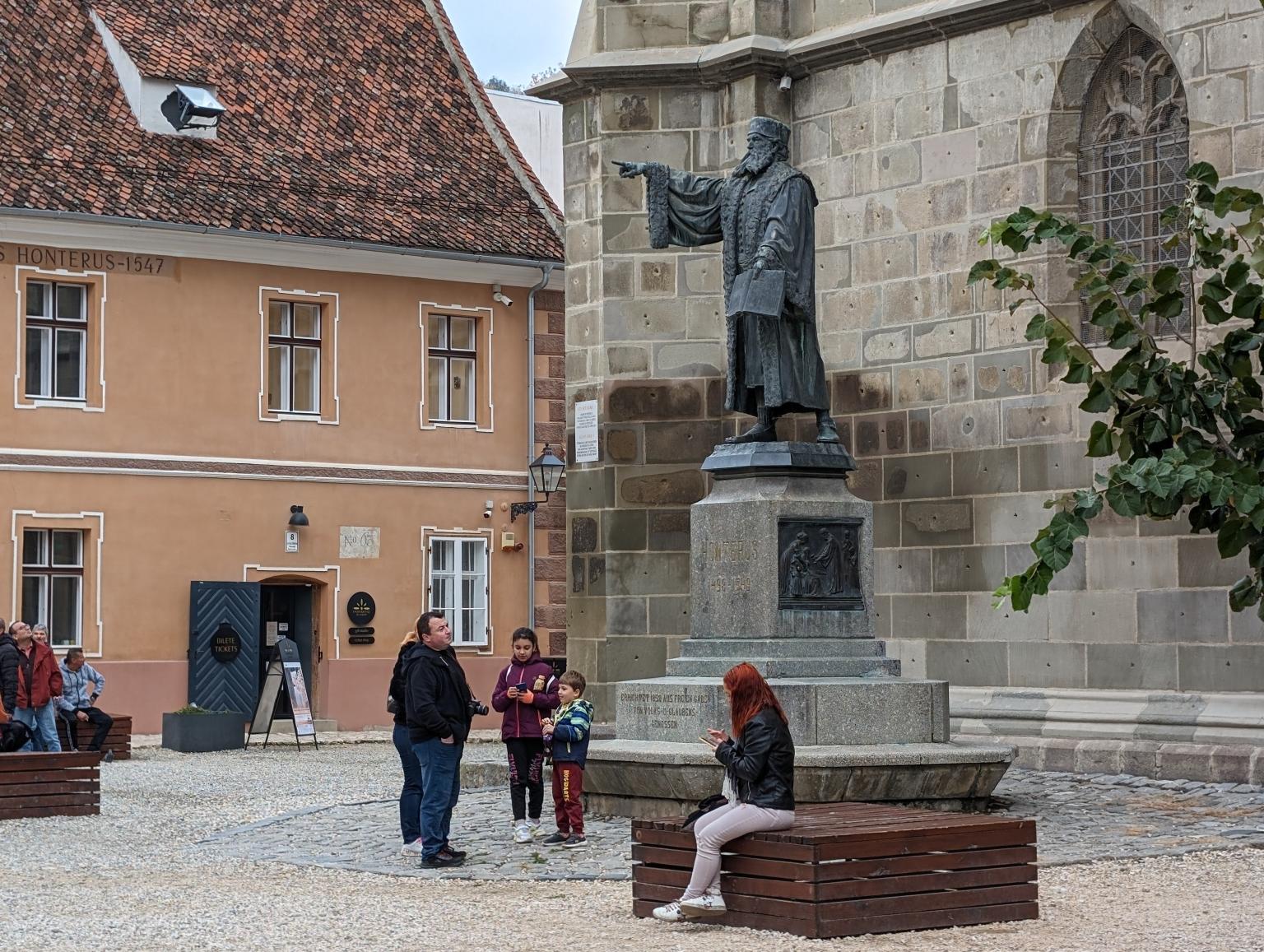
One of the most important monuments of Gothic art in Romania, the Black Church impresses with its grandeur, the beauty of its architecture, the treasures it houses and its rich history.
On the site where the Black Church stands today, there was a small chapel, destroyed by the Tatars in 1242. The construction of the current church began in 1385, according to the oldest date found on the facade slabs, and lasted for a century.
The construction of the Black Church was completed in 1477, as indicated by the date inscribed in Gothic signs on the entrance gate. This gate is the only woodwork that survived the fire of 1689.
In 1689, a devastating fire destroyed a large part of the city of Brașov. The Black Church was also affected, losing all its woodwork, including the organ and bells. Due to the smoke and flames, the walls of the church remained blackened, which is why it received the name Black Church.
The Black Church is an imposing building with impressive dimensions: 89 meters long, 37 meters wide, 21 meters high at the side walls, 42 meters high at the inner ceiling and 65 meters high at the tower. The tower houses the largest bell in the country, weighing 6 tons.
The church is built of cubic stones of friable sandstone, which have led to the deterioration of the carvings and profiles. Andesite blocks were used to give strength to the building. The church belongs to the final Gothic phase, characterized by elegant and slender lines.
Externally, the Black Church presents a simple and sober elegance. The high walls, set on a solid plinth, are decorated with a beautiful and simple cornice, which is crowned by a gallery with four open lobes, now hidden by the eaves of the roof.
The buttresses, placed on rectangular bases, rise above the cornice, being separated by simple and discreet girdles. In the middle part, the buttresses are decorated with statuettes placed under canopies, and above with varied arches or blind, trefoil or braced arches.
The walls of the chancel have tall slender thin windows with broken ogive arches. The windows are framed in stone profiles, beautiful, with a sober design, in the form of trilobes or quadruples.
The sculptures on the outer buttresses are from several periods. Being made of friable sandstone, some of the originals deteriorated and were replaced by copies of them. The oldest of these sculptures is the statue of Saint John the Baptist, installed on a buttress located on the southern side.
The six portals are true works of art, featuring different styles. The oldest (the western one, where the main entrance is located) is of a late Gothic style, the most recent ones have elements of the Renaissance style, due to frequent renovations that sometimes demonstrated a total misunderstanding and forgetting of the old functions.
On the north side is the Golden Gate, preceded by a portico located between the two buttresses that flank the entrance. The portal has stylistic elements of the same value as those on the western portal. The opening is crowned by a polylobed archivolt decorated with rich foliage. The doors, provided with toruses, continue without interruption in the archivolt with a broken arch around the side window. There were statues on plinths crowned with canopies, which have disappeared today.
The portico is covered with a simple, profiled ogive, and in the facade it presents a semicircular arch, above which grows an exuberant Gothic foliage. Under the right cornice, which supports the slope of the roof, an openwork gallery is interspersed.
The eastern portal of the Black Church in Brașov was built in 1476 by ruler Matei Corvin. The fresco on the tympanum of the inner door is also attributed to him.
The Black Church is an imposing building, both externally and internally. It has three naves of almost equal height, separated from each other by pillars. Their construction was completed in the middle of the 15th century. The central naves, along with the great choir, impress with their width.
Inside the Black Church, Gothic elements blend harmoniously with Baroque elements. In the sacristy there is a large stone chest in the Renaissance style, a bronze baptistery from 1472, decorated with beautiful medallions, and an old altar, restored in the Baroque style. The choir is supported by six columns and impresses with its dimensions: 28 meters long and 16 meters wide. Here is the organ, installed in 1839, which has 4000 pipes, seven registers and four keyboards.
The traditions of instrumental music in Brașov are very rich and date back to the 16th century. The first known organist in Brașov was Jeronim Ostermayer, who lived between 1500 and 1561. As a musician, Ostermayer demonstrated his talent in front of Petru Rareș, who entered Brașov in 1539, as well as in front of the ruler Radu Paisie , in 1539. Ostermayer was also the author of some "Histories" that contain information about Transylvania, Moldova and Wallachia from the period 1520-1561.
The pillars supporting the choir are supported by statues, including that of the church's builder, holding a model of the building. It seems that this statue represents the mason Conradus Lapicida, who lived in Brașov in the 15th century.
Inside the church, on the tympanum of the southeast portal, there is a 15th-century fresco depicting Saint Mary sitting on the throne with the child in her arms, surrounded by angels and Saints Catherine and Barbara. The fresco is an exceptional monument of art. The attitude of the figures and the fine faces belong to the North Italian Renaissance.
The painting, which has the coats of arms of Matthew Corvinus and his wife Beatrice of Aragon, probably dates from 1477, as does the portal. Conversely, the outlines of an Annunciation painted inside, near the triumphal arch, show that Gothic forms continued to be used.
The most valuable objects in the church are the 119 old oriental carpets, from the 16th-18th centuries. Most are Turkish prayer rugs. Some are unique specimens, donated by the city's merchants returning from their caravans in the East.
In the church there is also a collection of embroideries, some coming from Italy and the East. A saddle cloth, made of red velvet and with motifs woven in gold thread, is supposed to have belonged to Michael the Brave.
Priests, knights, magistrates and city councilors are buried in the church. Their tombstones, beautifully written in Gothic script and with bas-reliefs of the faces of the deceased, can be seen in the inner walls.
Source: Brașov and surroundings (Ministry of Tourism, 1978)