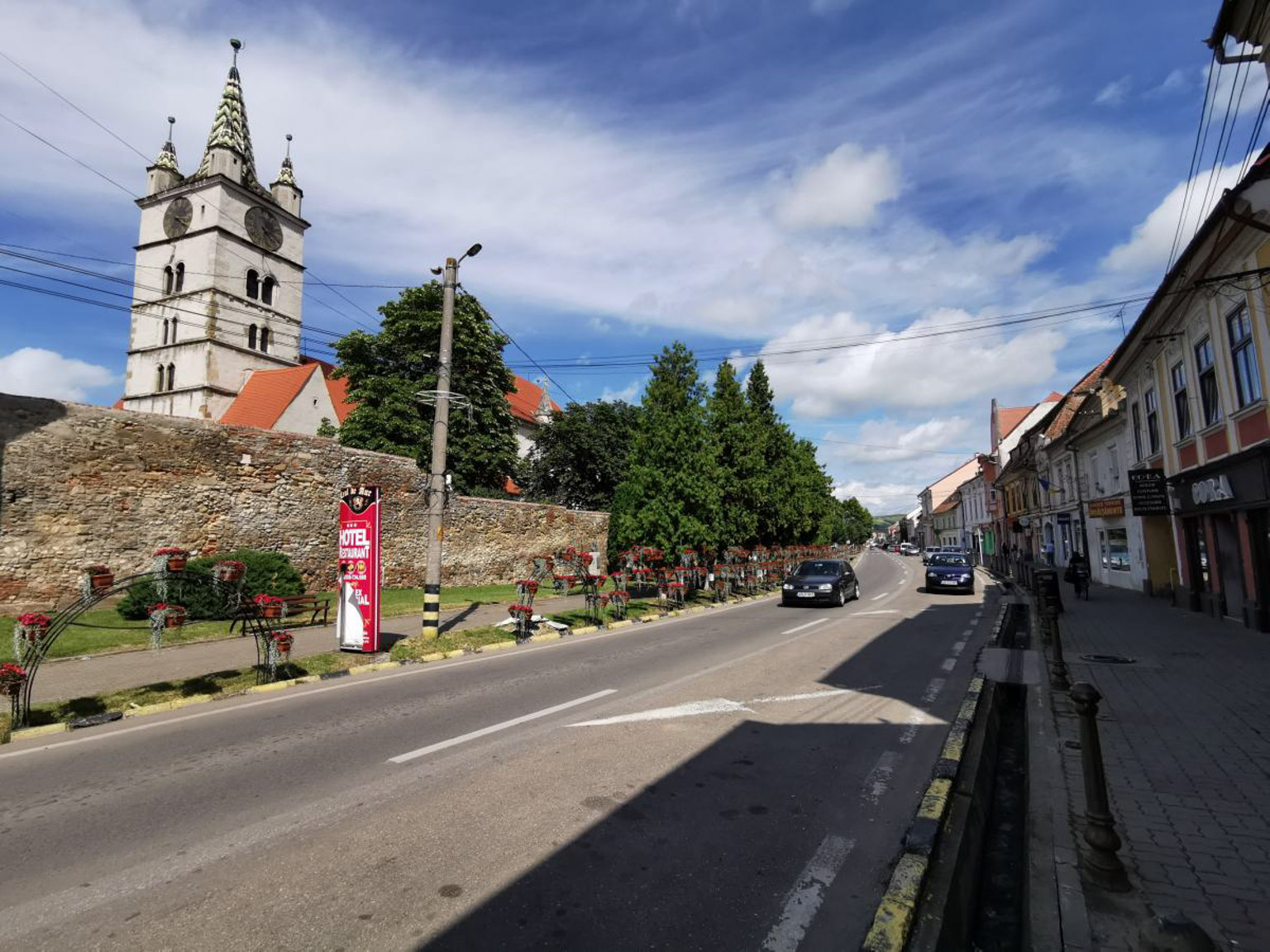
The city of Sebeș is located in the western extremity of the Apold Depression, at the confluence of the Sebeș and Secaș valleys.
On July 1, 1982, the city's population was approximately 30,000.
The name of the locality comes from the Latin term "Sebus", assigned by the Romans to the valley that runs through the city and is mentioned for the first time in documents in 1245. This name precedes the German name of the city, "Malembach", which, following some transformations, developed in "Mühlbach".
Sebeșul was founded by German settlers, who found an old Romanian population here, its presence being confirmed by archaeological discoveries.
Excavations in the area of the city and its surroundings indicate the continuity of habitation, starting from the transition from the Neolithic to the Bronze Age (with elements of the Coțofeni culture), then in the transition period to the Iron Age (with elements of the New cultures) and in the Hallstatt era. Vestiges of a Dacian settlement were also identified, as well as elements (ceramics, necropolises) dating from the 4th - 9th centuries.
During the Roman rule, Sebeș established itself as a crucial node on trade routes. During the developed period of the Middle Ages, Sebeșul, which became a flourishing commercial center in 124, controlled the production of pears in the neighboring depressions and was recognized as a center of crafts, manufacturing various goods, with an emphasis on iron objects. Before 1376 (the year of the first passage of the Transylvanian army), trades such as blacksmiths, locksmiths, potters and bakers stood out. Sebeș also functioned as an important commercial center, with skilled merchants, establishing trade relations with Wallachia and Vienna.
Sebeșul was the first city in Transylvania to receive permission to build a fortified citadel in 1387, with walls, gates and towers, as a means of defense against Tatar invasions.
In 1458, the city was conquered and destroyed by a Turkish expedition, and in the 16th century it was under the rule of the troops of John Zápolya. In 1848, it became the seat of the Romanian prefecture led by Dionisie Fodor, and in 1609 it was conquered twice by the armies of General Iancu.
The strong development of crafts turned Sebeș into an important cultural center. In the economic and cultural landscape of the city, the craft of printing played a significant role, hosting one of the oldest printing houses in Transylvania (the others being in Alba Iulia, Orăștie, Brașov and Sibiu). In 1500, in Sebeș, "Zbornicul evanghelic" was printed by deacon Coresi. In 1657, the printing house from Alba Iulia was transferred here, and in 1653 a new Romanian printing house was established, which produced in Romanian the Golden Casket, containing 12 burial sermons.
In the period between 1908 and 1910, the magazine "Munca" was published as the official organ of craftsmen, journeymen and apprentices from the cities of Cluj, Blaj, Sibiu, Sebeș, Miercurea, Timișoara and Săliște, highlighting a pronounced democratic orientation. The literary supplement of the publication housed the most outstanding works of that era.
In the past, the city of Sebeș witnessed an intense musical life, with an emphasis on worship music, where instrumental music occupied a central place not only in educational institutions, but also in private homes. Thus, for the inhabitants of the city, music has become a mass cultural manifestation.
Carol Filtsch, born in Sebeș in 1830, was the most talented student of the famous pianist F. Chopin. With an astonishing interpretive genius, Filtsch shone like a meteor in the capitals of Europe, impressing great pianists of the time such as Thalberg, Moscheles, Liszt and even his teacher. At the age of only 14, in 1844, he died of a relentless illness, after several resounding tours in Paris, Vienna and London.
Currently, in Sebeș, the cultural-artistic festival "From the hearth of history, to the gate of lights" takes place annually in August, as well as the "Lucian Blaga" creation and interpretation competition festival.
The Saxon writer Iosif Merlin was also born in Sebeș, author of the stories "Mountains from Săsciori", "Baba Novac", the drama "Decebal" and the unfinished novel "Horea". Merlin made collections of folklore from the Sebeș area.
Source: Tourist itinerary Brașov - Sibiu - Alba Iulia (Ministry of Tourism, 1982)