Carol I Boulevard, one of the most important traffic arteries in Iasi, hosts some of the city's most notable institutes and can be compared to a "Vast heart that pulses with spiritual energy". This old street is integrated among the old streets of Iasi, connecting the city center with the vineyard area on Dealul Copoului, which, in the past, was outside the city limits.
From ancient times, Iași was surrounded by famous vineyards, and vine culture was present in the Tătărași area until the 18th century, when it was a village. On the coast of Galata, heading towards Bucium, Socola, Valea Adâncă and Copou, the vineyards were endless. In the 18th century, these places were preferred for walks by the Iesian nobility, some of whom built their houses among the vineyards for recreation.
With the passage of time, starting from the 17th century, Copoul, due to its proximity to the city and its accessibility without crossing any water, became the preferred place for walks, being influenced by the gentlemen of the Ghica family, who built gazebos and pavilions in the style Turkish.
Alecu Russo, around 1840, described Copoul as a "long plain with burnt grass, on which the noble wheels make numerous traces in the evening" and called it "the theater where the young man makes his debut in the world". Starting with the second half of the 19th century, Copoul underwent significant transformations, with new constructions, including those with social and cultural purposes, and urban development, contributing to the creation of a well-equipped and beautiful area in the city.
The legend relates that the name of Copou derives from a hound, following whose footsteps Vasile Lupu followed, on an occasion when, returning from a confrontation, he was forced to go in search of his wife, Mrs. Tudosca, who, fearing from enemies, he had hidden himself in a secular oak.
Following the route on Copouului Hill, you arrive in front of Copou Public Garden, a green area established since the first decades of the 19th century. The park was laid out during the reign of Mihail Sturza. In 1852, due to overcrowding in the existing garden, which had become too small for those who came for carriage rides, two planted areas were created over 0.5 km apart on the hill. These were each 50 m wide and included roundabouts and carriage turnings, as well as pedestrianized streets among flowers and trees.
The garden's landscape style combines two park styles: the English, with a wild look, and the French, with a neat, man-made look. The credit for the achievement goes to the landscape architect F. Rebhun.
During the Second World War, the garden suffered significant damage. Currently, it has been restored and improved, remaining a favorite place for a walk for the residents of Iași.
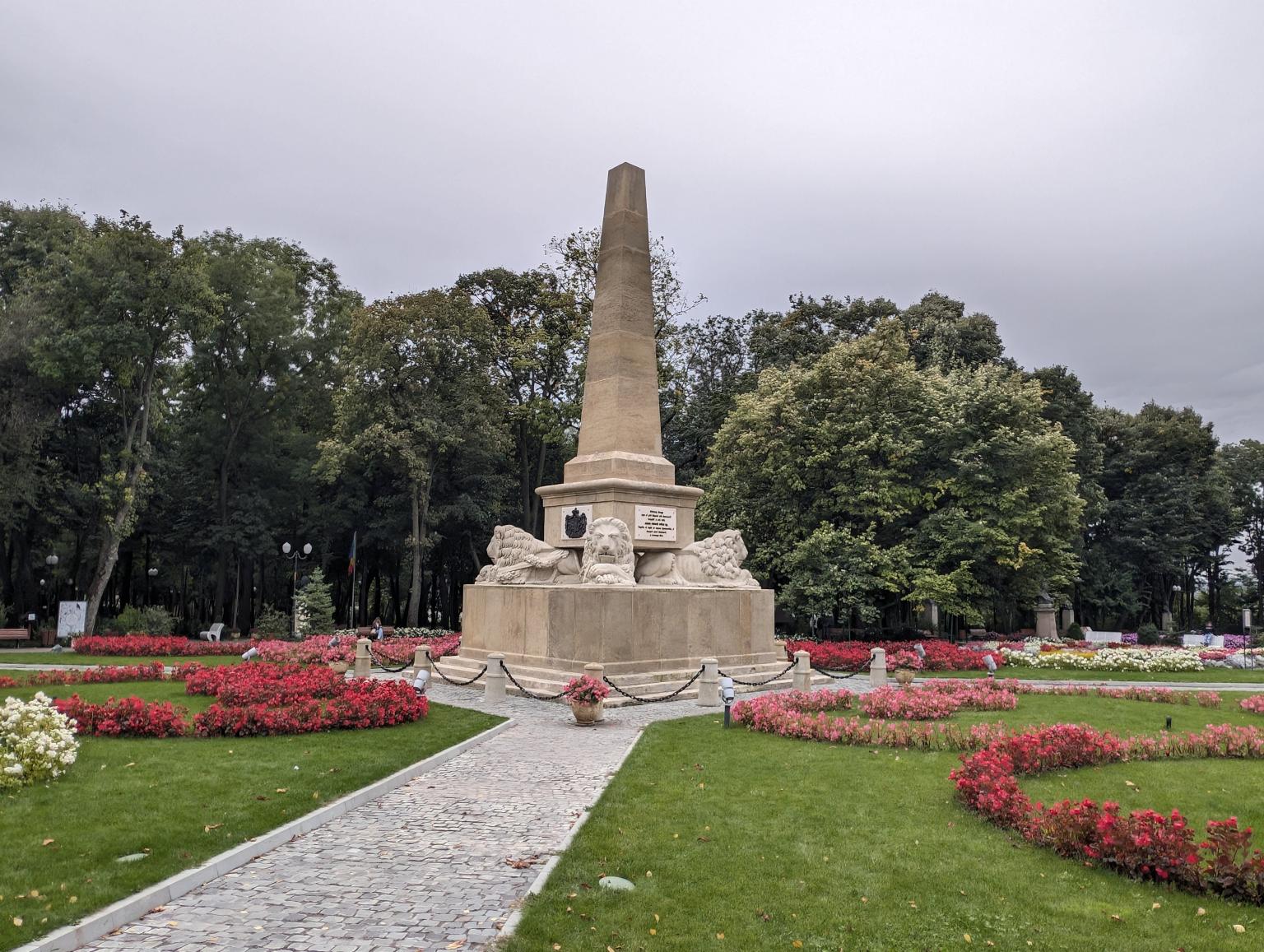
In the center of the garden is the monument known as the Obelisk of the Lions, represented by a four-edged stone column, placed on the backs of four stone-carved lions, bent on their paws, all placed on top of a marble plinth. The monument has a height of over 13 m and was created at the initiative of some boyars of the former lord of Moldova, Mihail Gr. Sturza, during the implementation of the Organic Regulation in 1832, the first constitution of Moldova. The inauguration took place on November 8, 1834, and the project was developed by Gh. Asachi.
The monument is surrounded by a series of sculptures representing illustrious personalities, most of them located along the famous "alley of statues". Among them are the busts of Ion Creangă, sculpted by Dimitriu - Bârlad in 1932; Emanoil P. Bardasare, work of I. Mateescu; Octav Băncilă, created by I. Irimescu; I. L. Caragiales; Barbu Delavrancea, sculpted by I. Mateescu and completed in 1924; C. Negruzzi, made by I. Mateescu in 1924; Mihail Eminescu, sculpted by I. Mateescu and unveiled in 1924; Veronica Micle, the work of I. Irimescu; Iacob Negruzzi, made by the sculptor Sahagiu in 1943; Gheorghe Panaiteanu, sculpted by Dimitriu - Bârlad in 1932; Ciprian Porumbescu, work of I. Bârleanu from 1957; Nicolae Tonitza, sculpted by V. Florea; N. Gane, made in 1943 by R.P. Hette.
These sculptures also surround the linden tree dedicated to Eminescu, evoking the great poet's "gentle dreaming nights".
The linden tree was the poet's favorite tree and appears frequently in his work.
As a tribute to the poet, the "lime festival" is organized in Iași every year. On this occasion, flowers are placed at the statue of Eminescu in front of the library. Amidst the sounds of the brass band, the pilgrimage goes to the tei, where there are recitations of Emincian poetry and performances, with the participation of national and international personalities.
The celebration ends with the linden ball, which has become a real popular event.
In the past, the most impressive festivities in Iasi also took place in Copou. On the occasion of some holidays, a women's committee decorated the park with lanterns, set up kiosks and organized fireworks games. In the alleys, flowers and cigarettes were sold in carefully arranged baskets.
Music was playing in the kiosks, and at the entrance to the park, two masked characters invited passers-by to enter the garden.
In front of the Copoului garden is the statue of the cavalryman in attack, made in bronze by the sculptor Dimitriu-Bârlad and erected with the contribution of the officers and other heroes of the 2nd Cavalry Division, fighters in the 1916-1918 war, for the completion of the unity of the Romanian state.
Source: Iași Municipality and surroundings (Ministry of Tourism, 1980)