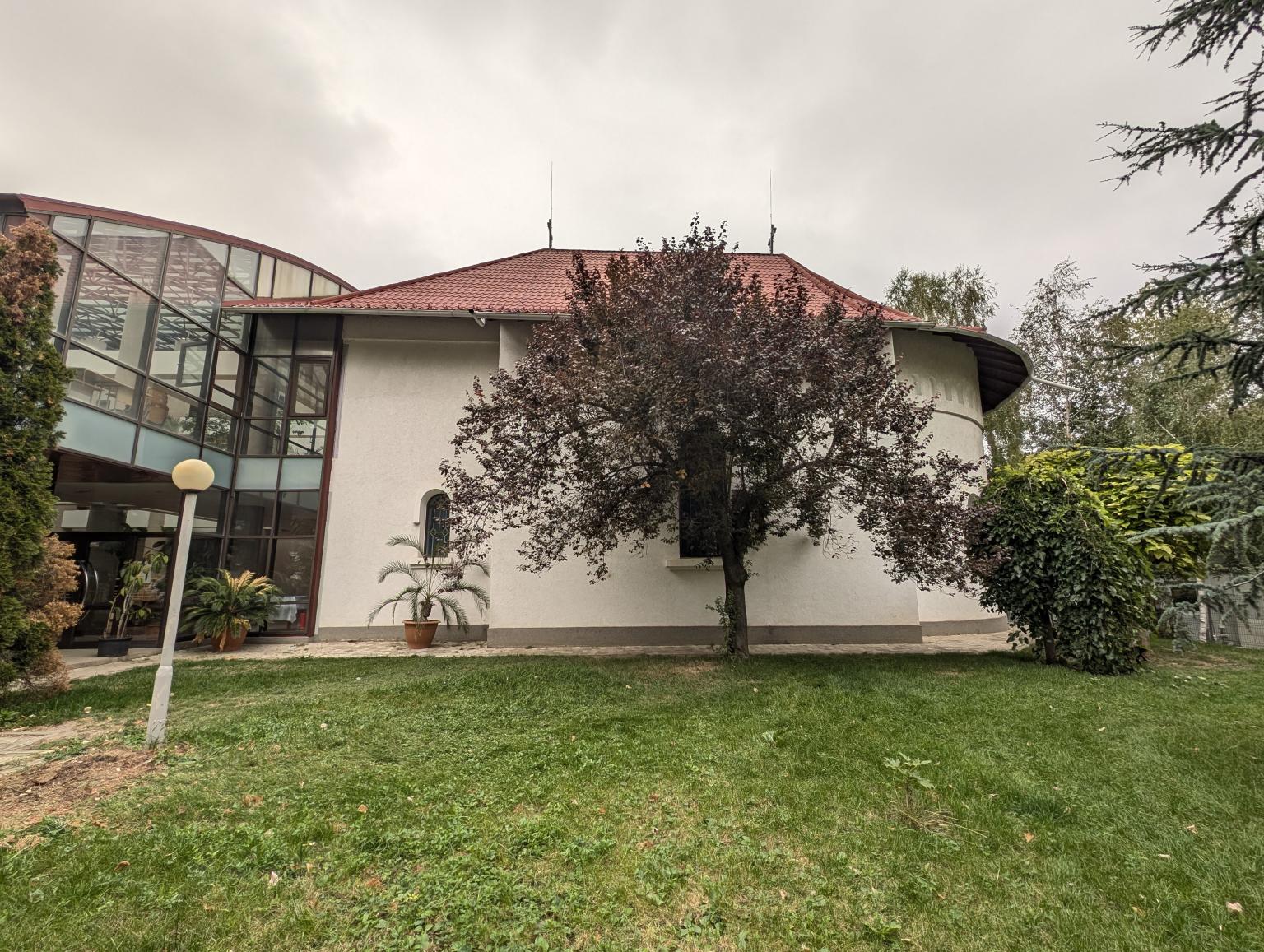
At first, the chapel was used as a place of prayer for the students of the Normal School. Since 1828, at the initiative of Gheorghe Asachi, a school for teacher training operated in Iaşi. It evolved over time, becoming a gymnasium, then a preparatory school, and during the reign of Alexandru Ioan Cuza it was named "Vasile Lupu". At that time, however, the institution did not have its own building (Sorin Iftimi, 2000, p.87). The current building was built specifically for the normal school, in the area of the Pester vineyard, beyond the Copou barrier, and was put into use in 1891.
Being located at a considerable distance from the city center (approximately 5 km) and from the existing places of worship, the school felt the need for its own chapel. It was built between 1907 and 1911. The choice of the chapel's patron saint recalls the beginnings of education in Moldova, linked to the Three Hierarchs Monastery and the initiative of Prince Vasile Lupu, who in 1640 founded a school here for the sons of boyars. The architects of the project were N. Mihăilescu and C. Artachino, who also took care of the painting and decorations. The construction was financially supported by the Church House Administration.
The chapel was consecrated by the Metropolitan of Moldova and Suceava at the time, I.P.S. Pimen Georgescu. The school's students used the chapel until 1947, after which it was closed, being reopened only in 1990, when it was redeveloped for religious services. Since 1995 it has served as a chapel for the students of the "Saint Basil the Great" Theological Seminary, established within the normal school, but remains open to students from the normal school as well.
The building is made of stone and brick, and the facade reflects an aesthetic play between the two materials. On the western side, on the outside, there are three icons painted on wood: a central one, above the entrance, depicting the patron saints of the chapel, and two lateral ones, representing the Holy Apostles Peter and Paul. The inscription, engraved on a white marble slab, mentions that the building was built in the "44th year of the reign" of King Carol I, that is, in 1910.
The church has lateral apses that are polygonal on the outside (with three sides) and semicircular on the inside. The narthex includes a space for the choir (cafas), and on the western wall are painted portraits of King Carol I and Queen Elisabeth, as founders. The interior is completely decorated in fresco. The iconostasis, made by the sculptor Paul Smărăndescu, is richly ornamented. The gabled roof is simple and devoid of a spire, but has five large metal crosses. Between 1989-2000, repair works were carried out, and the furniture and religious objects were renewed.
Sursa: monumenteiasi.ro