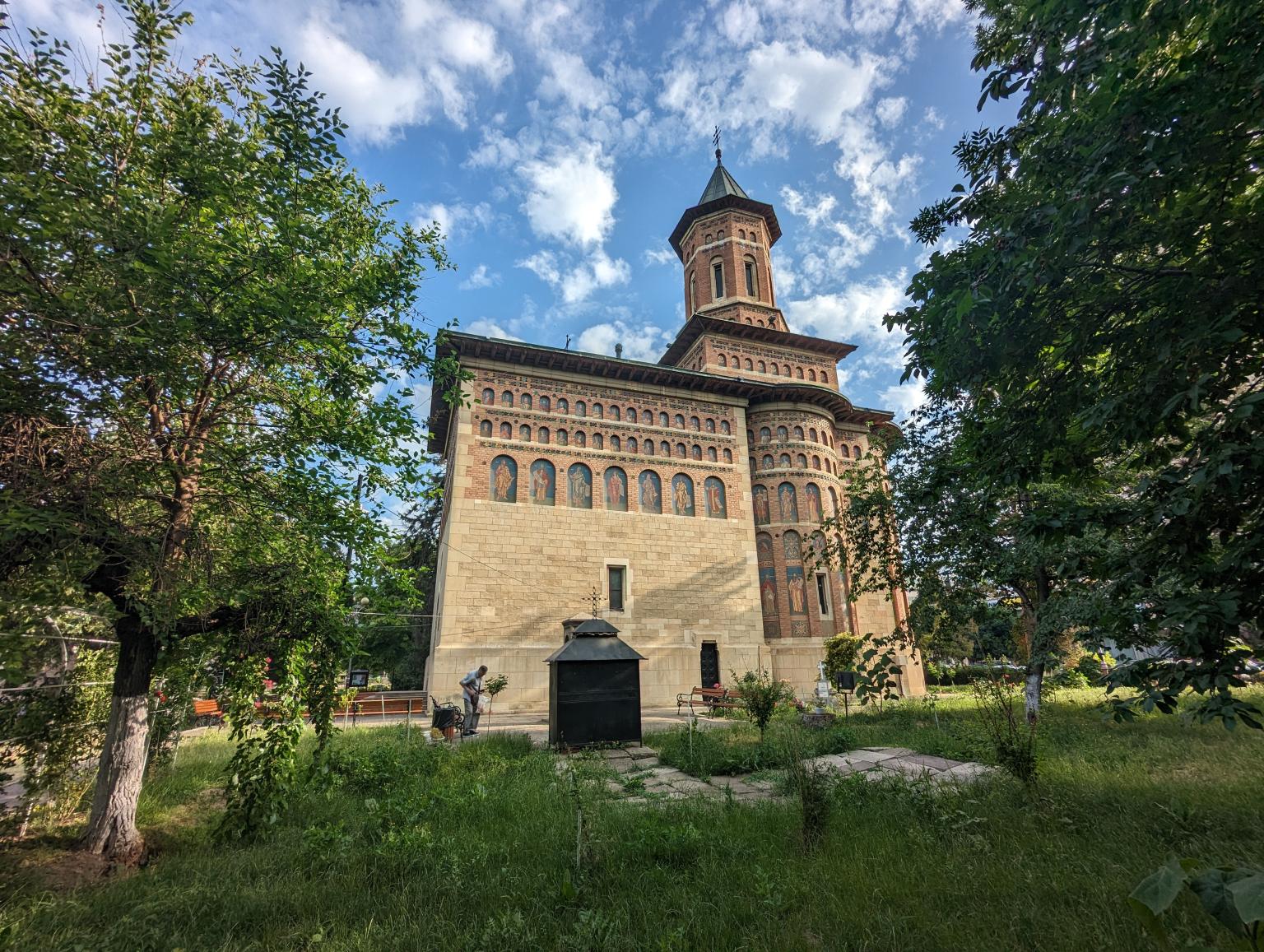
This sanctuary was founded by Voivode Stephen the Great and the Holy in 1492, in the typical style of city churches. After 1564, when laşi became the capital city of Moldavia, the rulers were anointed here. The church was added a bell tower, and after 1700, two more chancels: one dedicated to St. Stephen and the other to St. Barbara, their position being marked by the present rock crosses on both sides of the narthex. The service was held simultaneously in three languages: Greek, Slavonic, and Romanian.
In order to rehabilitate it, the French architect André Lecomte de Nouy demolished the entire edifice and only rebuilt the original church, between 1884-1904.
The Neoclassic painting with the life of St. Nicholas, the founders and the royal family, the gilded iconostasis, and the Byzantine church choir offer a great experience.
Text taken from the presentation panel
On the eastern side of the square is the church of Sf. Nicolae Domnesc, the oldest historical structure in Iași, preserved in the form of an almost identical reproduction. Originally built by Stephen the Great, the edifice was erected between June 1, 1491 and August 10, 1492.
With significant changes over time, the building was completely rebuilt at the end of the last century, trying to restore the original architecture of the monument. Being considered an almost exact replica of the original construction, the church provides information about the architecture during the reign of Stephen the Great.
The Church of St. Nicolae Domnesc is included in the category of city churches. Located in the vicinity of the royal court, just like the churches in Hârlău, Vaslui or Piatra Neamț, this church was often used for court ceremonies, in which the city's population also participated. The rulers of Moldova were crowned in this church, starting with Alexandru Lăpușneanu and earlier, Dabija Vodă.
Under the leadership of Antonie Ruset in 1676, a first restoration of the monument was initiated, and Gheorghe Duca continued this work in 1678. In the 18th century, the church underwent radical changes by adding two rooms, equipped with apses, located at to his left and to his right.
Over time, the monument was affected by several fires, requiring repeated repair operations. In 1888, the question of its restoration was raised, and the responsibility of this task was entrusted to the French restoration architect A. Lecomte de Nouy.
In the restoration process, two perspectives were confronted. One of the approaches promoted the principle of historical restoration, supporting the preservation of the history of the monument and significant additions that reflected the different stages of its existence, even if they altered the original image of the church. M. Kogălniceanu supported this perspective, insisting on the preservation of the added altar, arguing that this image has become familiar to the people and thus must be appreciated.
However, the restorer took a different approach, demolishing not only the additions made over the centuries, but also the original core of the edifice. He reconstructed the monument according to his own imagination of its original form. Although the works carried out between 1888 and 1904 were noted for the precision of construction and finishing, they led to the loss of the historical and archaeological value of the monument, which would have been preserved by preserving the materials and authentic parts of the construction.
The structure of the church is trilobed and includes the traditional rooms: pronaos, naos and altar, accompanied by a proscomidia and a diaconicon.
Initially, the interior painting of the church was done, but unfortunately, the restorer removed the old painting, replacing it with one that was inadequate both for its sumptuous character and for the fact that it makes it difficult to perceive the architectural forms.
Pieces of the original painting, executed during the reigns of Antonie Ruset, Gheorghe Duca and Ioan Mavrocordat, can be seen in the "Gothic Hall" at the church of the Three Hierarchs and at the old Metropolis.
The new paintings were created by Boris Bernard, Emile Mempiot and P. Mauretal.
The outline of the church is characterized by a dynamic and gradual growth, the transition from the massive trunk to the high spire being made progressively, by means of the two bases.
On the outside, the edifice has a series of storied niches in the upper part. Within them, in the arches of the niches, 282 figures are painted in fresco, alongside polychrome glazed discs, arranged in friezes or continuing the architecture, eyelets, various emblems and Gothic-style window frames. Overall, it gives an appearance of thinness and simplicity, highlighting at the same time a harmonious combination of decorative elements: exposed brick, terracotta, and the colors of the frescoes. The brilliance of the polychromy that dominates the exterior of the church contrasts with its interior, characterized by a severe coloring in blue tones.
During the reign of Antonie Ruset (1676-1678), an enclosure wall was built around the church of Sf. Nicolae Domnesc. Next to the enclosure wall, various buildings were built, among them a metropolitan house and Dosoftei's house, the latter still standing today. Only a piece of the enclosure wall remains today, located between the church and the Palace of Culture, being partially incorporated into the more recent constructions.
On October 2, 1904, the inauguration ceremony of the new church took place. On this occasion, in the altar, on the painted table, a silver box was placed in which the deed of establishment was deposited. The event was attended by members of the ruling family, as well as special representatives of Franz Joseph, Emperor of Austria and King of Hungary, and Emperor Nicholas of Russia, along with important personalities of the time, including Spiru Haret, Petru Poni, N. Eyes etc.
The inauguration of this monument coincided temporally with the celebration of the Trei Hierarhi church and the centenary of the Veniamin Costache seminary.
Source: Iași Municipality and surroundings (Ministry of Tourism, 1980)
Sursa: www.facebook.com