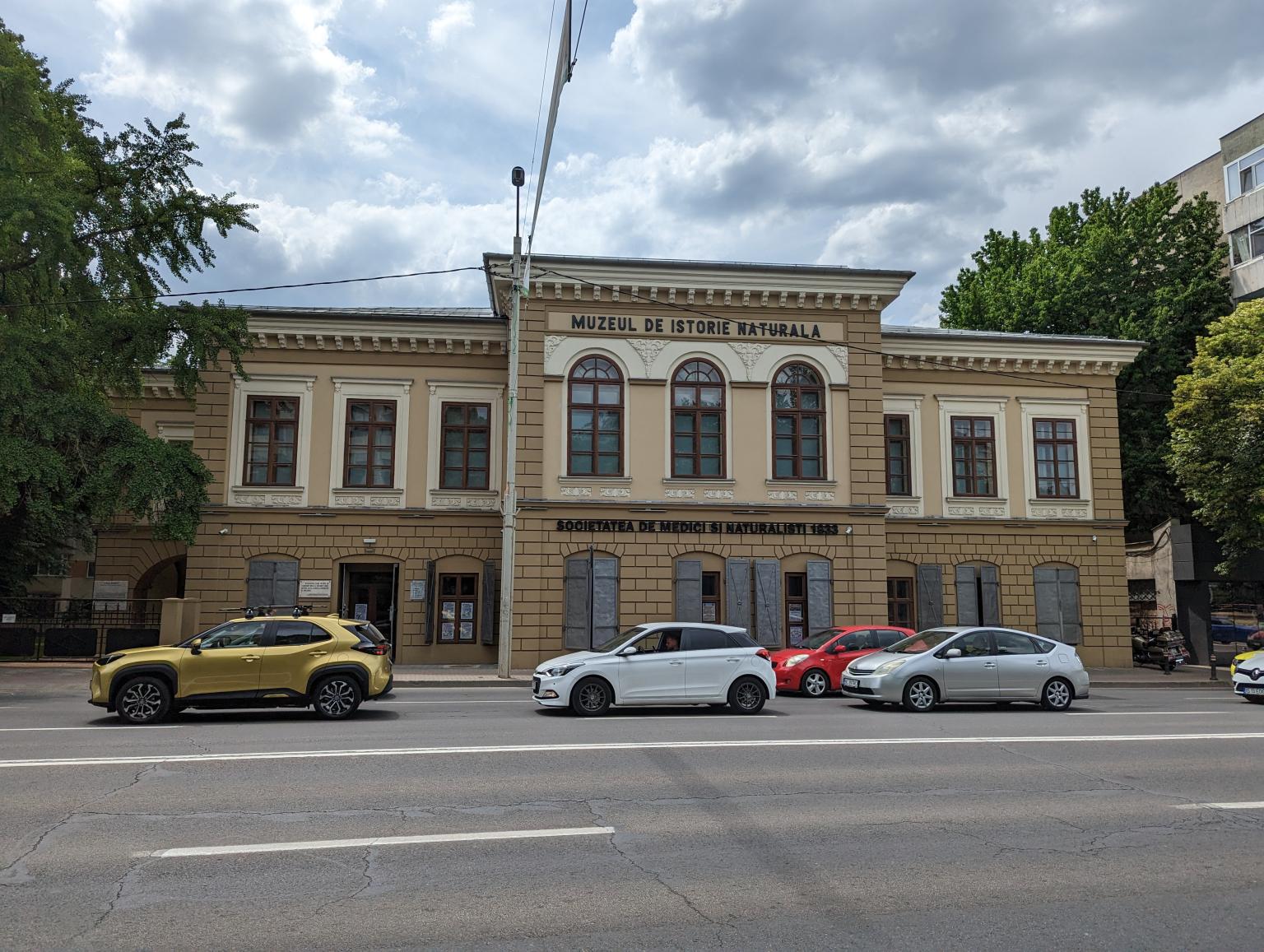
The former house of the nobleman Costachi Sturdza has housed the first natural history museum in the Romanian Principalities since 1840, with unique collections in the Romanian scientific landscape.
Currently, the museum collection has over 300,000 specimens of animals, plants and minerals. The building remained in the national memory through a decisive event for the birth of modern Romania. In a room called the Elephant Cabinet, on the night of January 3, 1859, the deputies from the National Party decided the candidacy of the unionist Alexandru loan Cuza for the rule of Moldavia, after stormy debates. It is said that the discussions were so heated that Lascar Rosetti, later a minister under Cuza, had to lock the room to get the members to come to a decision. Today there is a room in the museum dedicated to this historical moment.
Text taken from the street sign
A memorial plaque is placed on the facade of this building, erected to commemorate the event of January 3, 1859, when the candidacy of Al.I. Cuza as ruler of Moldavia, and the construction itself was completed around 1800, adopting the classical style of the era, with adaptations to new requirements. The main rooms are arranged along the axis of the building, and as an original architectural detail, the carriage vaults attached to a side face stand out.
Since 1841, this monument has had a significant role in the life of Iasi, hosting the first society of doctors and naturalists in the country. This society was the forerunner of the "Medical Reading Circle" founded in 1829 by Dr. Iacob Cihac, chief physician of the Moldovan army. In 1832, under the guidance of Dr. Cihac and Dr. M. Zotta, the circle expanded its activity, becoming the "Moldo-Romanic Society," then the "Medico-Istorii Naturale Society," legally recognized in March 1834 by General Pavel Kiseleff , the governor of the Romanian Principalities.
In just three years of scientific activity, the 8th Society captured the attention of Europe, including 11 foreign corresponding members. The purpose of this society was to establish a Museum of Natural History, considering that the doctors of that time were also naturalists, with the intention of educating the general public.
The first collections of the museum included significant donations, such as that from General P. Kiseleff, who offered a collection of rocks and minerals from Moldova, or that from Metropolitan Veniamin Costache, who donated a collection of mammoth bones and molars and rhinoceros discovered in the balance of the tools of the fountains from Râșca (Suceava county). These collections are still on display in the museum today.
Until 1841, when it moved to its current location, the museum exhibited its collections in the first phase in the Balș house, known today as the "Casa Armatei", and later in the Mihăilene Academy building.
During that period, the meetings of the Society of Doctors and Naturalists were held in the house of Gh. Asachi, an active member of the society and one of the promoters and supporters of the initiation of the museum.
Over time, the museum's heritage has grown steadily, currently presenting collections and exhibits of scientific value in the fields of botany, geology, mineralogy and zoology.
In the final section, the complete skeleton of a mammoth and a stuffed elephant purchased in 1935 from a circus that passed through Iasi attract attention. The room where this gigantic mammal is exhibited is called the "Elephant Hall", a name that has expanded to include the entire building. In terms of publishing activity, the Society of Physicians and Naturalists made a remarkable contribution.
In the period 1834-1835, Iacob Cihac held a public natural history course in the museum. The lessons taught were published in the form of a manual in July 1837, in Iași, thus representing the first natural history manual in the Romanian language. The manual, written in Cyrillic characters, followed Linne's classification and, although it was based on his fixist conception, the approach to the problems was generally scientific, contributing to the establishment of scientific terminology in the Romanian language in the field of natural sciences. This manual has long represented the basis of the study of zoology, botany and mineralogy in the Romanian Countries.
In 1844, Dr. C. Vârnav launched the first medical magazine, "Povătuitorul Sănătății", under the auspices of the society. However, in 1847, the publication ceased its activity, returning in 1868 under a different name, but for a short period. The scientific activity of the society decreased during this period, being resumed in 1886. On January 1, 1886, the "Bulletin of the Society of Physicians and Naturalists" was launched, which in 1924 became the "Medical-surgical Journal of Iasi", published until 1949 .
The magazine reappeared in 1956 and is still in circulation today.
The building also houses the history of an important event on January 3, 1859.
This event took place in the hall where the Society of Doctors and Naturalists held its meetings since 1843, a hall now known as the "Al. I. Cuza Hall". The showcases in the hall display objects belonging to the ruler, the urn used for voting, the seals from Cuza's time and portraits of the electors from January 24, 1859, photographed by C. Sathmari. Currently, the building also houses the Editorial Office of the "Medical-Chirurgical Journal".
Source: Iași Municipality and surroundings (Ministry of Tourism, 1980)
Sursa: www.bio.uaic.ro