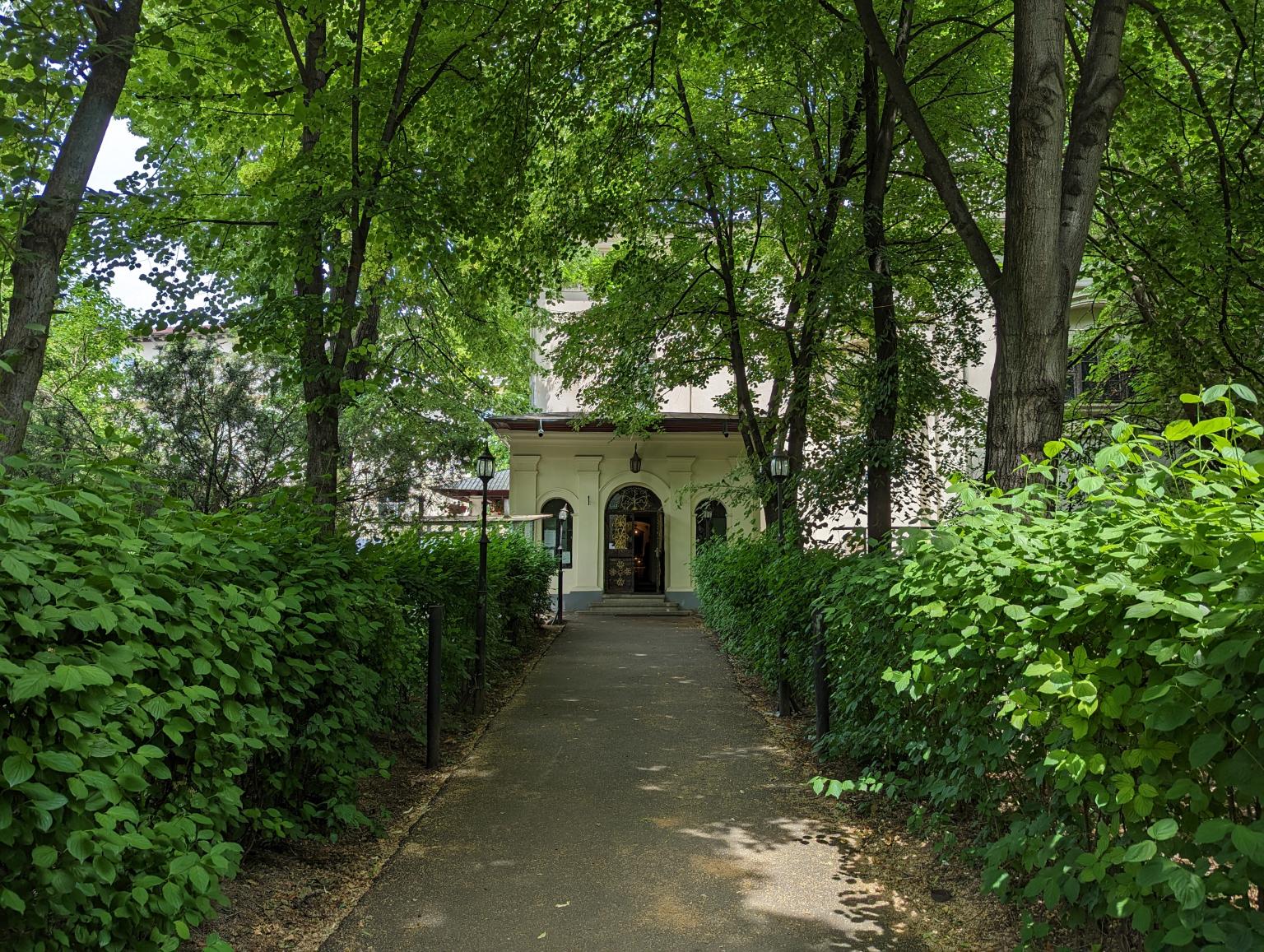
The Clinical Hospital, also known as Spiridonia, is the first medical institution in Moldova. The initiator of the foundation of this hospital was Ștefan Boisie, a nobleman with progressive ideas, who, between 1752-1758, built the monastery of St. Spiridon and several hospitals for the care of the sick near the church.
The monastery occupied a space resulting from the unification of several private properties, delimited by an enclosure wall, probably built before 1770, when the Russian authorities turned the monastery into a fortified point.
On May 1, 1756, ruler Constantin Racoviță formalized the recognition of the hospital. Its funds have grown constantly through the contributions of donors from all over Moldova, facilitating the expansion of the hospital's space. This was achieved by acquiring other properties outside the enclosure wall, expanding the hospital to cover a vast area that also includes the Stratulat house, still standing today, used as a hospital pavilion (the radiology pavilion).
Since 1756, the institution has coordinated and provided all medical assistance in Moldova. In the 19th century, he established the country's first unit for mother and child care, established a psychiatric hospital and a nursing home. He also made available to the Ministry of Public Education the clinical basis necessary for the establishment of university medical education, achieved in 1879 by the establishment of the Faculty of Medicine in Iași.
State healthcare was only established in 1880.
In the courtyard of the hospital is the church of St. Spiridon, built in 1807 by Mihail Grigorie Sturza, replacing the church of Stefan Boisie from the 18th century, severely affected by the earthquake of October 14, 1802 and demolished as a result.
The building, symmetrically composed in relation to a longitudinal axis, has an imposing volume, with a single nave surrounded on the auditory side by two small and narrow annexes. The nave is crowned in the middle by a massive octagonal spire, supported laterally on the outer walls and internally on two double arches.
The decorative elements of the church highlight Russian influences.
Inside the church is the grave of Mr. Grigore Ghica and a tombstone from 1829, with an unusual inscription in Greek verses, translated as follows:
"Sacrifice, alas, of the doctors, Scarlet Ghica, son of Grigore, rested under this stone."
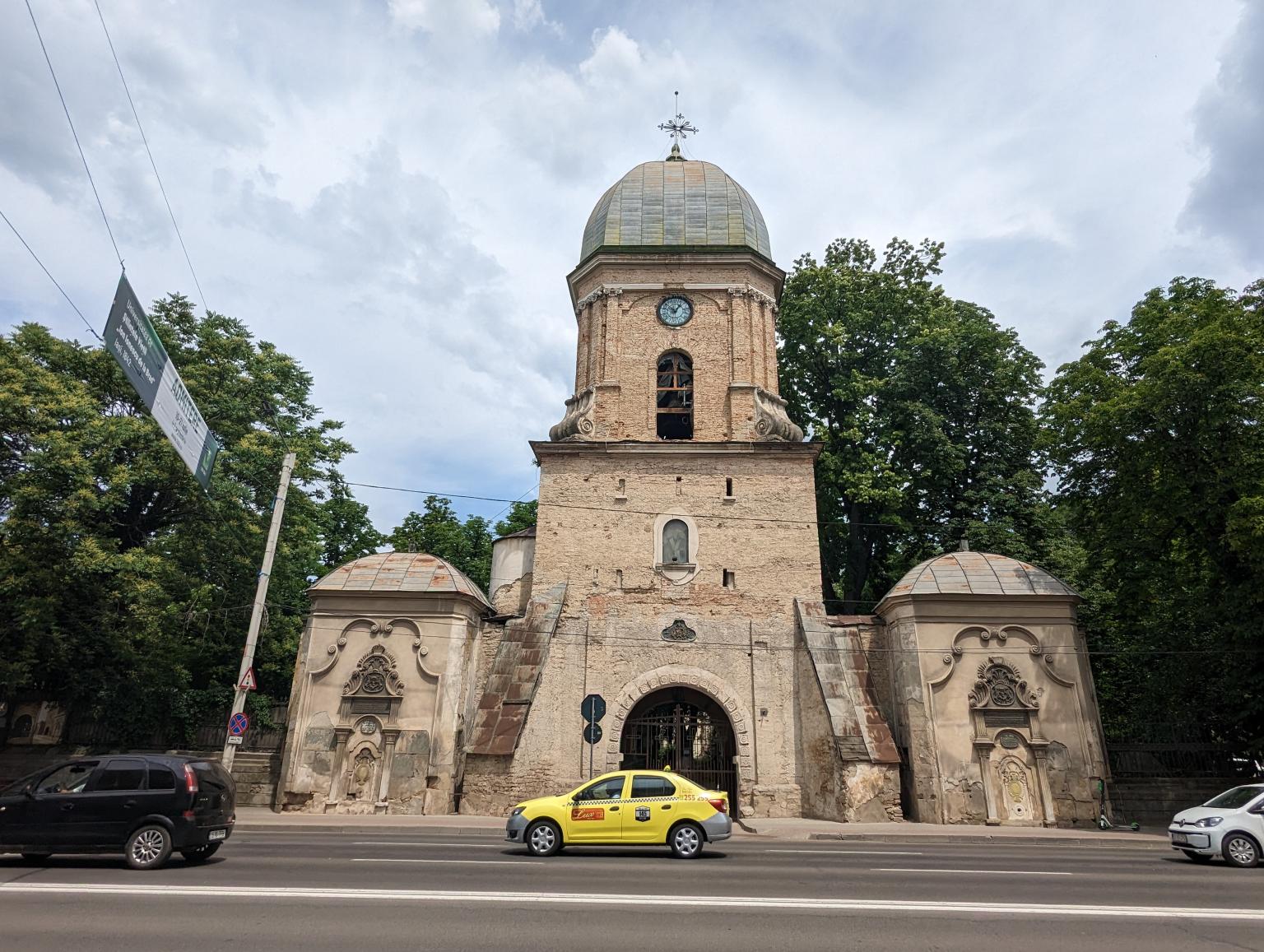
At the entrance to the hospital courtyard rises the bell tower built in 1786, rebuilt in 1807-1808 and repaired in 1862 (according to the date inscribed above the gate), thus acquiring its current appearance.
The tower consists of an assembly of three overlapping sections. The first, lower part, in which the vaulted entrance gate is found, is a massive cubic block of unplastered stone, with small windows arranged in a cross and storeys on its sides (this block dates from the construction of 1786). Next is the bell chamber, placed above, thinner and with a square base, with arched openings on each face, worked in the Russian Baroque style. The upper part of the building has a hat-shaped roof (culion), taken from Russian church architecture, covering the floor immediately below.
The tower functioned as an entrance to the monastery premises, being delimited by two public wells built during the reign of Al. Guess
Above them, each fountain bears an inscription in Turkish with the following text: "Under the reign of Ghica Bey, son of Alexandru, a benefactor who ruled with justice, this clear and clean flowing water sprang up in Moldova. Those to whom it is thirsty people are satisfied by seeing this fountain with two pipes, from which it flows as if from the eyes of lovers, and who will mention that Grigore Bey made the city of Iasi happy, bringing this water as sweet as honey, 1765".
Initially, until 1909, when the works to supply the city with water from the Timișești springs were completed, water represented an aspect that the community could not be proud of. Wells fed from local aquifers provided only salt water, suitable only for industrial or domestic use, but not for consumption. The Bahlui water was not potable and could not be used for water supply.
Collected from sources with a low flow, distributed through a few public wells, of which only a few have survived to this day, water only reached households through street vendors of water, also called apparitions. These people, poor and very poor, carried a heavy burden from morning till night. The two baskets, each containing at least thirty kilograms, hung from a device supported on the bearer's shoulders and neck, known as a yoke. Some apparitions carried this burden on mares, but their numbers were always few. Even when the apparition institution had to be abolished, those who wore the yoke missed it and mourned its loss.
Source: Iași Municipality and surroundings (Ministry of Tourism, 1980)