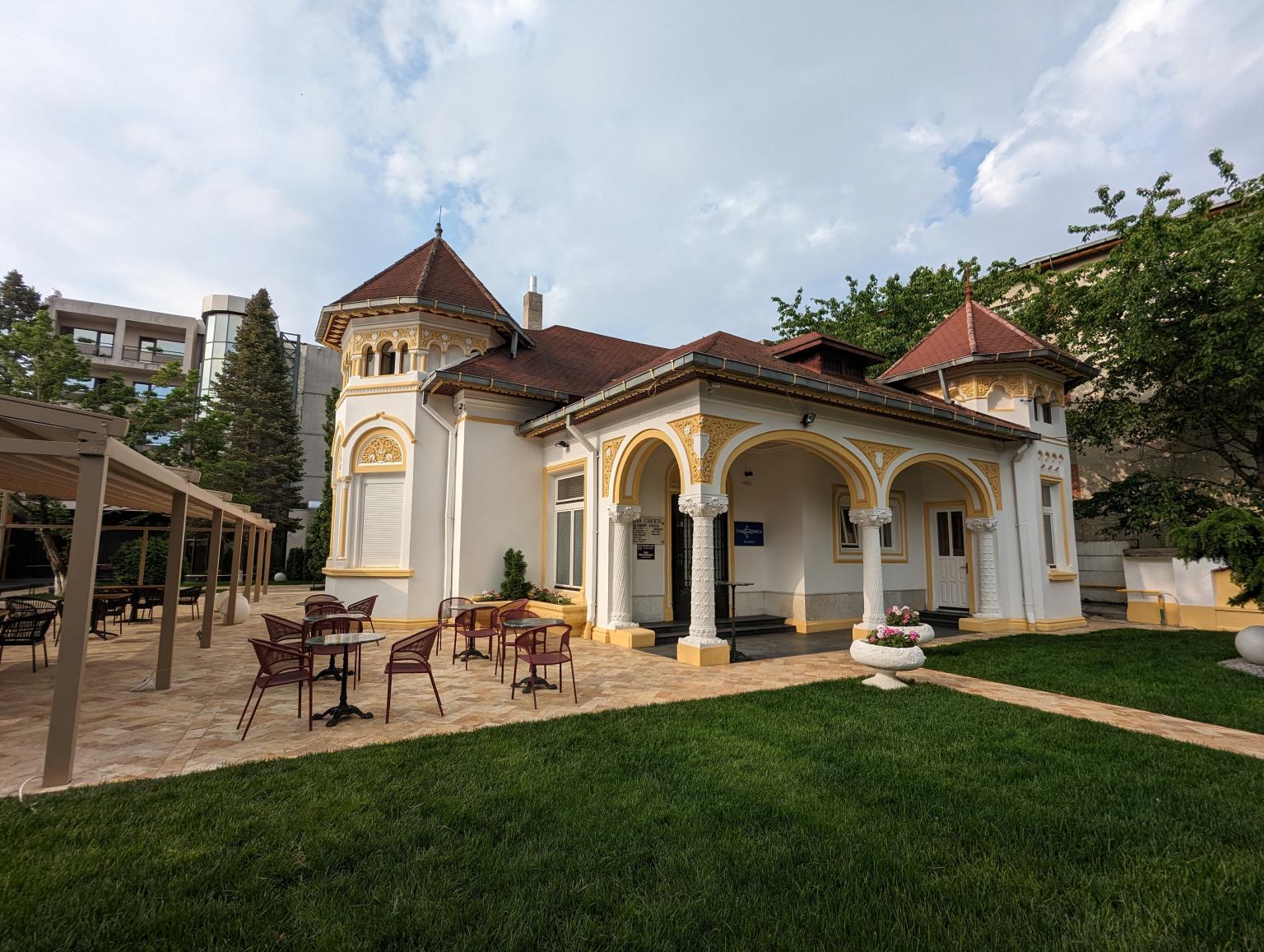
Another important personality born in Bacău County is the prose writer Georgeta Mircea Cancicov, born on May 29, 1899, in the village of Poieni, Godinești commune, today part of Parincea commune, Bacău County. She passed away on April 16, 1984, in Bucharest.
The writer was born into a boyar family, being the daughter of Petru Jurgea Negrilești and Elena, née Crăiescu. She was the first child of the family's four daughters and received the first name Maria at birth, but also the name Georgeta, used at baptism. Her mother, Elena, was raised by her uncle, Gheorghe Racoviță, the father of the well-known scholar Emil Racoviță (1868–1947). On the paternal side, her grandfather was the Moldavian poet Costache Conachi (1777–1849).
Between 1900 and 1905, the family grew with three more girls: Pierette (also known as Petruța), Paulette Eufrosina (Paulina) and Jeanette (Ioana). After the birth of the youngest sister, the parents' marriage fell apart. The father remarried, and the mother retired to the Poeni estate, choosing never to marry again.
Although the girls should have been divided between the parents after the divorce — two to the father and two to the mother —, based on an amicable agreement, all four remained together, raised by Elena Crăiescu. Emil Racoviță, Elena's cousin and former fiancé, became her legal guardian. Elena, a renowned pianist, spent the autumns in Paris and returned to the Poeni estate in the spring.
Thus, the four sisters attended the Victor Duruy boarding school in Paris, located within the Sacré-Cœur Monastery, run by a headmistress close to Poincaré. At just five years old, Georgeta met George Enescu in Paris.
She spent her holidays in the country, in Poeni, with her mother and sisters, but also with distinguished guests, including George Enescu, the painter Tonitza, and Emil Racoviță. She frequented Enescu's mansion in Tescani, her father's property in Gioseni, the castle in Fântânele, the Hemeiuși of Sophia de Wied — a close friend whose husband would become king of Albania —, or her mother's residence in Bacău.
In 1916, Georgeta left for Paris, passing through Odessa, along with the French Mission in Romania. She did not complete her musical studies, went through a failed first marriage, and in 1926 she remarried in Poeni to Mircea Cancicov. He was an exceptional magistrate, university professor at the Faculty of Law in Bucharest, a prominent liberal politician, deputy and minister of finance in the governments led by Tătărescu and Antonescu. Born in Bacău in 1884, Cancicov had been a high school classmate of the poet George Bacovia and had studied Law in Bucharest, then at the Sorbonne. Georgeta began writing literature thanks to her husband's encouragement.
Between 1928 and 1935, she traveled to England, where she had the opportunity to learn in detail about British life and traditions, which she evoked in the novel "Cliffside", which remained unpublished.
In 1936, back in the country, in Bacău, she received a visit from the writer Liviu Rebreanu, to whom she showed some of her works. He considered them worthy of being published.
Georgeta Mircea Cancicov began writing at the urging of her husband and made her debut in journalism on the advice of Liviu Rebreanu, as she confessed in an interview given to the magazine "Luceafărul" on September 20, 1975. Her literary debut took place in 1936, with the plaque *Un vis*, a prose poem dedicated to Sophie of Schönburg–Waldenburg, a close friend, married to Prince Wilhelm of Wied, sovereign of Albania. The illustrations were made by her sister, Jeanette (Ioana) Jurgea, who had become a painter and who later signed the illustrations of other writings by Georgeta Mircea Cancicov, as well as editions of the works of Ion Creangă, Petre Ispirescu or Henrik Ibsen.
The writer's paternal house, owned by Petru Jurgea, was destroyed by peasants during events similar to those described in Rebreanu's *Uprising*. The entire family's wealth was nationalized, and on October 5, 1946, the writer's husband was arrested, accused of war crimes. Mircea Cancicov went through the harsh dungeons of Aiud and Râmnicu Sărat, where he would die in 1959.
Widowed and facing great material hardships, Georgeta Mircea Cancicov moved to Bucharest, where she would live in a modest apartment until the end of her life. She died at the age of 85, on April 16, 1984. She was initially buried in a cemetery in the Berceni District, and in 2000 she was reburied at the Bellu Cemetery in Bucharest.
Among the volumes published by Georgeta Mircea Cancicov are:
- *Un vis*, prose poem, bibliophile edition, Cartea Românească Publishing House, Bucharest, 1936;
- *Din viața satului meu*, novel, Adevărul Publishing House, Bucharest, 1938, with a second edition published the same year;
- *Dealul Perjilor*, short stories, Nationala-Ciornei Publishing House, Bucharest, 1939;
- *Cântare timpului*, prose poems, Socec&CO Publishing House, Bucharest, 1940;
- *Pustiuri*, short stories, Prometeu Publishing House, Bucharest, 1942, republished by Publishing House for Literature, Bucharest, in 1969;
- *Amurg*, novel, Publishing House for Literature, Bucharest, 1967;
- *Călătorul*, short stories, Publishing House Cartea Românească, Bucharest, 1971;
- *Moldoveni*, novels, Publishing House Minerva, Bucharest, 1972;
- *Îndrăgostitele*, short stories, Publishing House Minerva, Bucharest, 1975;
- *Povestiri*, Publishing House Cartea Românească, Bucharest, 1979;
- *Din viața văilor*, short stories and short stories, Publishing House Cartea Românească, Bucharest, 1984.
Sursa: www.facebook.com

4 out of 5 stars
based on 0 reviews
If you’ve visited this place, share your thoughts with others
write review