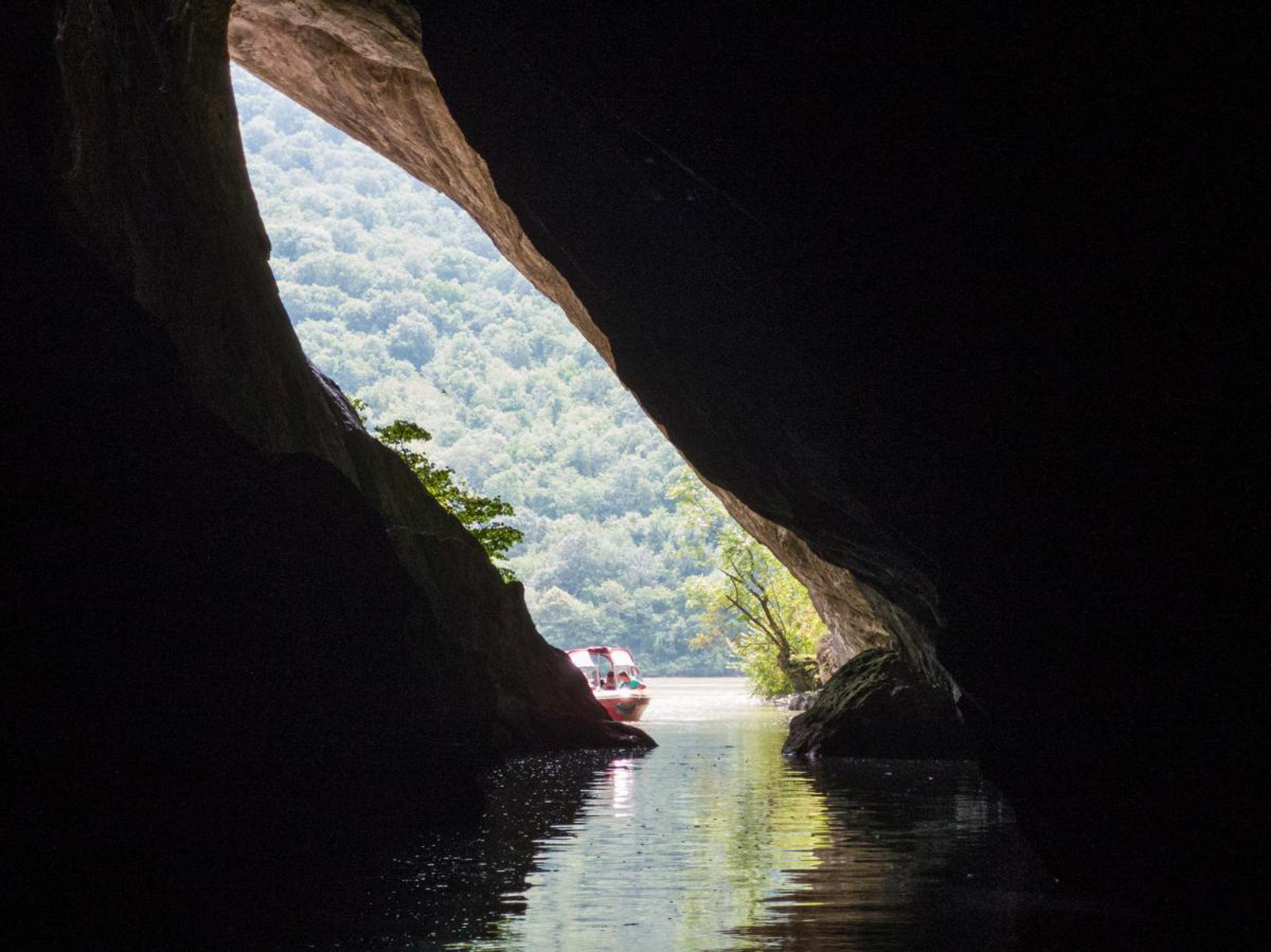
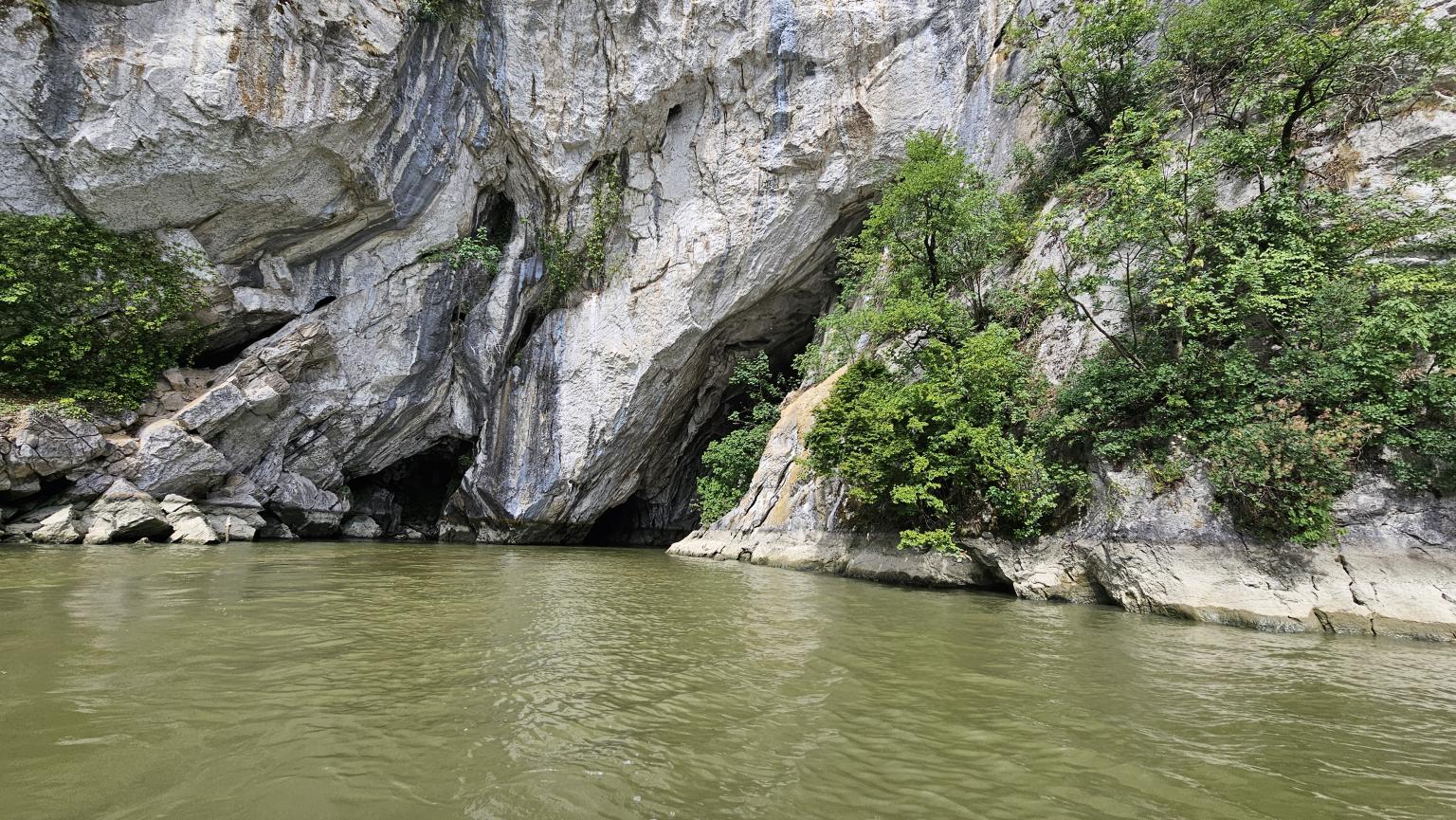
Ponicova Cave is located on the left side of the Danube, in Ciucaru Mare Mountain (Cazanele Mari), at an altitude of 62 m, with the entrance partially covered by the water of the "Portile de Fier" dam lake. The first geological surveys were carried out in 1872, and the faunistic ones in 1929. In 1962-1963 the first topographic plan of the cave was made, and in 1965-1969 extensive bio-speological studies were carried out.
The cave, the largest in the Danube Gorge, has a total length of 1666 m and an elevation of 65 m, being formed by the hydrological penetration of the Ponicova stream in Ciucaru Mare Mountain. The main part of the cave, Galeria Ogașului Ponicova, presents collapse blocks and is partially flooded by the waters of the dam lake. During high floods, the Ponicova stream crosses the gallery, leaving behind plant debris.
The most beautiful part of the cave is the Gallery of Concretions, characterized by spectacular formations such as stalactites and calcite columns. The cave also includes the Bat Gallery, accessible via a steep slope, which houses bat colonies and rare fossil formations.
Ponicova Cave is speleologically, paleontologically and archaeologically remarkable, hosting troglobiont species and cave bear and hyena fossil remains, as well as Neolithic artefacts.
The cave is protected as a county speleological reserve, and access to the cave requires special equipment and knowledge of the place. The tourist development of the cave will be possible with the construction of an asphalted road to the entrance through Cheile Ponicova. The complete visit of the cave takes between 2 and 3 hours.
Source: Caves from Romania, T. Orghidan, Șt. Negrea, Gh. Racoviță, C. Lascu, ed. Sport - Tourism, 1984
//
The cave has always been known to the inhabitants of the Danube Gorge, who sometimes call it Ponicova Cave, Gura Apei Cave or Liiecilor Cave. The cave is dug in the left bank of the Danube, in Ciucaru Mare, it has an absolute altitude of 62 m, and the relative altitude became negative after the creation of the reservoir.
It is considered the most important cave in the Danube Gorge, it is partly fossil, partly subfossil, formed mostly on diaclase system and less on limestone layer faces. It represents a hydrological breakthrough made by the Ponicova stream in the Ciucaru Mare massif.
Maternity colonies: Myotis myotis, M. blythii, on the one hand, either from Myotis capaccinii, M. dosycneme and M. daubentonii.
Hibernation colonies: Rhinolophulus ferrumequinum, R. hipposideros, R. mehelyi, Myotis myotis/M. blithii, M. dasycneme, M. capaccinii, M. daubentonii, Plecotus auritus/P. austriacus and Miniopterus schreibersil.
Text taken from the presentation panel