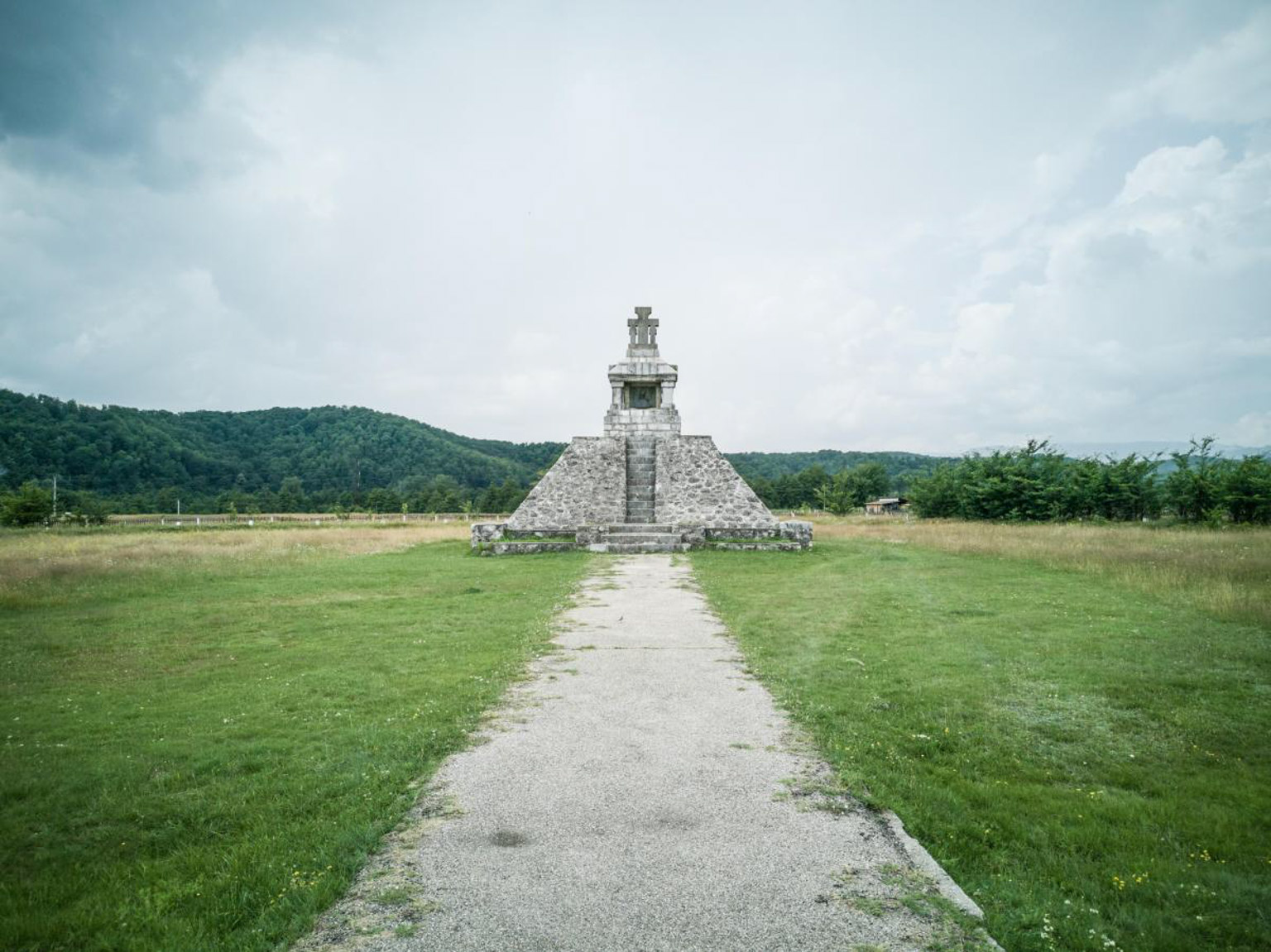
The "Pades Proclamation" Monument was erected on the "Sun field, the place where this historic event took place, signaling the start the Wallachian Uprising of 1821. It marked a turning point in the history of the Danubian Principalities (Wallachia Moldavia, predecessors of Romania) from a sort of medieval socio-economie order to a modem one. Also, the most important change brought by the ultimately failed uprising was that the Ottomans would no longer impose foreign rulers but appoint domestic ones.
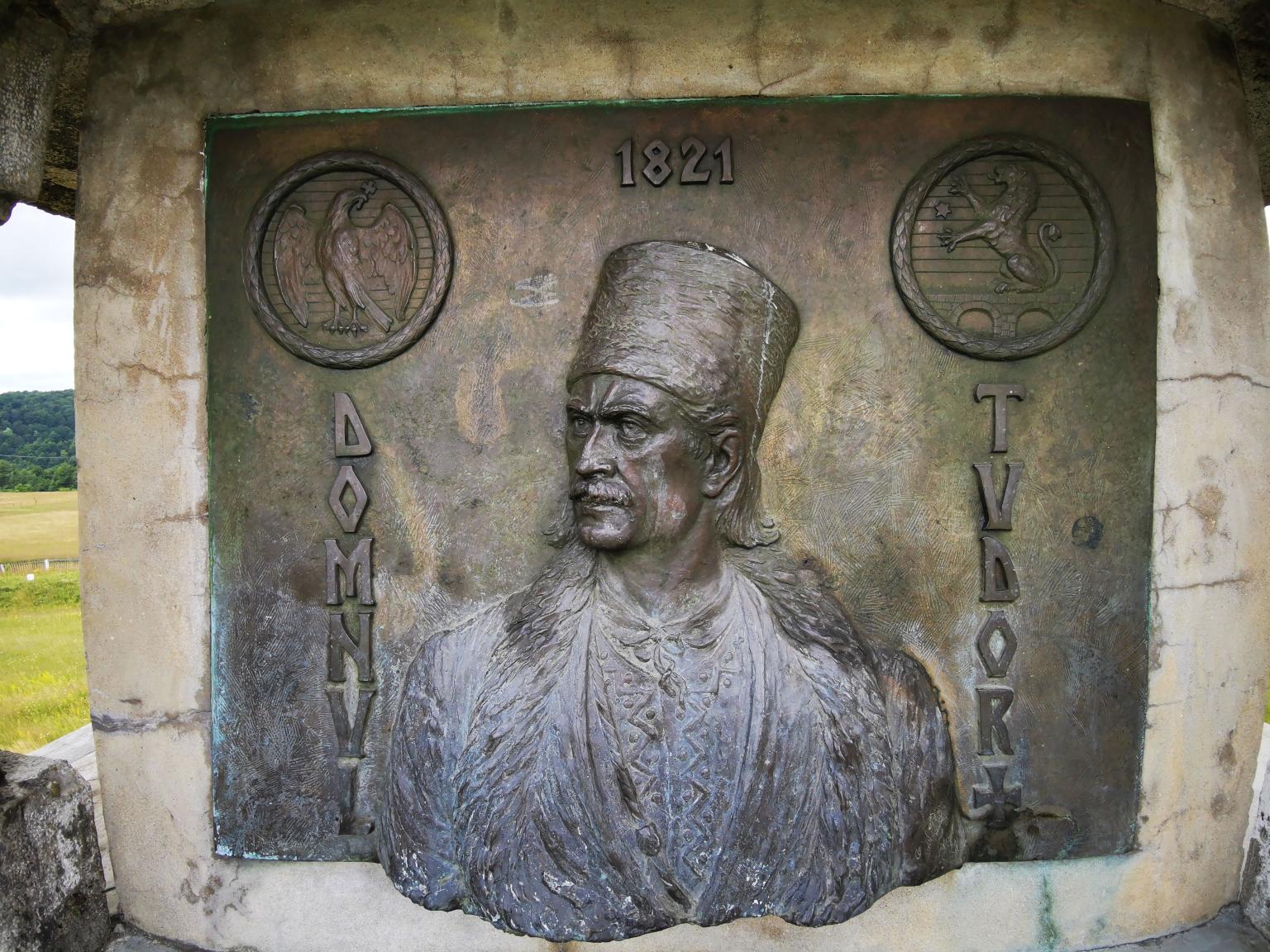
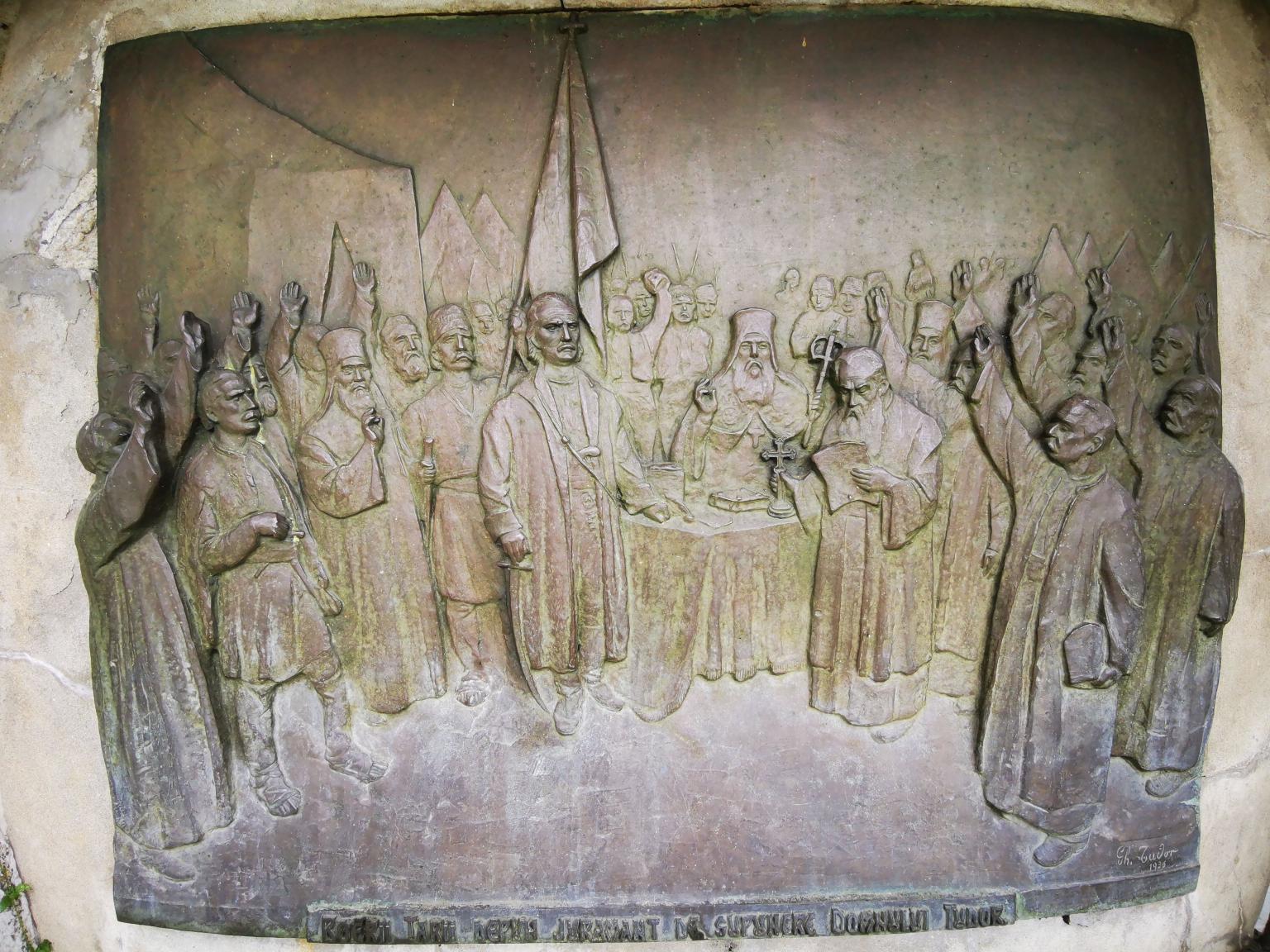
The monument looks like a steep Mayan pyramid. The stairs themselves are pretty steep. On top there is a platform with an altar surmounted by three crosses. The altar bears three bronze plaques: Tudor Vladimirescu with the emblems of Wallachia and Oltenia, the Pades gathering, boyars swearing an oath of loyalty to Vladimirescu and the uprising and the text of the proclamation itself. The monument's imposing stature is compounded by the natural setting: the field surrounded by mountains.
The initiative to build a monument honouring the events of 1821 was taken a century later by the inhabitants of Pades, especilly school teacher Nicolae Spineanu. According to the information, the monument was erected by renowned architect State Balosin and the reliefs sculpted by major artists Gheorghe Tudor and Emil Wilhelm Becker, sculptor of the Royal House. The sketches for the reliefs were made by Stolca Dumitrescu and Costin Petrescu (painter of the Romanian Atheneum).
It must be known that the Wallachian Uprising of 1821 is part of the great revolutions that shook the end of the 18th century and the beginning of the 19th: (France, The United States, Latin America, Serbia, Greece). The peoples all aimed at changing the existing social, economic and political order and/or liberating themselves from foreign rule. The Danubian Principalities wanted to return to domestic rules (not high ranking Greeks from Constantinople-the Phanariotes) and lower taxes and social burden.
It is not by chance that the leader of the uprising was Tudor Vladimirescu. He was the son of a free peasant and had the chance of being brought up by boyar loniţă Glogoveanu. He learned how to read, write and perform complex tasks for his master like administrating his estate, managing the trade with estate products etc. Leaving the service of the boyar, he is named leader of the troop (Pandurs) guarding Cloşani area. It was a remote place, on the border with Transylvania and Banat, then part of the Austrian Empire. His character was further shaped by the experience of participating in the 1806-1812 Russo-Turkish War, being decorated with the Order of Saint Vladimir. Then, in 1821, learning of the planned uprising in Greece aided by the secret society Filiki Eteria which was to cross Wallachia, he decided to rise against the Phanariote rule.
The text of the Proclamation is interesting in itself:
It starts with the declaration that "no law prevents men from fighting evil with evil". The evil ones are clearly designated: "our leaders, the tyrannical and malevolent leeches of Greeks and our own boyars". He further gives a concrete example, to make himself better understood by plain folk: "When a snake crosses your path you crush it with a stick to defend your life He invokes the approval of Divinity, an argument the people were and still are very receptive to: "If evil is not accepted by God, the destroyers of evildoers do a good deed in the eyes of God. God is good and we must try to resemble Him, and in order to do this we must destroy evil". Another metaphor follows, one that resembles the English saying "It's always darkest before light": "There shall be no spring without winter coming to pass", meaning that hope must not be abandoned even in the hardest times.
Follows the exhortation to join the revolt: "... until when shall we suffer that blood be sucked from our bodies, until when shall be bear to be their slaves?"... "Come, then, brothers, to fight evil with evil and do good and from among us to elect good leaders who, along with the rest of us, shall work to fulfill good, as they are obliged". This last part resembles a social contract, according to the notion developed in the Enlightenment, between the people and its leaders.
The people are advised to gather around their leaders with weapons or improvised weapons. "What the leaders of the Assembly advise you to do, do accordingly and go wherever they will call you"... "those who have arms with arms, those who do not with iron hay forks, axes and whatever else you may find". The aim of the revolt is the common good "the assembly organised for the good and use of the whole country".
Furthermore, anarchy is not tolerated. "And again you must know that none of you have permission, during this useful gathering, to tough a single grain, the livelihood or the house of a merchant, a townsman or a peasant, or a dweller or even a nobleman...", Reprisals shall be carried out only against the enemies of the uprising, those who have oppressed the people and are not willing to rally revolt: "only the goods of those not joining our revolt shall be confiscated for the common use".
Thus the Pades Proclamation is part of the family of great historical declarations and proclamations through which the peoples have asked their governments of those times liberty and justice. Even if the Pades Proclamation has an archaic language and is less comprehensive than texts of universal value such as the American Declaration of Independence or the French Declaration of Human Rights, in the same manner the mentioned texts are sacred to those nations, the Pades Proclamation, as an exhortation to revolt against tyranny, message of constant validity, should have a greater place in the consciousness of all Romanians.