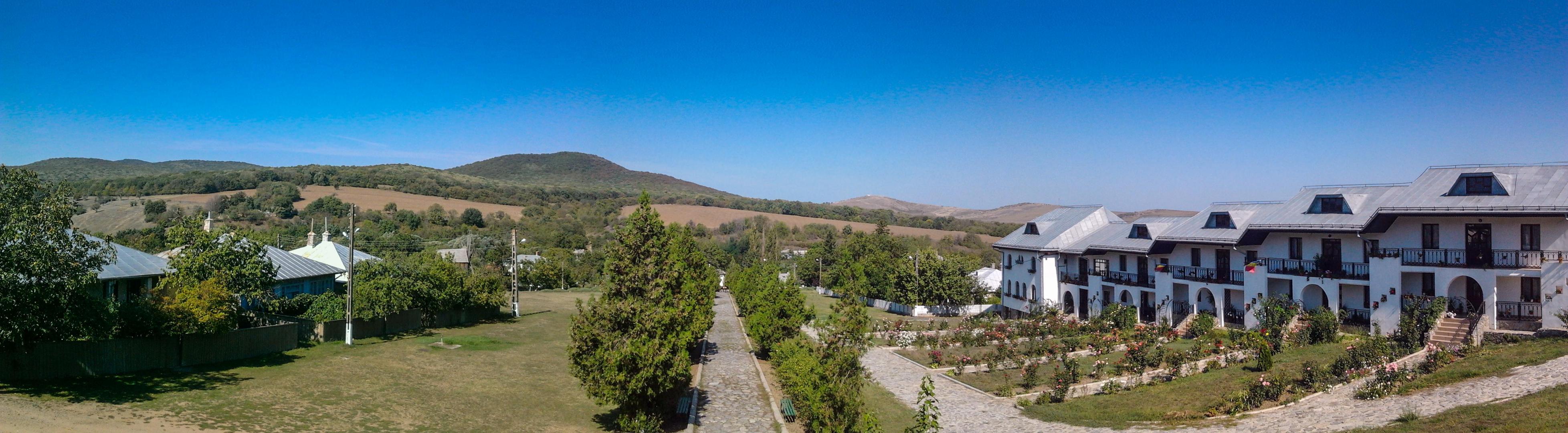
The Celic-Dere Monastery is an important spiritual center in the north of Dobrogea, the name comes from the Celic stream, where old weapons were discovered. Regarding the date of establishment, there are various sources, but it seems that it was founded around 1835 or 1840 by Romanian and Russian monks. Originally, it was a monastery of monks, but in 1845, it became a nunnery. The monastery underwent transformations and expansions over the years, including the construction of a main church between 1901 and 1916.
The church is imposing, having a trefoil architecture and was painted in neo-Byzantine style between 1926-1932. Inside, there is a carved wooden and gilded casket housing the Savior's epitaph and other valuables. In addition, the monastery houses a museum with various historical and artistic objects, such as old documents and icons.
The monastery cemetery is the resting place for many religious figures who served at Celic-Dere. Currently, the monastery is undergoing expansion, including the construction of cells and a refectory to improve monastic life. The monastery also has a valuable collection of Romanian church books from the 17th-19th centuries, including a Bible printed in Bucharest in 1688.
//
The monastery, originally built in 1838, underwent renovations in the period 1901-1909, and the furniture and painting works, in the Romanian style, were completed in 1932. It gets its name from the stream Cilic Dere, meaning "water of steel" in turkish language.
The church has a remarkable feature - it consists of two overlapping churches: the lower one, for winter, and the upper one, for summer services. Another peculiarity is the absence of fences and defensive gates.
Over time, a church painting school, an embroidery workshop and a carpet weaving workshop, as well as a pottery workshop, functioned in the monastery premises.
A museum has been set up in the building where the weaving workshop operated, the exhibition comprising objects of church art, fabrics and embroideries made by the nuns of the monastery.
The monastery also houses objects of inestimable value, such as an icon brought from Mount Athos, considered the oldest in the country, and the bones of Bishop Athanasius, located in a casket imitating the tomb of Jesus Christ in Jerusalem, dating from 1845. The collection of religious art objects includes high-value pieces such as icons, cult objects and ancient manuscripts, such as the Bible of Şerban Cantacuzino and the Cauldron of Varlaam, alongside a collection of glazed ceramics.
The entire group of households forms a genuine ethnographic treasure.
Source: The Romanian Black Sea Coast (Ministry of Tourism, 1976)
Sursa: www.episcopiatulcii.ro