Space and time in the liturgical context, once detached from worldly uses, acquire a sacred meaning, being marked by “keros”, divine time, even if they remain subject to “chronos”, that is, the human measurement of time – days, years and their divisions. The gestures and actions carried out in this context by priests and believers, although they take place on earth, have the power to penetrate the heavens, opening the gates of Heaven and offering those who participate the opportunity to restore themselves spiritually, to perfect themselves and to communicate with God through the intercession of saints and priests, in communion with the Holy Spirit.
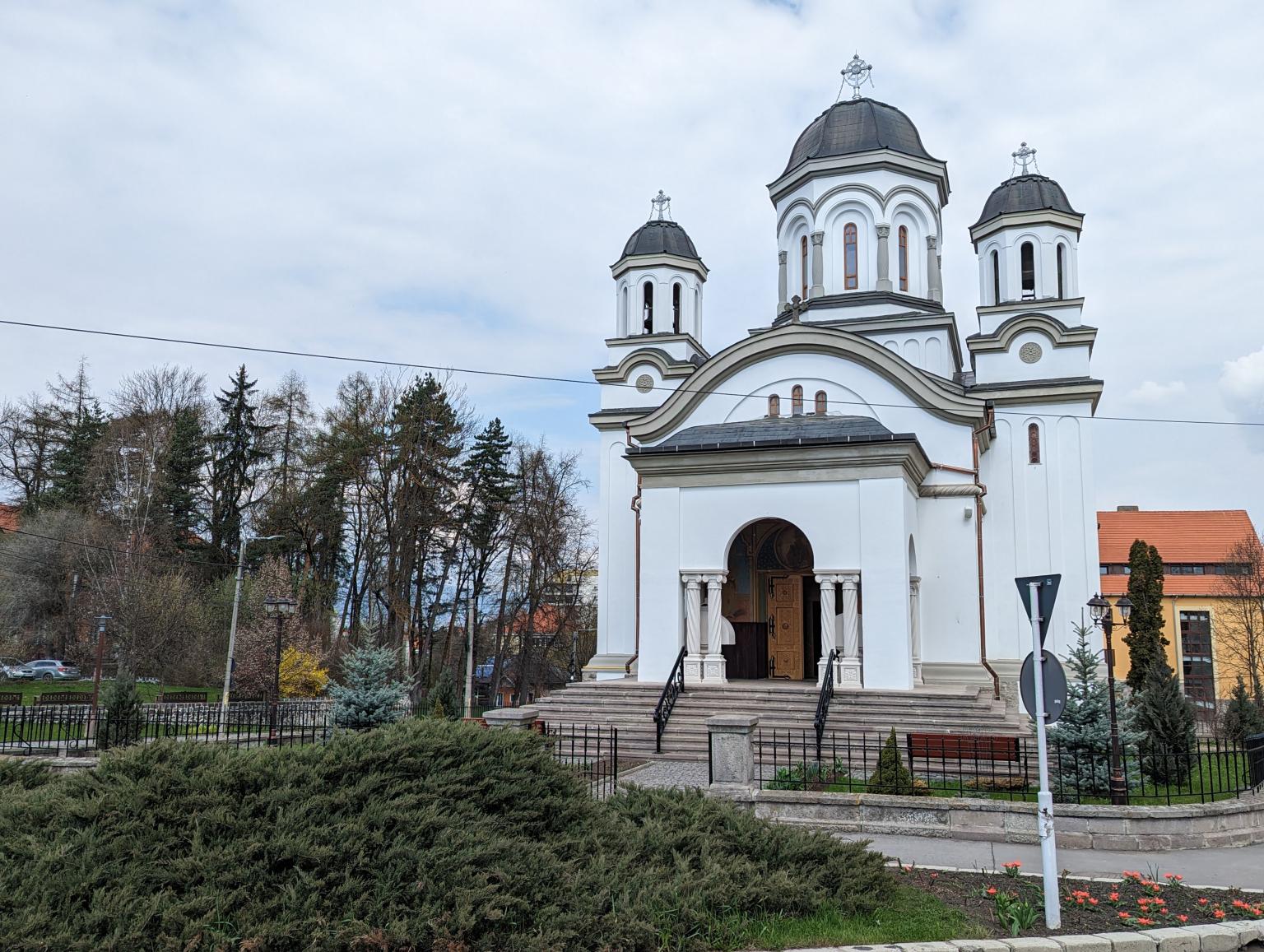
The church dedicated to “Saint Hierarch Nicholas” was built between 1929 and 1936 by priest Gheorghe Cerbu, together with Romanian parishioners from Miercurea Ciuc. They were supported and guided by the then Metropolitan of Transylvania, Nicolae Bălan, who consecrated the church on November 8, 1936.
The architecture of this place of worship is inspired by the Byzantine style. The plan is trilobed, the church has three spires, the facades are marked by a braided belt, and the interior has domes. The interior painting, as well as the iconostasis, were made in 1936 by the painter Gheorghe Belizarie from Pitești, the brother of the famous artist Dimitrie Belizarie.
With the establishment of the Orthodox Diocese of Covasna and Harghita in 1994, the church "Saint Hierarch Nicolae" became an episcopal cathedral. This event was linked to the installation of the first hierarch of the new diocese, His Eminence Ioan Selejan.
One of the important consequences of the Great Union of 1918 was the decision to build a place of worship for the Romanian Orthodox community. Thus, in March 1920, priest Gheorghe Cerbu formed an initiative committee to draft a memorandum that would reflect the spiritual aspirations of the faithful and the clergy regarding the construction of a suitable place for religious services.
Documentary sources of the time show that the donations collected for this project reached the amount of 500,000 lei, to which were added contributions from the authorities, other parishes and Orthodox communities in the country.
The actual construction took place between 1929 and 1936. The inscription at the entrance to the church records for posterity that the church dedicated to “Saint Hierarch Nicholas” was built during these years by the Romanian Orthodox believers from Miercurea Ciuc, under the guidance of Metropolitan Nicolae Bălan, who consecrated it on November 8, 1936.
Inside the church are liturgical vessels donated by Miron Cristea, the first Patriarch of Romania. The publication “Ţinuturi szekuizate”, in its issue of November 15, 1936, noted that the consecration of the church took place with great solemnity, in the presence of Metropolitan Nicolae Bălan.
In 1940, after the cession of Northern Transylvania, priest Boian recorded that the church had been desecrated: the religious heritage – including books and icons – had been destroyed, some of which had been pierced with bayonets, and the exterior walls and paintings had been damaged.
A testimony from 1946, written on the cover of a Holy Gospel donated to the cathedral, reflects the gratitude of the faithful who returned to Transylvania after the war. They expressed their emotion and renewed faith, thanking God for the liberation and for finally being able to return to the church abandoned in 1940, now rediscovered in 1946, after the end of World War II, the consequences of which were still felt in the world and in places of worship.
Currently, the Church dedicated to Saint Hierarch Nicholas functions according to the monastic order. Services are held here daily – Matins and Divine Liturgy in the morning, and Vespers in the evening, followed by the Prayer of the Atonement or the Akathist Service.
Sursa: episcopiacvhr.ro