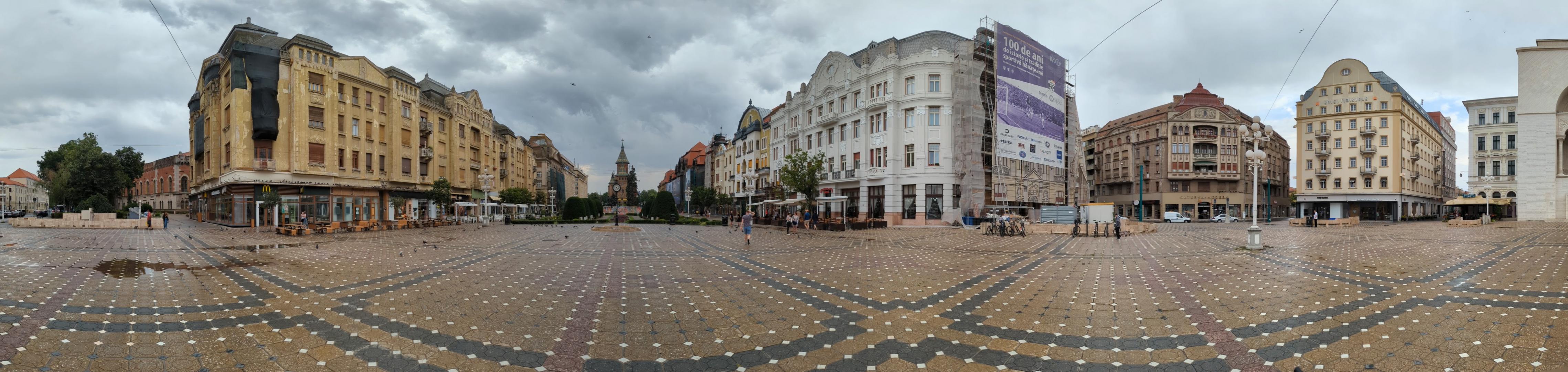
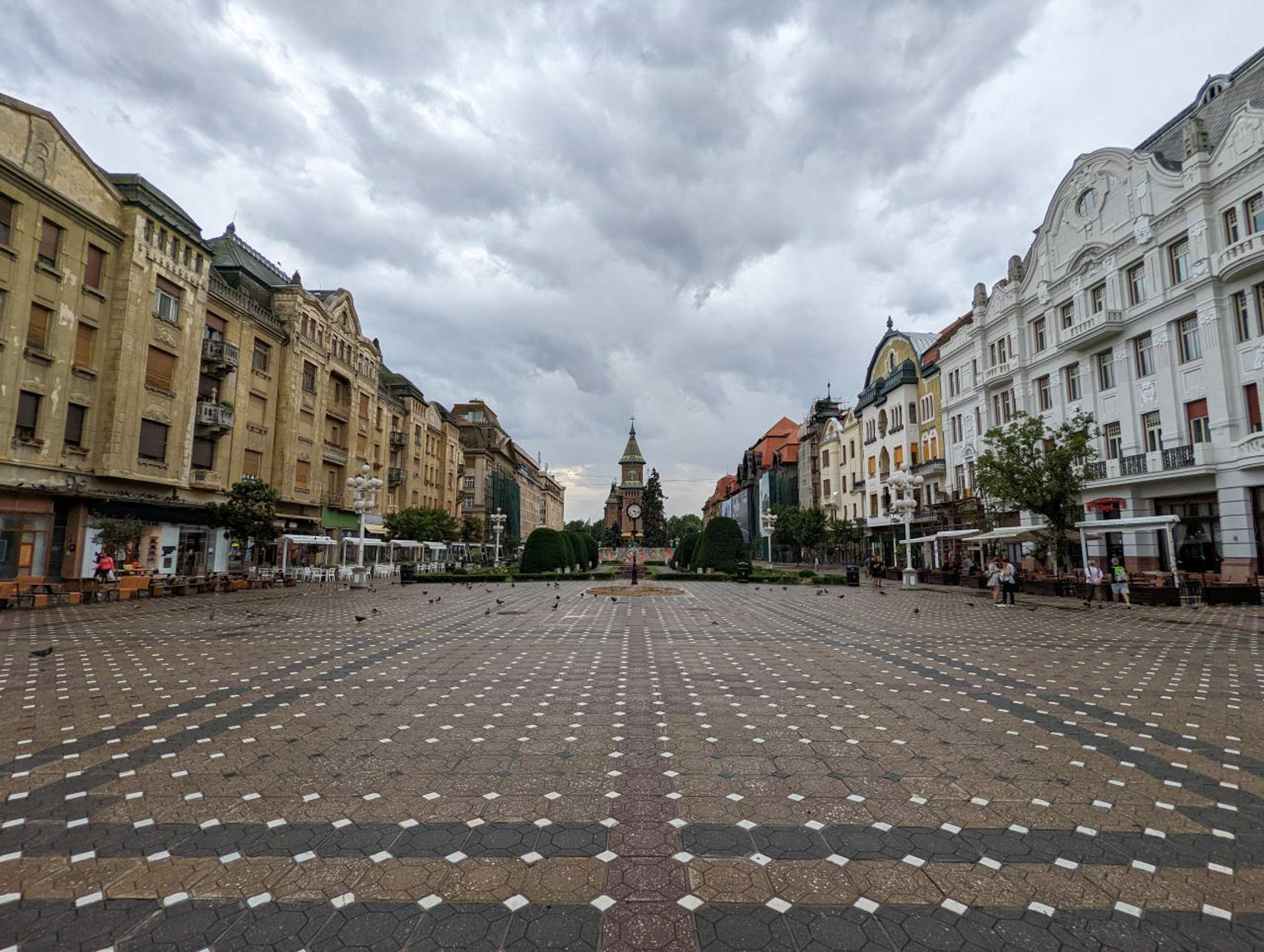
The western pediment of Victory Square is furnished with monumental buildings between the Opera and the Romanian Orthodox Metropolitan Cathedral. This pediment includes the palaces: the palace of the Weisz company (architect Adalbert Szladek, sponsored by Dr. Frigyes Hajdu, building connected to the sewerage on October 19, 1926 and to the water network on November 4, 1926),
Lloyd's palace (headquarters of the Politehnica University, Victoria Square no. 2, architect Lipót Baumhorn, builder Arnold Merbl, building permit of 29 August 1910, building opening on 29 September 1912),
Ernö Neuhausz Palace (architect László Székely, building permit 26 October 1910),
Arnold Merbl Palace (architect and builder Arnold Merbl, building permit March 8, 1911),
György Dauerbach Palace (Dr. N. Paulescu Street no.1 -J.W. Goethe Street no.2, architect László Székely, building permit July 12, 1911),
Lajos Hilt Palace (Square Victory Square No. 6, architect László Székely, building permit December 2, 1911, work completed in year 1913) and
Széchenyi Palace (Victory Square no. 8, sponsored by Antal Vogel, architect László Székely, building permit 26 October 1911, work completed in 1913).
The eastern pediment includes the Jakab Löffler Palace (Victoriei Square no. 1, architect Henrik Telkes, building permit March 18, 1912,
The row of palaces in Victory Square work completed May 1, 1913) and the Palace of Commerce and Industry (Victoriei Square no. 3, architect László Székely, building connected to the water supply on March 13, 1925 and to the sewerage on November 27, 1925), along with blocks of flats built between 1961-1963.
From the Opera to the Cathedral the promenade on the right is called Corso, and the one on the left is called Surrogate.
"(...) Later, when I grew up, there was a very good bookshop, the "Niculescu" bookshop, opposite today's "Eminescu" bookshop (replaced today by Cărtureşti Bookstore n.n.) on the ground floor of the Löffler Palace, about where the CEC agency is, from McDonalds towards the Cathedral. (...) Then there were the Meinl shops, a network throughout the country, branches of a German company, where the coffee smelled terribly good. There was one on the Corso, where the "Helios" gallery is now, and the gelateria next to it."
Radu Ciobanu (b. 1935), interviewed by Simona Adam in 2002 in Deva. Third Europe Archive, BCUT
pigeons eat the plaster
cries a white-haired gentleman
pointing his cane at the scarred palace
we both turn our heads at once
all we see are empty swallow nests
up
under the eaves
and an open window
through which stick out like a tongue
the drapes
the old man stomps his foot in anger
loses balance and falls
we take flight
every which way
Robert Şerban, June 2022