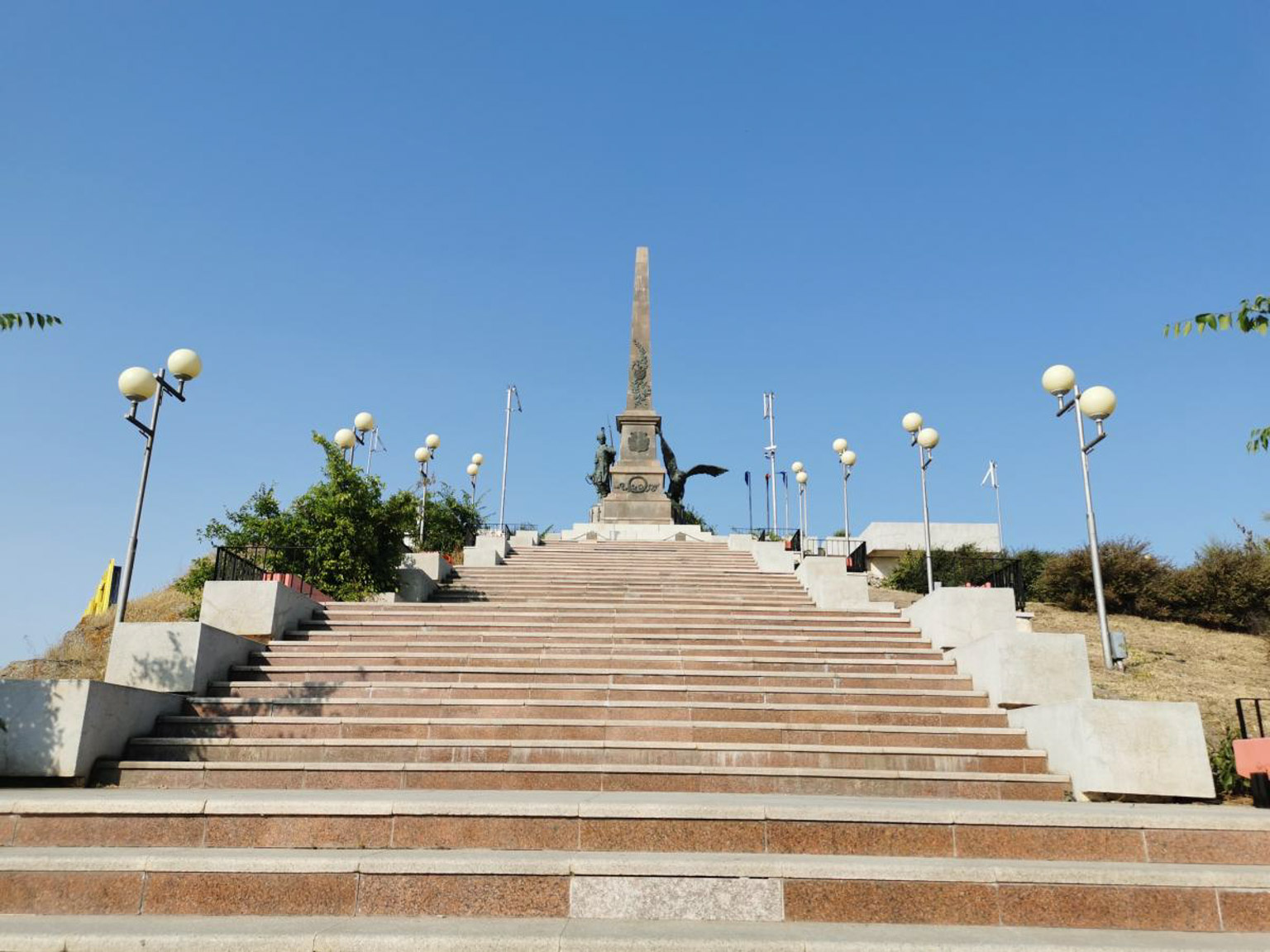
The Independence Monument (also known as Colnicul Horia), located right on the site of the ruins of the old ancient fortress Aegyssus, was created by the sculptor G. Vasilescu and was erected in the period 1897-1900, being inaugurated on May 2, 1904.
In the second decade of the 14th century, Dobrogea came under the control of the Ottoman Empire. In 1878, with the achievement of Romania's independence following the war, the territory between the Danube and the Black Sea returned to the country. At the same time, the Romanian army, freshly returned from the front, returned from the old garrisons where the army of the Grand Duke Mircea had once defended. This monument was erected as an expression of gratitude and admiration for the courage of those involved.
Archived documents show that as early as 1879 the locals expressed their desire to build the monument, laying the first stone in a festive event. The ceremony was also attended by General Carol Davila, the dedicated man who invested all his energy and expertise in saving the lives affected in the assaults on the redoubt.
Sculpted by G. Vasilescu, the monument is designed as a massive obelisk, based on two recurring elements in the memorial art dedicated to the heroism of the Romanian army in the war of 1877-78: a dorobanț with a gun on his shoulder and horns in hand, ready to attack , symbolizing the courage and sacrifice of tens of thousands of soldiers whose qualities formed the basis of the declaration of independence. The second element is a huge eagle with spread wings and claw ready for flight, symbolizing the fearless courage of the army, the pride and determination that fueled the spirit of the fighters, from the soldier to the general.
The obelisk, 22 meters high and made of Bavenno granite, was built in three floors in the stone workshop of Innocentie Pirovano in Milan. The coat of arms of Romania, surrounded by laurels, is placed on the obelisk, and below it there are two bronze plaques, which remind of the event for which the monument was erected and the date of inauguration.
The first engraved plaque contains the following words: "The citizens of Tulcea and the country erected this monument in eternal memory of the return of Dobrogea to its ancestral home through the bravery of the Romanian army."
The second plate contains, among other things, information such as: "The monument was placed in October XVIII MDCCCLXXIX (1879)". On a third metal plate are engraved the names of the members of the "Working Committee for the elevation of the monument".
The statue of the bugler, raised in Venice in the workshop of the famous Munaretti, is made of bronze and measures almost 5 meters. In the same location, the effigy of the eagle was cast, 5 meters high and with its head turned towards the doroban.
All these elements – the obelisk, the statue and the eagle effigy – were arranged on a square pedestal, at significant distances from each other. The pedestal was surrounded by a heavy iron chain, supported by 12 granite pillars.
The official inauguration took place on May 2, 1904, representing a day of celebration for the people of Tulceni. The soldiers of the 33rd Tulcea Regiment, descendants of the Dorobants of 1877, were placed in a row, from the center to Colnicul Horia. People from all over Dobrogea made their presence, turning the ceremony into an expression of the thoughts and feelings of the entire region and country. On this occasion, an effigy of the monument was made, a piece that today has documentary value.
During the First World War, the occupying forces caused partial damage to the monument, and in the period 1934-1936 it was rebuilt, but without the dorobant and eagle. Later in 1977, the monument was restored to its original appearance and the unveiling ceremony was held on 9 May 1977, marking the centenary of the War of Independence.
Source: Danube Delta (Ministry of Tourism, 1978)