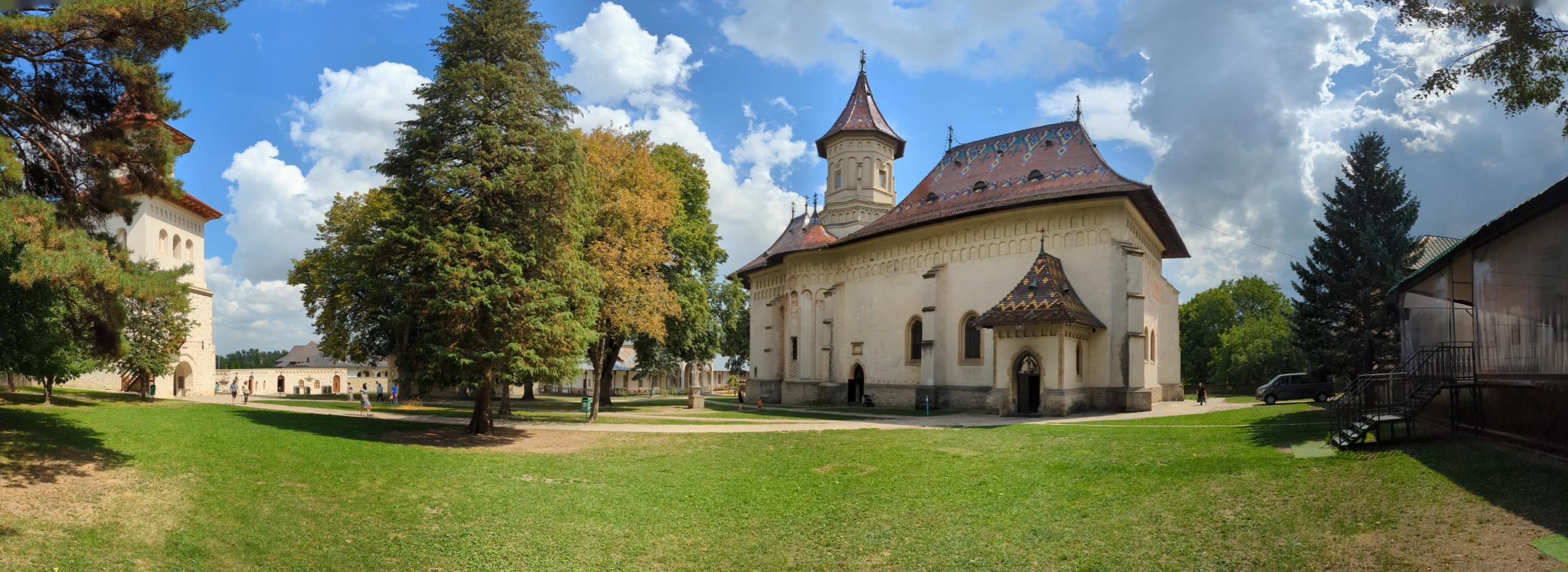
Among the monuments of ecclesiastical architecture that can be seen nowadays in Suceava, highlighting either stages of the history of Moldavian history, unique in world architecture, or aspects of life in that corner of the country, Saint George's Church - Saint John the New Monastery convinces with its grandeur and monumentality, with its features that have been designed and brought into being by Moldavian craftsmen.
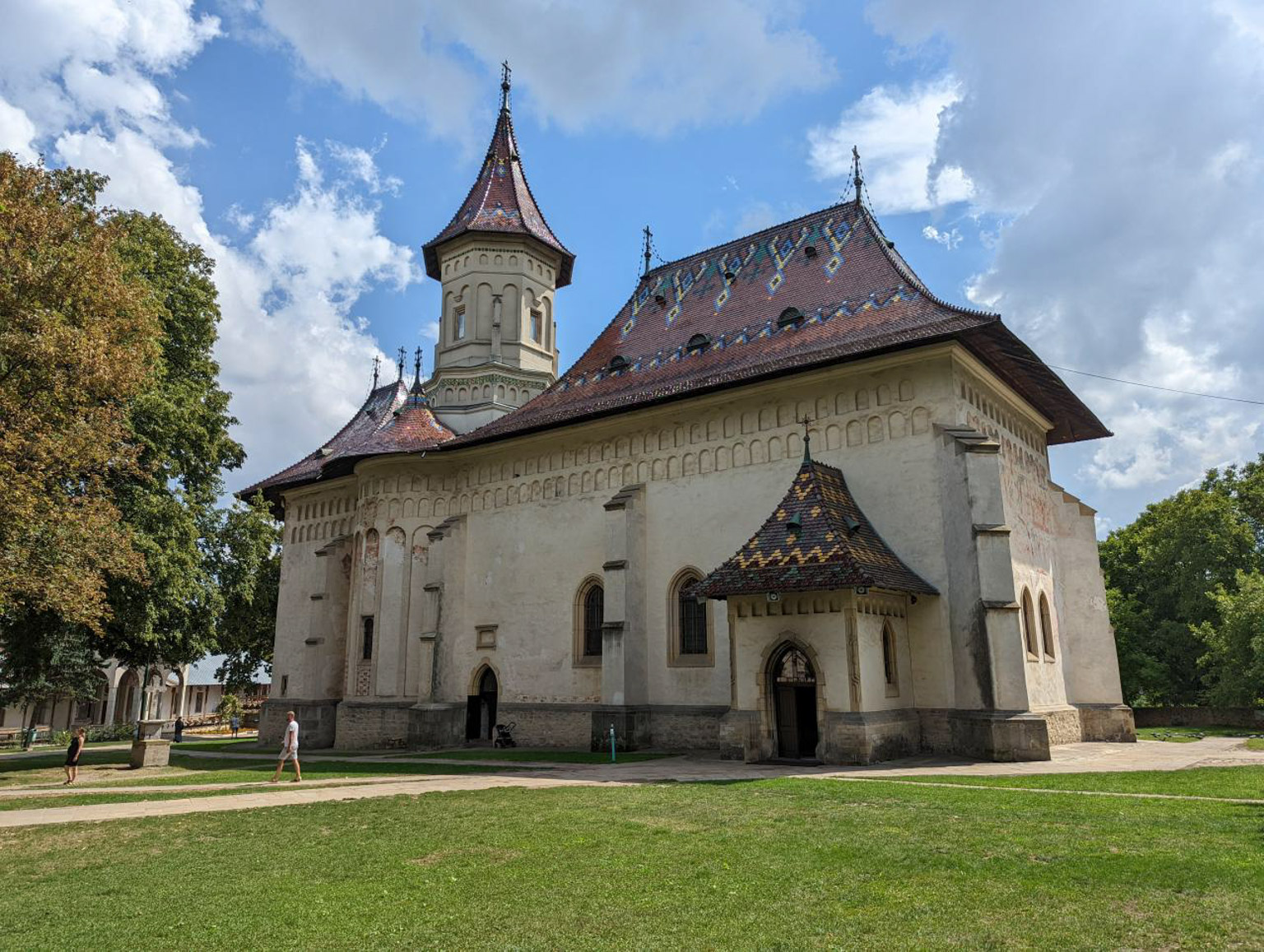
The Slavonic votive inscription placed above the front door in the exonarthex indicates that the edification of Sf. Gheorghe Church was begun by voivode Bogdan III in 1514 and finished by his son ŞȘtefăniţă Vodă in 1522. The church was going to serve as metropolitan cathedral of Moldavia, as the old metropolitan cathedral, Mirăuți Church, turned out to be scanty for Christians. Sf. Gheorghe Church is surrounded by 8 buttresses: 4 of them enclose the lateral apsis, two support the median arch of the pronaos walls and two are placed in the porch corners; one buttress leg was placed in the axis of the altar apse. Above the church naos, on two superposed star-like bases, rises a beautiful octagonal spire enclosed by four buttresses that bears among the decorative architectural elements of the spire some niches and, for the last time in Moldavian architectural history, glazed discs with a button in the middle, differently coloured.
The small porch leading inside the church is built with help from Metropolitan Veniamin Costachi in 1837. From the porch itself we pass into the pronaos through a portal on which we can distinguish the tori finished in a broken arch. The pronaos vault has two caps divided by a median arch.
The separating wall between the pronaos and the naos was removed at the end of the 18th century so that the eye meets the iconostasis beyond which continues the altar apse, similar to a large extent to the lateral apses of the naos.
If from an architectonic point of view Sf. Gheorghe Church connects the two great epochs - that of Stephen the Great and that of Petru Rareş - from a pictorial point of view, the church belongs to the epoch of the latter.
In the porch and in the pronaos, we can find the paintings of the saints celebrated the Synaxarion as well as various moments in the history of Christian religious life - namely the 7 Ecumenical Councils. In the vault of the naos spire, we find the representation of the Pantocrator while the lower part of the spire contains the painting of the Divine Liturgy, thus finding itself in front of a Romanian contribution to the patrimony of the Orthodox Orient iconography.
In the conch of the northern apse, we find a depiction of Crucifixion, one of the most successful iconographic representations, while in the conch of the southern apse we find the painting of the Descent of the Holy Spirit. Near the iconostasis that belongs to the Moldavian baroque style, on the right side, on the southern wall, under the open window at the end of the 18th century we find an interesting fresco presenting the voivodal family of the Movilești surrounding the reliquary of Saint John the New of Suceava.
Among the scenes that surround the exterior of Saint George's Church we notice the Judgment Day on the western wall of the church; the Siege of Constantinople, Akathist of Virgin Mary, Parable of the Prodigal Son, Tree of Jesse, Saint John the New's Apprenticeship on the southern wall, images highlighted through the restoration-conservation works conducted between 1983 and 1985.
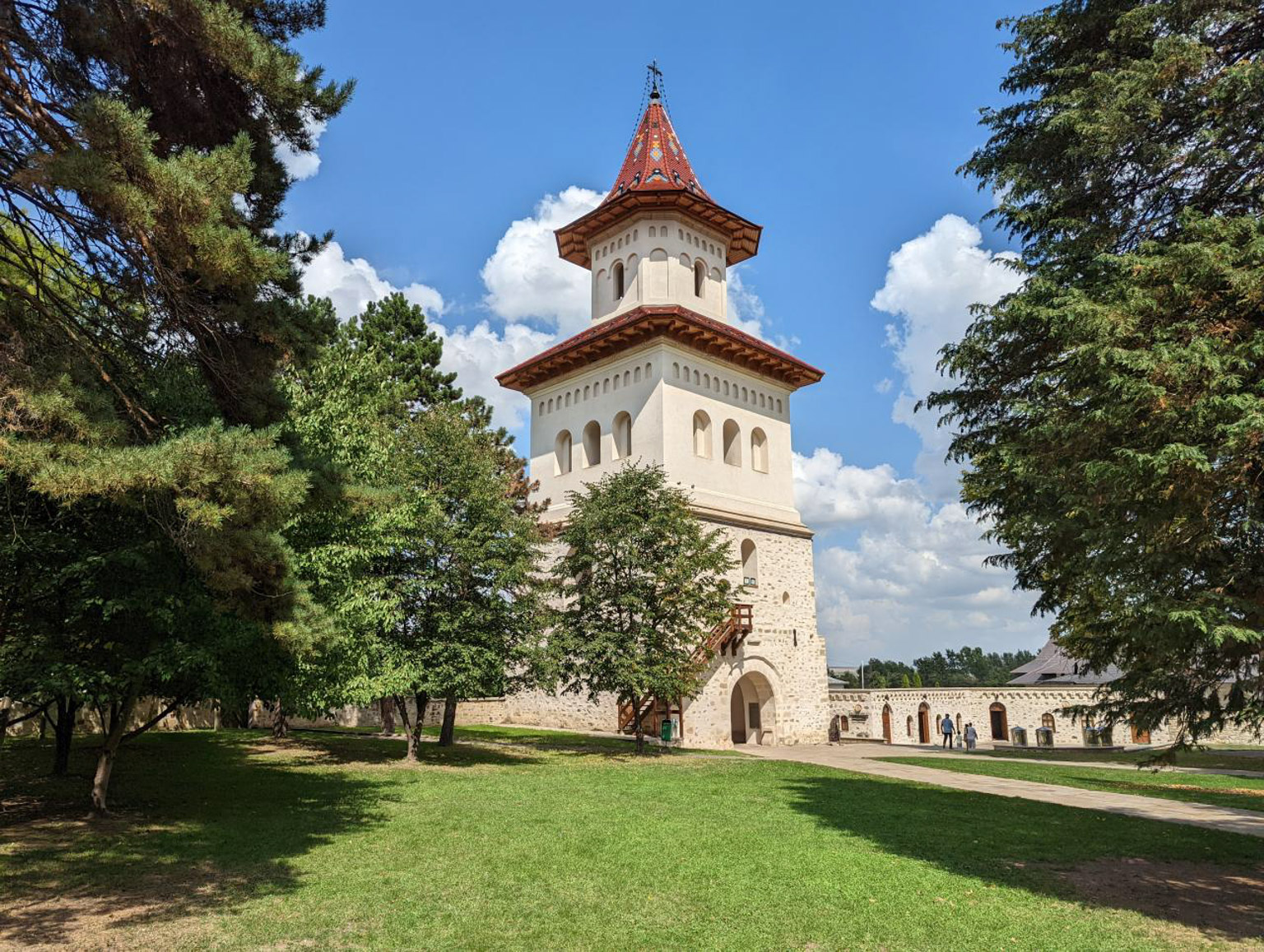
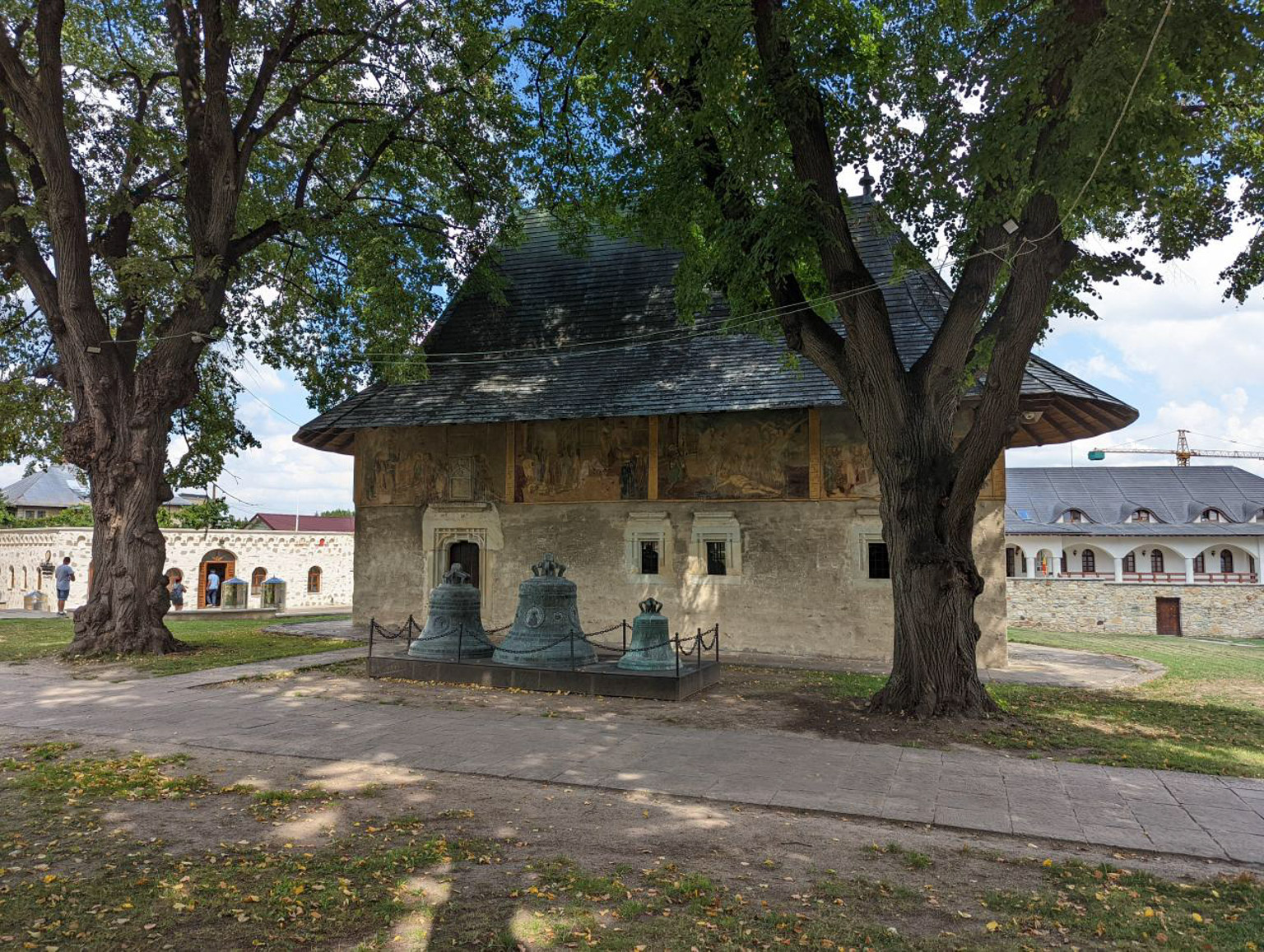
The medieval architectural compound from the former metropolitan cathedral comprises besides the church itself the Bell Tower, built in 1589 through the care of Ruler Petru Șchiopul; the Oratory built later between 1626 and 1629 through the assiduity of Anastasie Crimca, where the first clerical catechetical school in Suceava was going to functio, the Buildings for Cellars - built during the reign of Metropolite lacob Putneanul, the Priorship-built at the end of the 19th century, today the Archdiocesan residence and Saint John the New's Oratory built at the end of the 20th century.
Starting from the 16the century and until the second half of the 17th century, Saint George's Church was the headquarters of the Metropolitan Church of Moldova, and then it was moved to laşi where in the meantime the capital of Moldova was established once and for all. The Monastery running to this day around Saint George's Church was established after 1783. In 1866, it was declared a subsidiary of Dragomirna Monastery until 1904 when it becomes again a stand-alone monastery. Saint George's Church, in its current form, comes into prominence as a complex monument, illuminating for its visitors due to its originality and ongoing renewal of its religious architecture in the 16th century Moldova. At the same time, Saint George's Church-Suceava has integrated with the urban scenery of Suceva, participating in completing the image of the former capital of Moldova. In Saint George's Church, under a certain stone canopy built in 1910, we can find the Reliquary of Saint John the New.
Saint John the New's life is shrouded in the ordinary hagiographic wonder. John, a merchant from Trebizond, not wanting to deny his faith in Christ, reaches due to the betrayal of a sea captain of Latin faith-a Genovese or perhaps a Venetian - his death-bringing judgment around 1330 in Cetatea Albă from the banks of Nistru river. Beaten up with rods, thrown into jail in chains, taken out of there, he was tied to the tail of a horse and dragged behind the horse until an unfaithful struck off his head. Hearing about the miracles performed in Cetatea Albă around the relics of Saint John the New, the Voivode Alexandru cel Bun (1400-1432) decides to bring the holy relics to Suceava within two years following his kingship and he will put them in the old Mirăuți Cathedral and then he will transfer them in 1589 to the current Saint George's Church.
In 1686, after a Polish invasion conducted by loan Sobieschi, the Relics of Saint John the New were taken to Zolkiew in Poland where they were to be kept until 1783 when they have been brought back to Suceava. The reliquary with the relics of Saint John the New - features on the front side one of the oldest and most important silver binding in medieval Moldavia. The binding is made of 12 silver plates displaying the Saint's apprenticeship. The plates are worked in the au repousse technique and the connection between them is made using fine strips of silver filigree.
//
The church of the monastery of St. George, an important construction of medieval religious architecture, was built between 1514-1522 by the rulers Bogdan III the Blind and Ștefăniță Vodă, representing a replacement of the old metropolitan (Mirăuți church).
Also known as St. John's church among the population, it houses the relics of St. John the New.
The new metropolitan cathedral reproduces the shape and style of the Neamț monastery church, with a slightly larger size. The thin buttresses, with a verticality slightly tempered by the roof segments that indicate slight steps, reflect the layout of the church in Neamț. The elongated curves that adorn the semicircular apses accentuate the feeling of thinness that the entire construction emanates. Under the profiled stone cornice, two rows of shutters can be seen, except for the western facade which is decorated with a single row.
Over time, the original shape of the windows underwent changes. Above the church rises a beautiful octagonal tower, supported on two overlapping star bases and surrounded by four buttresses. Among the decorative elements of the spire are eyelets and glazed discs, with a bulb in the middle, showing various colors. During the general restoration carried out by the Austrian architect Karl Romstorfer at the beginning of the 20th century, the roof regained its original shape, being structured according to the contours of the church rooms; however, glazed tile of different shades was used in place of shingle or lead sheet.
In the church of St. Gheorghe, unlike the prototype from Neamț, the space intended for the burial chamber is united with that of the nave, taking on large dimensions - unusual for a monastery or parish church. This was a necessity for the seat of the country's metropolitan, where the royal court could attend the service together with the lord.
Painted in 1534, at the behest of Petru Rareș, the Church of St. George had an undisturbed interior painting until our century, when the painter Johann Viertelsberger refreshed it during the restoration. He highlighted the old frescoes and repainted the erased ones, thus maintaining the iconographic tradition.
The interior painting of the church, continuing the iconographic tradition, offers scenes of outstanding artistic value. The monumental nave impresses with its safe iconographic order and mastery of extensive surfaces, with richly articulated compositions and numerous characters, whose gestures and attitudes are highlighted with plasticity by the anonymous painter.
In the northern shell of the nave, the scene of the Crucifixion is masterfully represented, being one of the most accomplished in the medieval painting of northern Moldova. The scale of the proportions and the vigorous construction of the characters impress in this scene.
The image of Jesus as a high priest, enthroned in sumptuous robes, impresses on the north wall. The throne is presented in perspective, and the face of Jesus seems to be that of a young Italian, idealized by Fra Angelico.
The votive painting in the nave of the church attracts attention with its initial part destroyed with the removal of the western wall of the nave. With the exception of the partially damaged portrait of Bogdan III, the historical characters have been preserved in their entirety. Of exceptional artistic value is the expressive portrait of Ștefăniță, made in a grand style reminiscent of Ravenna and Kiev. Ștefăniță's look and outfit express a strong connection with life, determination and dignity, inspired by the greatness of Justinian from San Vitale and the intensity of the look of Teodor Metohitu from Geamia Kahrie (Petru Comarnescu). The mantle he wears, decorated with pearls and precious stones, is masterfully painted in a splendid monumental style.
The pronaos painting, very smoky, is difficult to follow, and the menologist does not reveal much detail. The colors of the frescoes in the porch are more distinct and brighter, recalling the life and vibrancy of the paintings from Humor and Moldovita. In the tympanum of the east door is a beautiful image of Mary, tenderly embracing her infant.
The bright exterior painting, which gave churches painted during Rareș's reign a unique appearance, was mostly destroyed at St. George's church. On the southern facade, it is still preserved, but in a precarious state, where the Akathist Hymn, the scenes from the parable of the Prodigal Son and the Tree of Jesus can still be discerned, even if its blue tone, so vibrant in other churches in the north of Moldova, it has now turned almost gray.
On the right side of the nave, there is the casket with the relics of Saint John the New, which houses the oldest silver jewelry in Moldova on the front side. Made in gilded silver using the "repoussé" technique, it consists of twelve metal plates arranged on two levels and connected to each other by narrow silver filigree bands, finely decorated with floral motifs found in both the East and the West. In small and balanced compositions, the silversmith translated into metal the legend of the martyrdom of St. John, the patron saint of medieval Moldavia, highlighting notable illustrative qualities.
Around the year 1300, in the White Citadel, the martyrdom of a Greek merchant from Trebizond, named Ioan, took place. The rulers of the time, the Tartars, were trying, on the basis of wrong information provided by an enemy of John, to convert him to their faith. Firmly, John objected. Neither the terrible torments to which he was subjected - such as being dragged, tied to the tail of an unusual horse through the streets of the city - nor the threat of death caused him to renounce his faith. Hardened, the Tartars finally cut off his head. Since his body did not rot (probably being embalmed), the wonderful miracle-working holy relics were kept in the Orthodox church in the White Citadel and later brought to Suceava.
For the first time in this piece of silverware, the legend of Saint John the New becomes visually impressive in 16th-century Moldavian painting, where local political elements give the saint's martyrdom a heightened drama and lay characters wear the clothes of the enemies of the time (for example, Voronet ).
Made in a Suceava workshop in the first half of the 15th century, probably during the reign of Alexander the Good, this piece of silverware, singular among those preserved, represents the most significant example of Moldavian craftsmen from that period.
Apart from the church of St. George, the medieval architectural ensemble of the former metropolitan cathedral of Moldova also includes a bell tower, built in 1589 by voivode Petru Șchiopul and restored in our century, where the floor and spire were added, as well as a construction called the metropolitan's churchyard, which, by its proportions, reminds of the fascinating little church of the same founder, in the Dragomir cemetery.
Source: Bucharest-Suceava and in Northern Moldova (Ministry of Tourism, 1977)