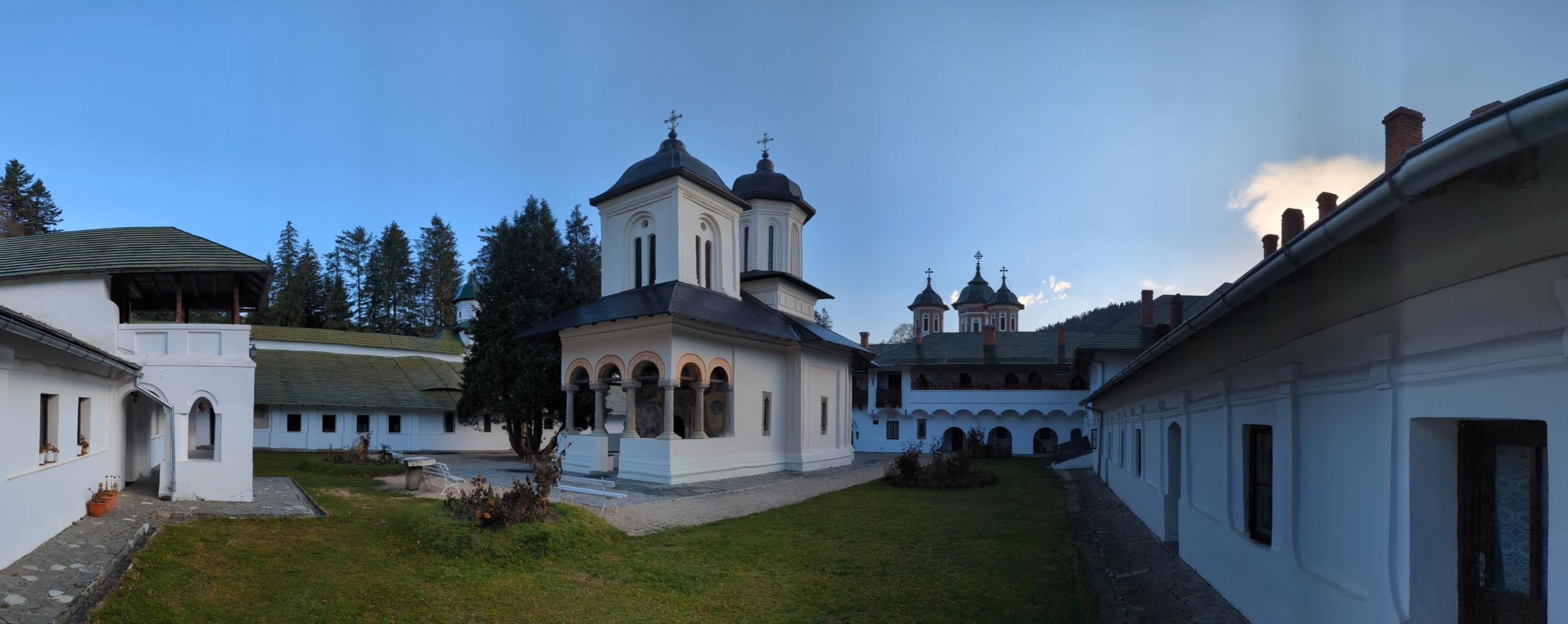
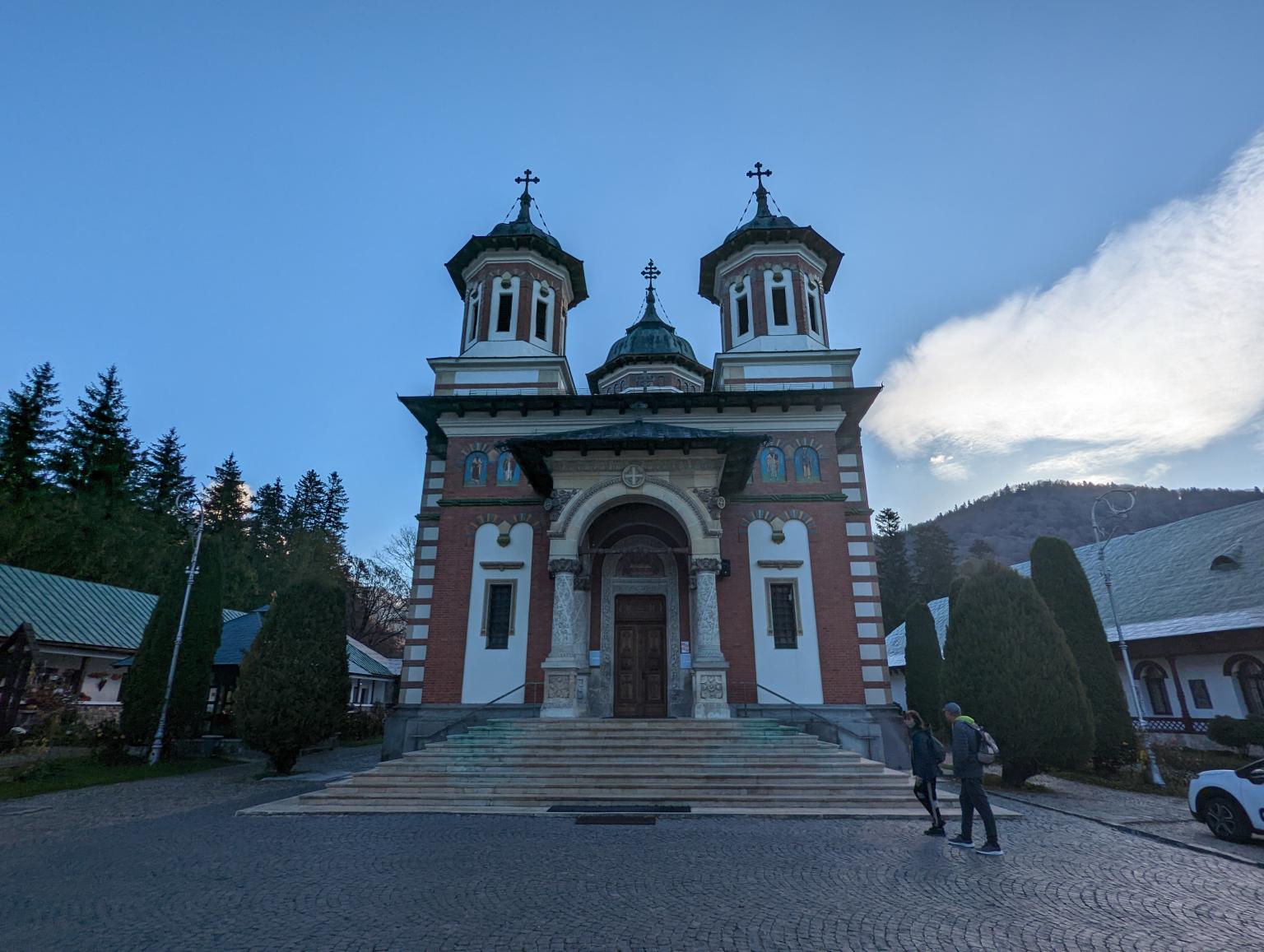
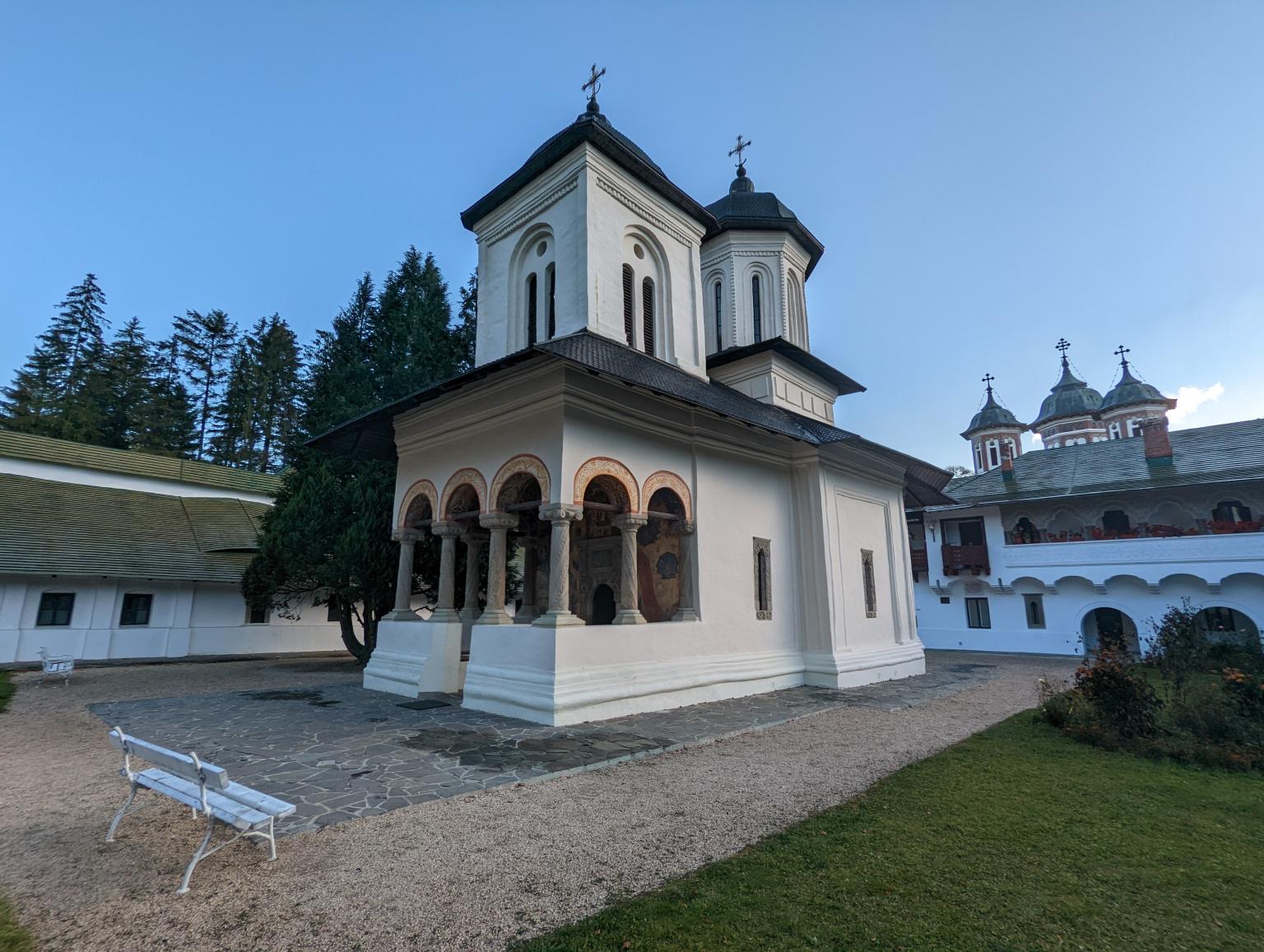
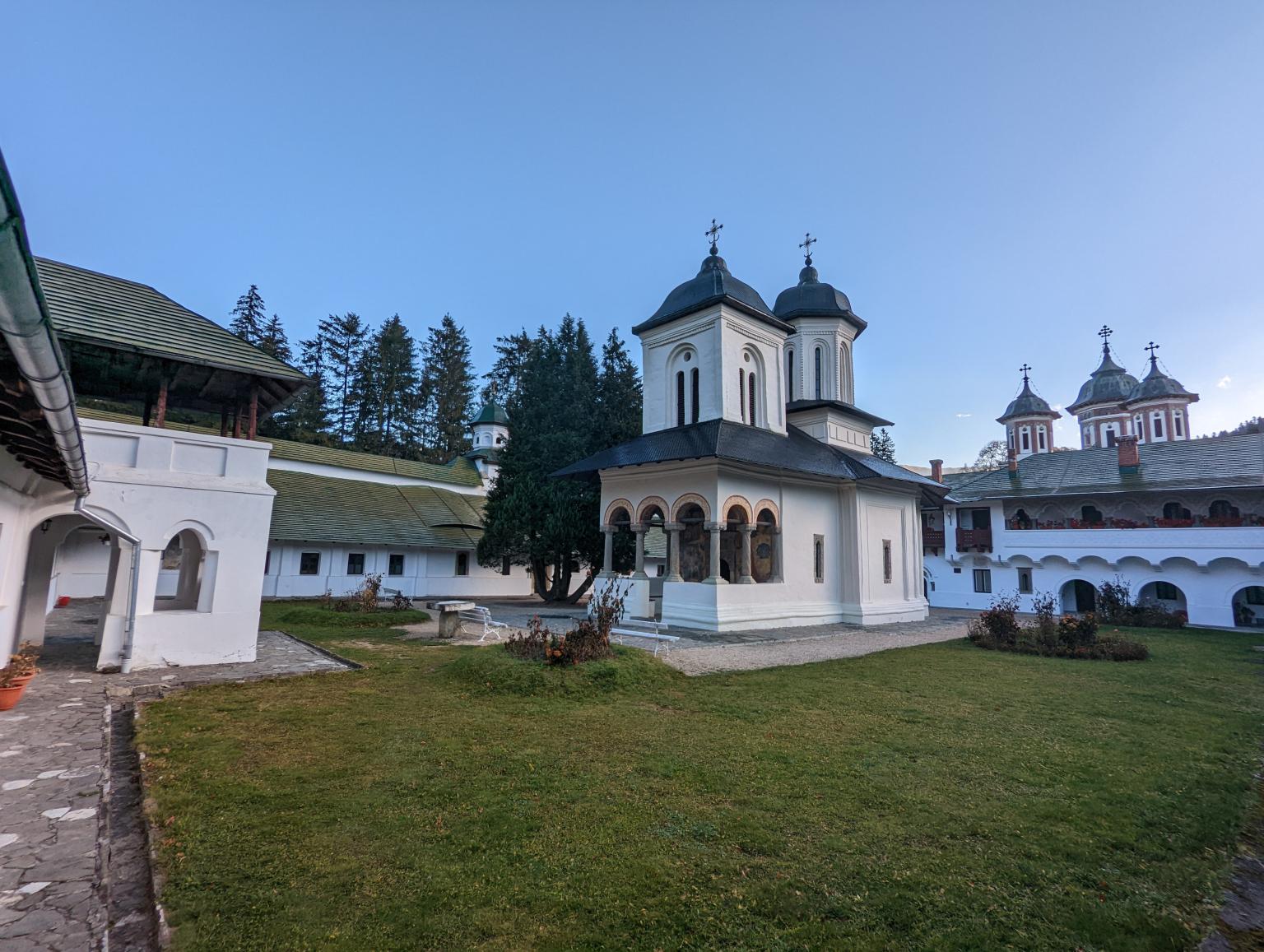
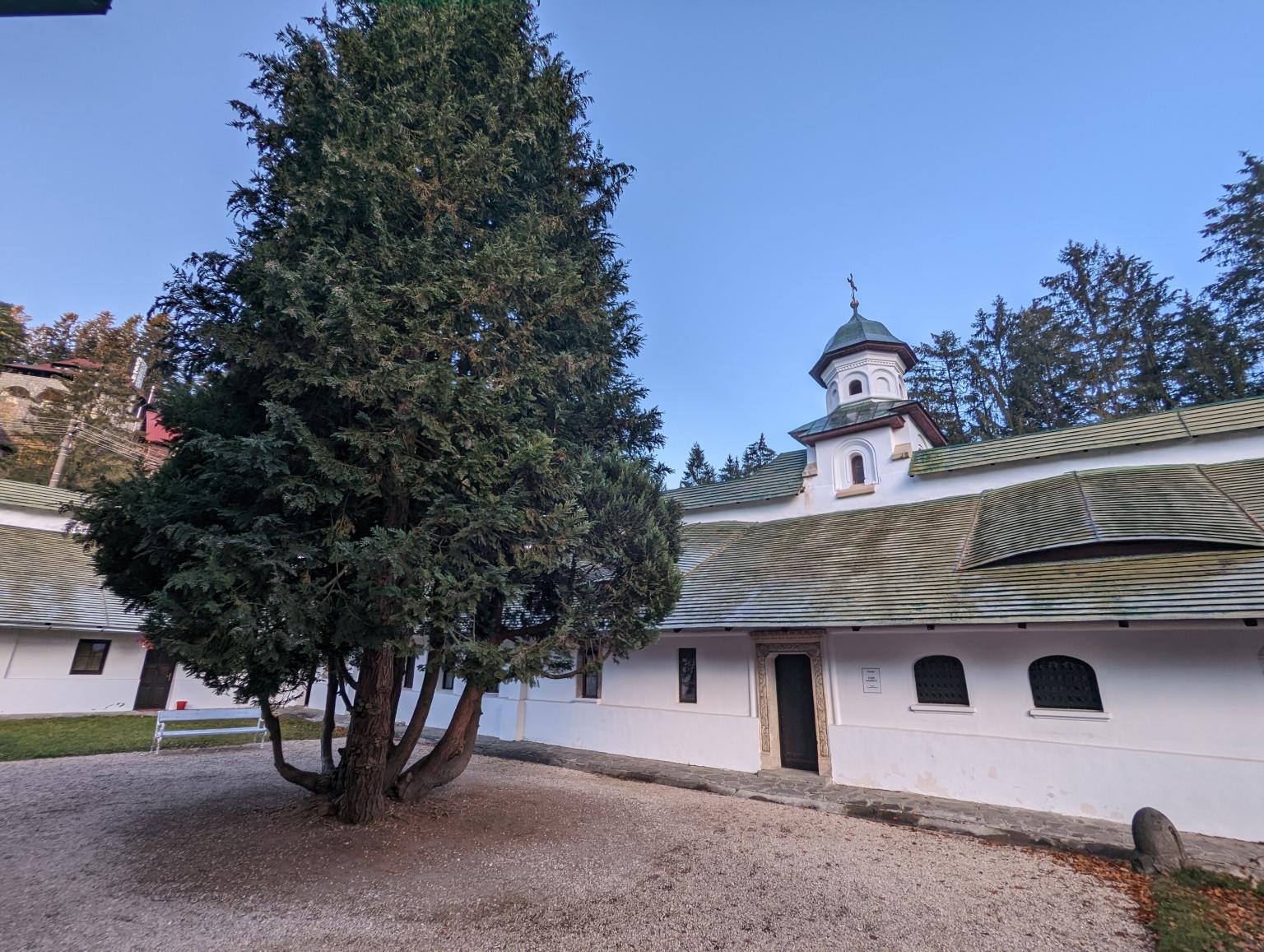
About the Monastery of Sinaia it is said that in 1672 Mihai Cantacuzino being persecuted by the country ruler Grigore Ghica fled on the horseback from Bucharest and being chased by a posse he grabbed the less traveled paths of Prahova Valley. Arriving in the evening down the Bucegi mountain area, he was hidden by monks in the small hermitage called Molomoț. He promised that if you lives he will rise a monastery on the place.
Build between 1690-1695 the Monastery was dedicated to the Assumption and was called Sinaia, the name coming from Mount Sinai in Egypt.
Upon completion of construction it looked like a fortress with high and thick stone walls arranged on four sides following the cardinal points. The simple little church building inside, painted by Pârvu Mutu is the settlement mark for the future site later named after the Monastery of Sinaia.
Today the visitors can admire the old church, in Transfiguration chapel, The Holy Trinity Church, built between 1840 to 1846, but also a museum with numerous exhibits.
The Monastery Museum was built in 1847 and was the guest house of Sinaia Monastery. In 1849 it was transformed into barracks and ammu- nition storage for the Russian Army, and served the same purpose for the Austrian Army during the Crimean War (1854-1858).
Between 1871-1883, it hosted Romania's royal family and its guests. In 1895 the permanent exhibition of religious objects of churches and monasteries subordinated to the Eforia of Civil hospitals (from 1948 to today - the Museum of Sinaia Monastery) was opened here. From the museum terrace, all the kings and queens of Romania, princes and princesses, as well as personalities like Vasile Alecsandri, George Enescu, Nicolae lorga etc. have admired Sinaia and the upper Valley of Prahova.
The cornice, as well as the bell tower, are made of the murano mosaic with golden foil, made in 1891 by the Venetian Nicolo Candiani and lon Georgescu. Both are historical monuments. The museum houses the first Bible printed in Romanian (Bu- charest, 1688) and a beautiful collection of old icons (of which the most important is the "The Holy Trinity" painted by Pârvu Mutu, the Painter, 1693), objects given by the Royal family of Romania.
//
Sinaia is one of the most important climatic resorts in Romania.
The neighborhood through which we enter Sinaia is the old part of the city. It's called Izvor and it was the first permanent secular settlement on the Upper Prahova Valley, founded in 1782-1784 by the 24 scutelniks given by ruler Mihai Suțu to the Sinaia monastery.
We are now entering the climactic resort of Sinaia, also called the "Pearl of the Carpathians", spread over the slopes of Bucegi, at the foot of the Furnica (2102 m) and Piatra Arsă (2044 m) mountains, which dominate the Prahova Valley with over 1200-1300 m.
The climate is comforting, sheltered from strong winds, the summers are cool and the winters without severe frosts, but with a lot of snow (Sinai being also famous as a winter sports resort), the air is clean and ozonated. Altitudes: 798 m at the station, 845 m at the park, 860 m at the monastery, 970 m at Peleș Castle.
Sinaia began to develop as a resort after the construction of the road from Valea Prahova, but especially after the construction of the railway. It received the name of Sinaia in 1874, after the name of the monastery, and in 1880 it was declared a city.
Sinaia has been inhabited since the Bronze Age, but the first documentary evidence only dates back to the 17th century, with the construction of the Sinaia monastery. Tradition speaks of monks present in Sinaia since the 15th century. In those distant times, also known as hermits, hermits or hermits, the monks had their abode in the mountains around Sinaia, where they lived a harsh and deprived life.
Places such as Grota Zgarbura, Bogdan's cave and Poiana Pustniculiu seemed to be destinations for these monks. Another meeting point was at the foot of the St. Ana rock, located at 1218 meters above Sinaia, where the pilgrims gathered to pray in common.
The name of the rock originates from the refugee monks from Mount Athos, who chose to retreat to the forests of Sinaia after the conquest of Constantinople by the Turks in 1453. The legend also mentions the existence of another hermitage on Mount Molomoț (today Furnica), where, as well as in the case of Saint Anne, the monks gathered for prayers, especially in winter when the roads were covered with snow.
In the 16th century, an outlaw named Nicolae Grozea from the town of Brebu would have built a small wooden church in place of the old hermitage.
It is confirmed that there was a small church dedicated to Saint Nicholas on the top of Molomoţ in the past, destroyed during the Russian-Austrian-Turkish conflict of 1788. In 1858, a stone cross was erected on the site of the church.
The Sinaia Monastery was built during the reign of Constantin Brâncoveanu by Mihai Cantacuzino, the patron, and was completed on August 15, 1695.
In 1663, the Postman Constantin Cantacuzino fell victim to an order from Grigore Ghica. His descendants, including the defender Mihai Cantacuzino, took the path of Valea Prahova, reaching Brașov.
Mihai Cantacuzino, the rearguard, headed towards Transylvania, passing through the towns of Câmpina and then riding towards Brașov. Exhausted, he left his horse in Valea Prahova and climbed the coast of Molomoţu, where he found a spring. Here, he quenched his thirst, the spring later becoming the famous fountain of the monastery. That day, on the route, Cantacuzino met monks from the hermitage of Saint Nicholas. He promised to build a monastery in that place if he survived. Guided by the hermits from Molomoț, he arrived safely in Brașov.
During a pilgrimage to Jerusalem, Mihai Cantacuzino visited the Sinai peninsula, being impressed by the similarity between Mount Horeb, where the Sinai Monastery was located, and the mountain where he had been saved by the monks. Upon his return to the country, in 1690, he began the construction of the church, which he named Sinai.
The village of Traisteni and the "scutelnicii" were in charge of guarding the monastery. In critical situations, guards in the belfry would light a haystack on a long stick, keeping it alight above the belfry to signal danger. In response, the shepherds from Valea Rea also lit a haystack, with the flame visible as far as the village of Trăisteni on the banks of the Doftana. At this signal, the entire village mobilized, riding fast horses, heading towards the monastery to counter the threat.
The Sinai Monastery is composed of two enclosures, the old one being surrounded by massive walls, some 6 meters thick, with openings like those of a fortress, giving the monastery a civic rather than a religious appearance.
In the center of this precinct is the old church, small in size but with a significant artistic value.
The open porch is supported by stone carved columns, similar to those of the Colțea church in Bucharest, built shortly after the Sinai Monastery. The columns of the porch are decorated with ornamental motifs such as hollyhocks, oak leaves, vines and fruits, and the capitals are carved with floral motifs and two snakes symbolizing "Wisdom".
The remarkable portal, an impressive sculptural creation in stone, impresses with the presence of the coat of arms of the Cantacuzini, with the double-headed eagle symbolizing Peace, alongside the biblical figures of Moses and Aaron. This distinctive detail of the representation of biblical characters in an Orthodox church is a rare and particularly interesting aspect.
The painting of the church, made in 1694, bears the signature of master Pârvu Mutu, trained at the school in Câmpulung-Muscel, one of the most reputable of that period.
Pârvu Mutu (1657-1735), the most prolific painter of the Brancovene period, with a remarkable artistic mastery, contributed to the frescoes of several churches, including those in Mărgineni, Măgureni, Cotroceni, Călinești, Aninoasa, Fundenii Doamnei, Colțea, St. Gheorghe Nou from Bucharest, Bordești and Filipești de Pădure (where he also included his self-portrait). He was also a skilled iconographer.
During the war of 1787, the paintings were damaged by fire, being restored in 1795 and then in 1952. From the original painting, the porch painting, the votive paintings of the founders and the upper part of the painting in the nave (from the yellow cord upwards ). It is notable that the vault of the porch includes an iconographic innovation, representing the two patrons: Saint Demetrius, the patron saint of Wallachia, and Saint George, the patron saint of Moldova.
The columns between the nave and pronaos feature numerous sculptural motifs, including flowers, lilies, leaves and grapes. Two griffins are carved on the capitals in the middle, symbolizing "Good", and on those on the wall, winged bulls, representing "Power".
The chapel, an integral part of the historical complex, represents another valuable component, having roots in 1695, but subject to some changes in 1795. In this last period, the changes made to the cylindrical vault of the pronaos, with notable penetrations, can be noted. A special feature of the interior is the original treatment of the resurrection scene in the nave, presented in three distinct variations: Christ above the coffin, Christ rising with the full symbol of humanity, and Christ leading the heavenly powers.
The chapel stands out for its unusual construction features, such as the iconostasis with two doors instead of three and the vaults in which resonating pots are incorporated, intended to amplify the singers' voices.
In the perimeter of the same architectural complex, there is also the tomb of Take Ionescu, illustrated by the painting made by Costin Petrescu and inscriptions taken from the speeches of this important politician.
Dumitru (Take) Ionescu (1858-1922), native of Florești, Romanian politician committed to promoting national unity, held various ministerial positions and even that of Prime Minister of Romania. During the First World War, supporting Romania's alliance with the Entente, he was one of the main architects of the Little Understanding, an alliance between Czechoslovakia, Romania and Yugoslavia, as foreign minister.
The Great Church of Sinai Monastery was built between 1897-1903, with George Mandrea as architect. In the Byzantine style, it has a flat plan, two towers and two belfries. Materials used include exposed and glazed brick, and around the church is an ornate belt of green glazed pottery brought from Vienna. The decorative elements such as the pillars of the porch and the frames of the doors and windows are carved in stone, combining the Brancove style with Italian Baroque influences.
The oil painting with neo-Byzantine motifs and mosaic imitations belongs to the Danish artist Aage Exner. As for the tapestry, the pews and the furniture, they were made in Romanian style by the sculptor Gheorghe Babic.
The bell, weighing 800 kg, was cast in 1775 and rebuilt in 1914.
The Monastery Museum houses an impressive variety of exhibits, among which the collections of wooden icons from the Brancovena period stand out, with the mention that the icon of the Holy Trinity is the creation of Pârvu Mutu. The icons on glass from Transylvania and the embroideries made in the 19th and 20th centuries are also distinguished, as well as the remarkable paintings created with needle and thread by Ana Roth, Queen Elizabeth's lady-in-waiting, also known as a teacher of drawing and embroidery at Galatians.
Source: Bucharest-Brașov on Prahova Valley (Ministry of Tourism, 1976)