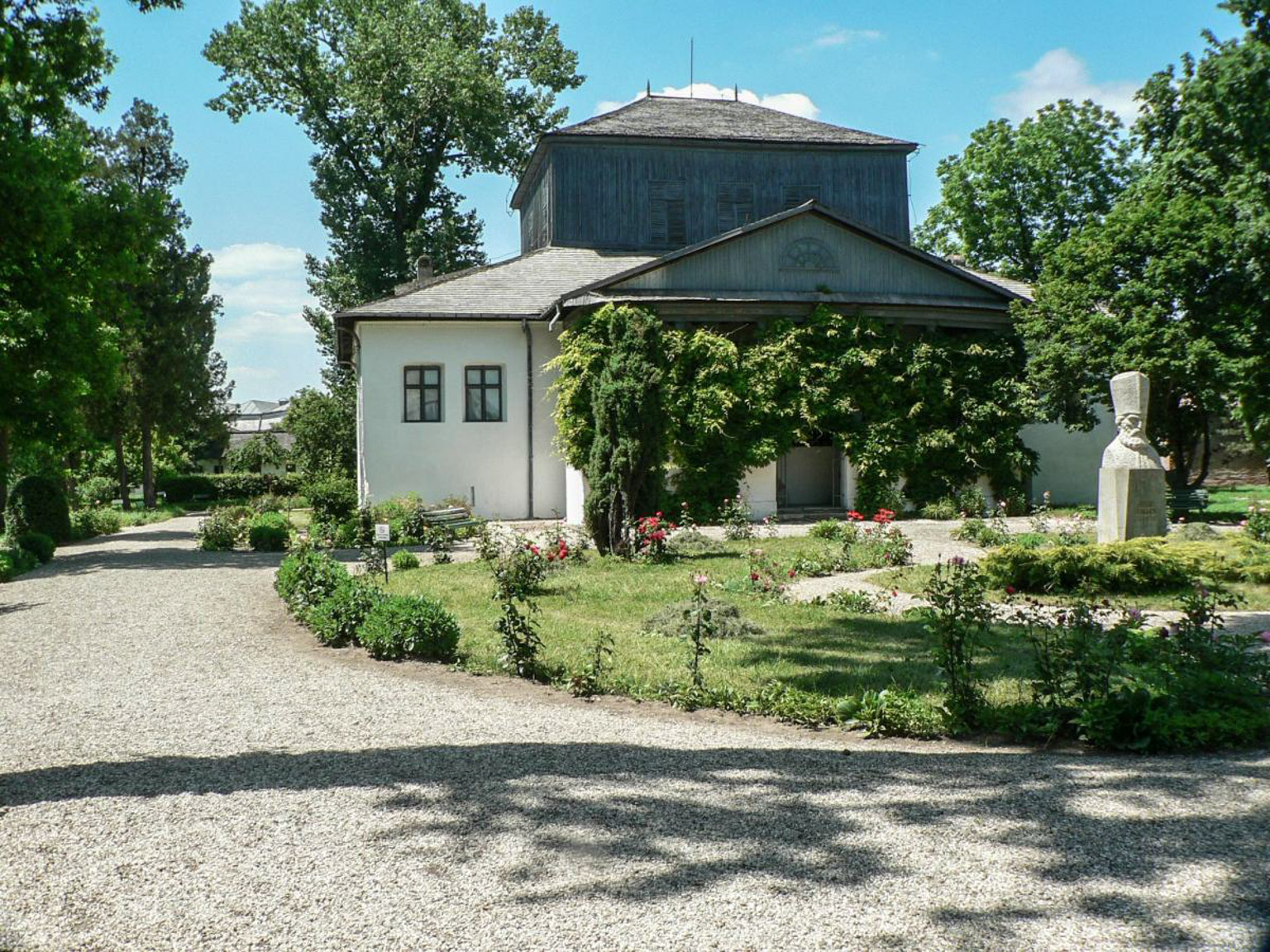
The museum is organized, mainly, in the houses of the Golescu family, recognized in the history of our country, for the contribution made by some of its members to the development of Romanian culture, for the activity carried out during the revolutions of 1821 and 1848-1849, during the realization of the Union of the Principalities (1859) and in the struggle to obtain Romania's state independence (1877 1878).
The museum was established in 1939, by King Carol II, under the name Dinicu Golescu Museum. The organization of the museum began in 1943, currently having the following sections:
memorial section: Casa Goleştilor, built in 1640
history section: the place and role of the Golests in national history and culture
pedagogical department: the first village school, in Romanian, of higher level, in Wallachia
The gazebo where Tudor Vladimirescu, the leader of the 1821 revolution, lived the last days of freedom (18 - 21 May 1821)
pavilion section: ethnography and folk art of Argeș county
the study warehouse of the museum, workshops, laboratories
The Museum of Viticulture and Pomculture from Romania
Text taken from the presentation panel
//
In the center of the town is the Golești museum complex, arranged in the mansion of the old family of mountain nobles Golescu, which had a significant role in the modern history of Romania.
The family of Wallachian nobles, Golescu, with a reputation dating back to the 16th century, contributed to the country with high dignitaries, military commanders and influential advisers, as well as rulers. They were rewarded with estates and villages, including the village of Golești, from which it derives its name.
The church in the area represents a valuable example of the architecture of Muntenia from the 17th century, with ornamental motifs of masterfully carved stonework, under the influence of Armenian art.
The mansion was originally built in 1640 and was later extended. In the period before the revolution of 1848, numerous leaders of the revolution gathered here, including Nicolae Bălcescu. On May 18-21, 1821, the plain in front of the mansion hosted Tudor Vladimirescu's camp. The gazebo at the entrance was dismantled and taken to Târgovişte, in an act of betrayal.
The Golești museum complex is structured in several sections, among which are: a) a history section with documents related to the revolutionary movements of 1821 and the revolution of 1848; b) a memorial section of the Golescu family; c) a section of ethnography and folk art from Argeș county; d) an exhibition dedicated to "The beginnings of the organization of national education in Wallachia in the first half of the 19th century", set up in the gazebo where Dinicu Golescu established the first village school in Wallachia in 1826.
Dinicu Golescu (1777-1830) held various positions in the feudal hierarchy, from steward to the title of great orator. He was proficient in Latin, Greek, French, and Italian, and his learning of the works of Homer prepared him to later translate fragments of the works of Plato, Aristotle, and Plutarch, among others.
During the three trips he undertook to Central and Western Europe, Golescu visited cities such as Pest and Buda, and then spent a month in Vienna. Next, he traveled to places like Trieste in Italy, stopping in Venice, the Doges, then Padua, Verona, Milan and Mantua, where he explored the famous university centers.
Later, in the following years, his travels took him to Pest, with special attention paid to the Banat, where he benefited from baths with hot mineral waters.
On the third trip, Golescu visited Bavaria and Switzerland, registering his son at the institute in Munich and at the University of Geneva. The impressions gathered from these trips were recorded in the work "Note of my trip", representing one of the first travel diaries published in Romania.
The ethnography section of the museum in Golești presents, in a concise manner, by means of representative tools, photographs and panels, the main occupations and crafts of the inhabitants of this area and the neighboring regions. Thus, various elements can be observed here, such as a wooden plow (one of the few pieces still preserved), hunting and fishing tools, but also tools used by animal breeders, winegrowers and fruit growers. Peasant home industry is illustrated by means of a loom, the wood of which is inlaid with decorative elements, forks and looms.
The art of skinning is presented both through the tools of leather processing and ornamentation, as well as through various finished objects such as skins or leather bags. Near a window are exposed the potter's wheel, ceramic objects in various stages of processing, a corner from a blacksmith's workshop and another dedicated to woodworking.
Another building is reserved for the presentation of peasant house interiors specific to the 19th century from the Drăgănești-Olt, Muscel, Vâlcea and Argeș areas. In one room attention is paid to the folk costume, and in another ceramic objects from these regions are exhibited. The large, green-glazed vessels made in Stroiesti and Curtea de Argeș are noteworthy, as well as the vessels from the Poenița, Poenari and Costești centers in the Muscel area, including a particularly beautiful zoomorphic mug and an anthropomorphic pitcher in the shape of a stern with book in hand.
In addition to their documentary role in reflecting the living conditions of the past, the exhibited objects bring considerable artistic value, representing yet another living proof of the talent and taste for beauty characteristic of all fields of activity of the Romanian people.
Source: Bucharest-Brașov on variants (Ministry of Tourism, 1976)