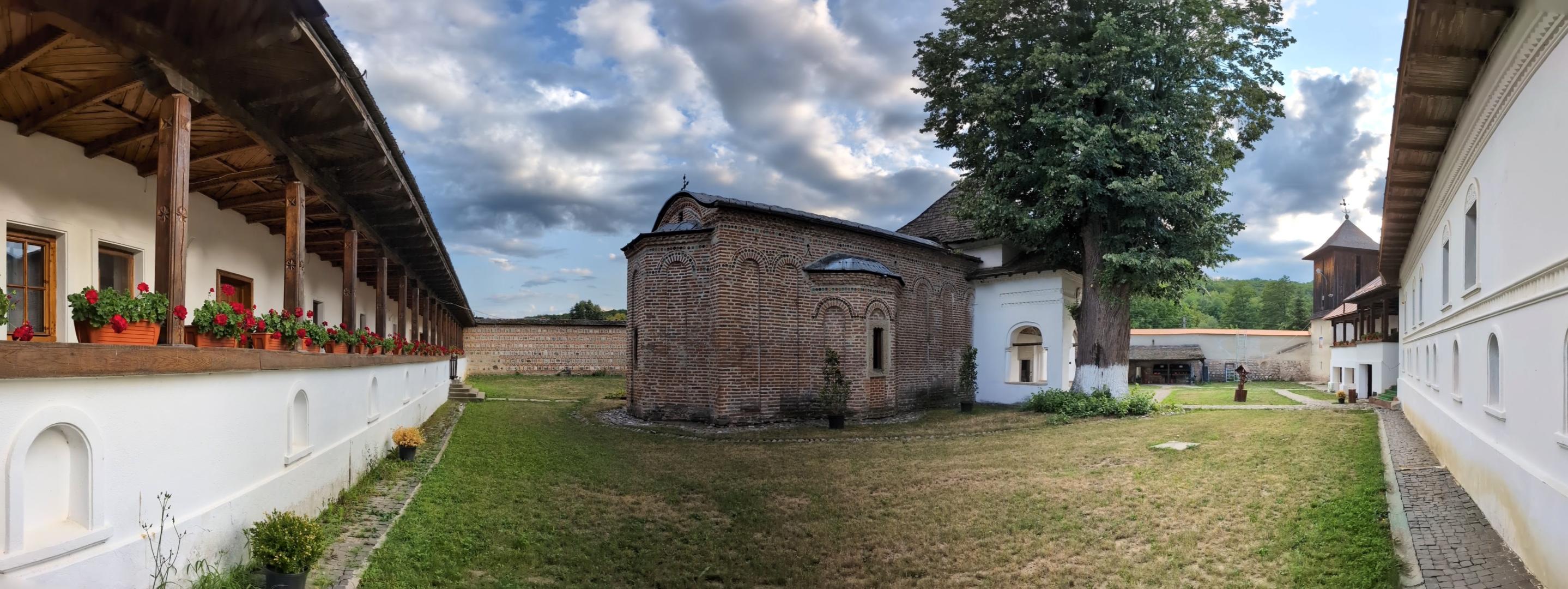
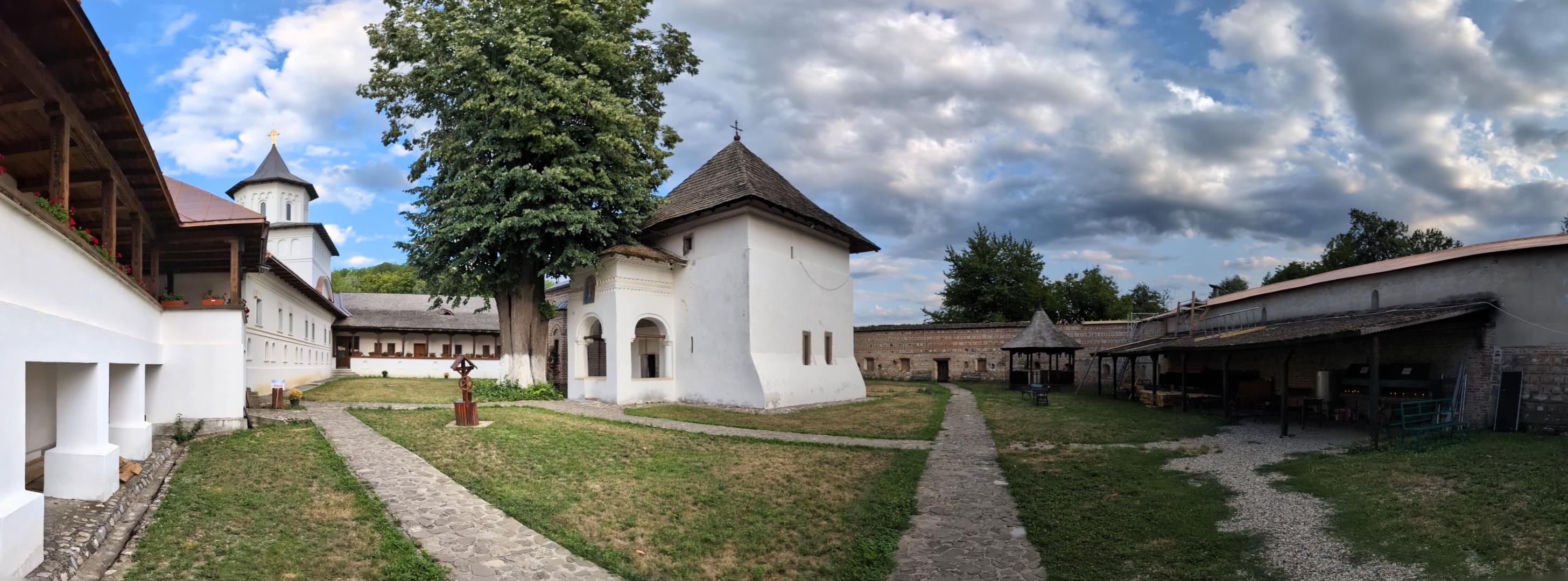
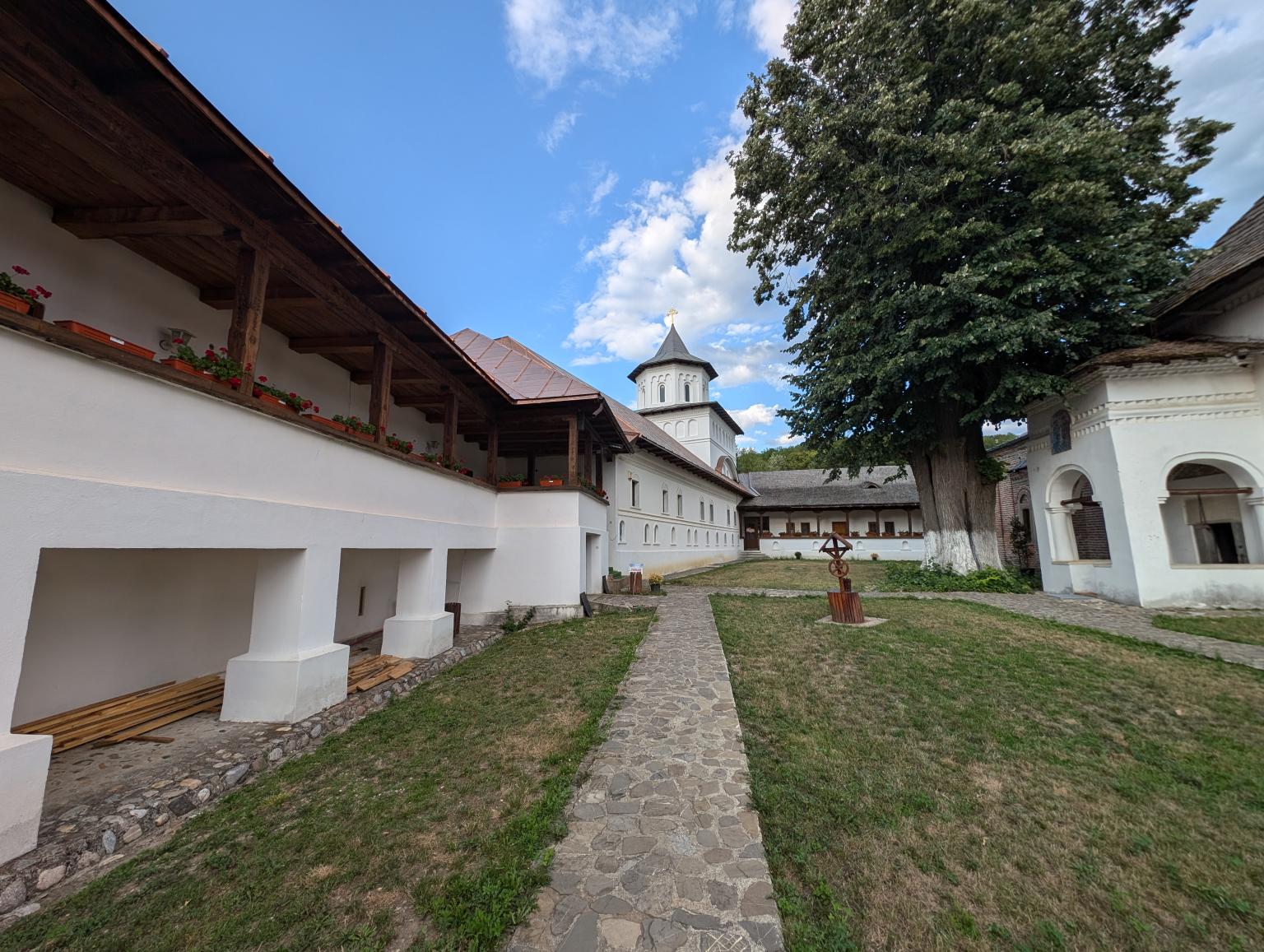
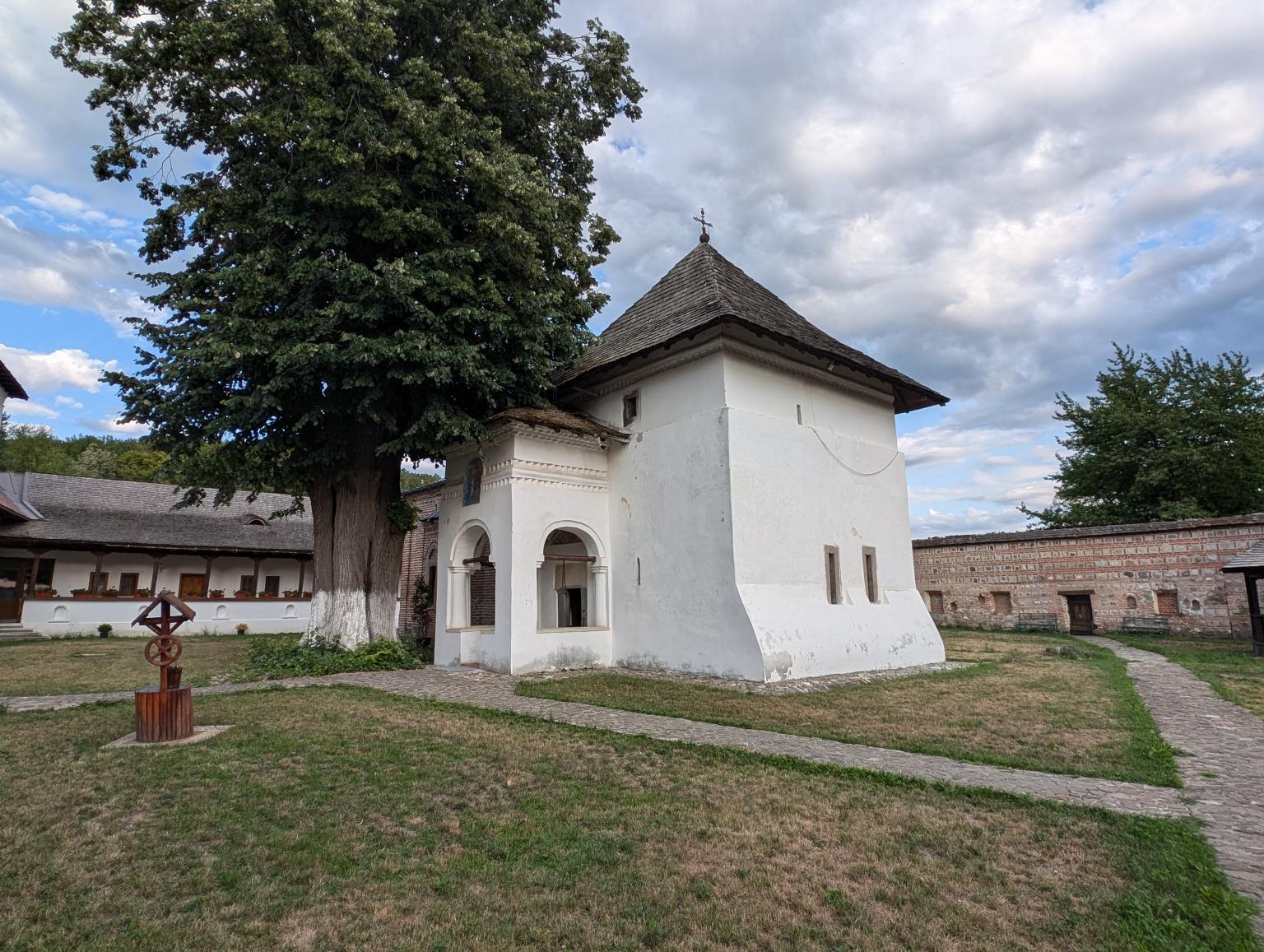
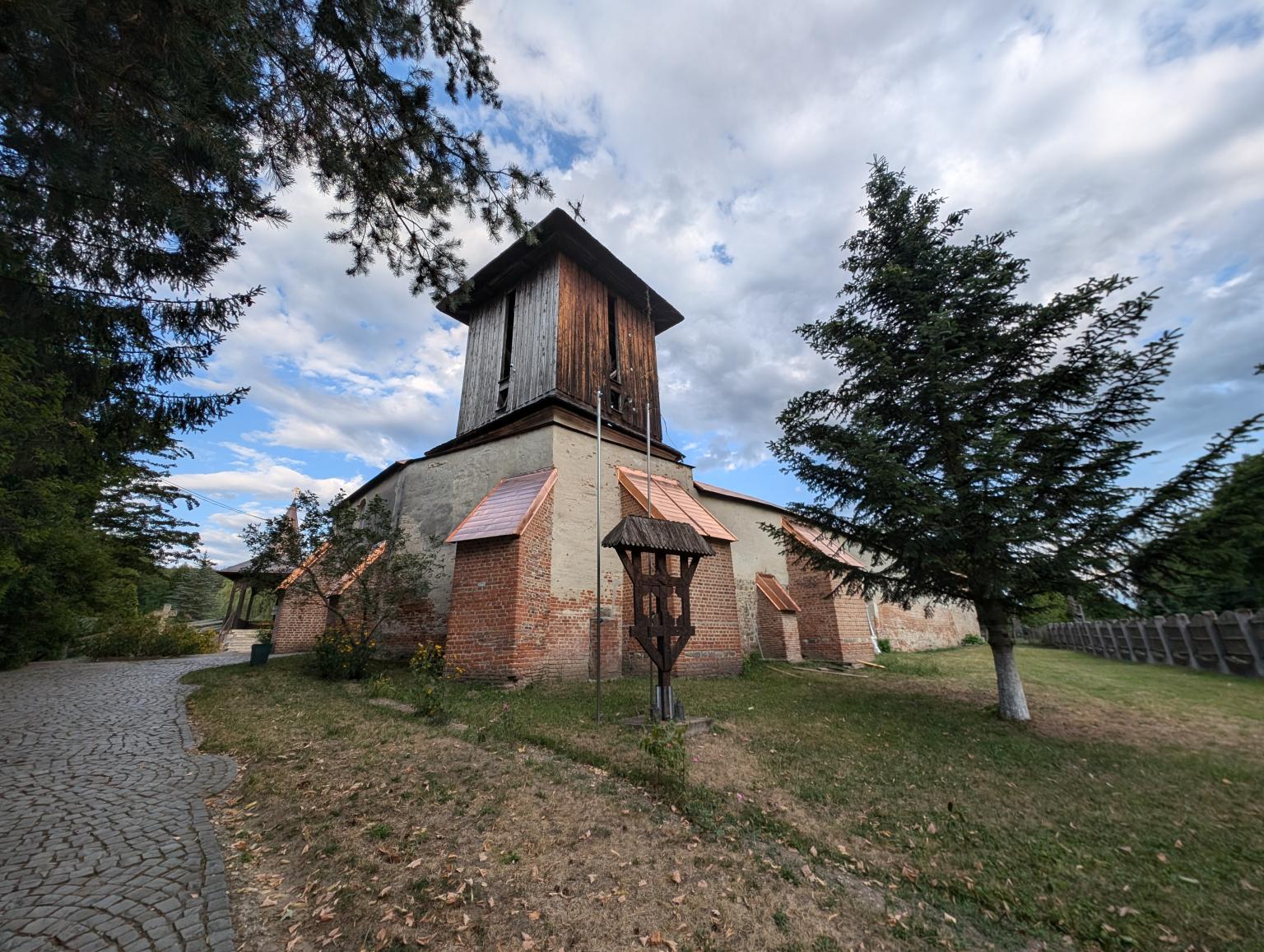
The Cotmeana monastery was built in 1383 by Mircea the Elder and went through several restorations. According to legend, on his journey from the Cozia monastery to Curtea de Argeș, Mircea the Old stopped here one evening, having dinner and resting overnight, which is where the name "Evening Feast" of the monastery comes from. To ensure the safety of the ruler and his companions in that area, it was decided to build the monastery.
According to the custom of the 14th century, these places were fortified with walls to protect them from unpleasant surprises.
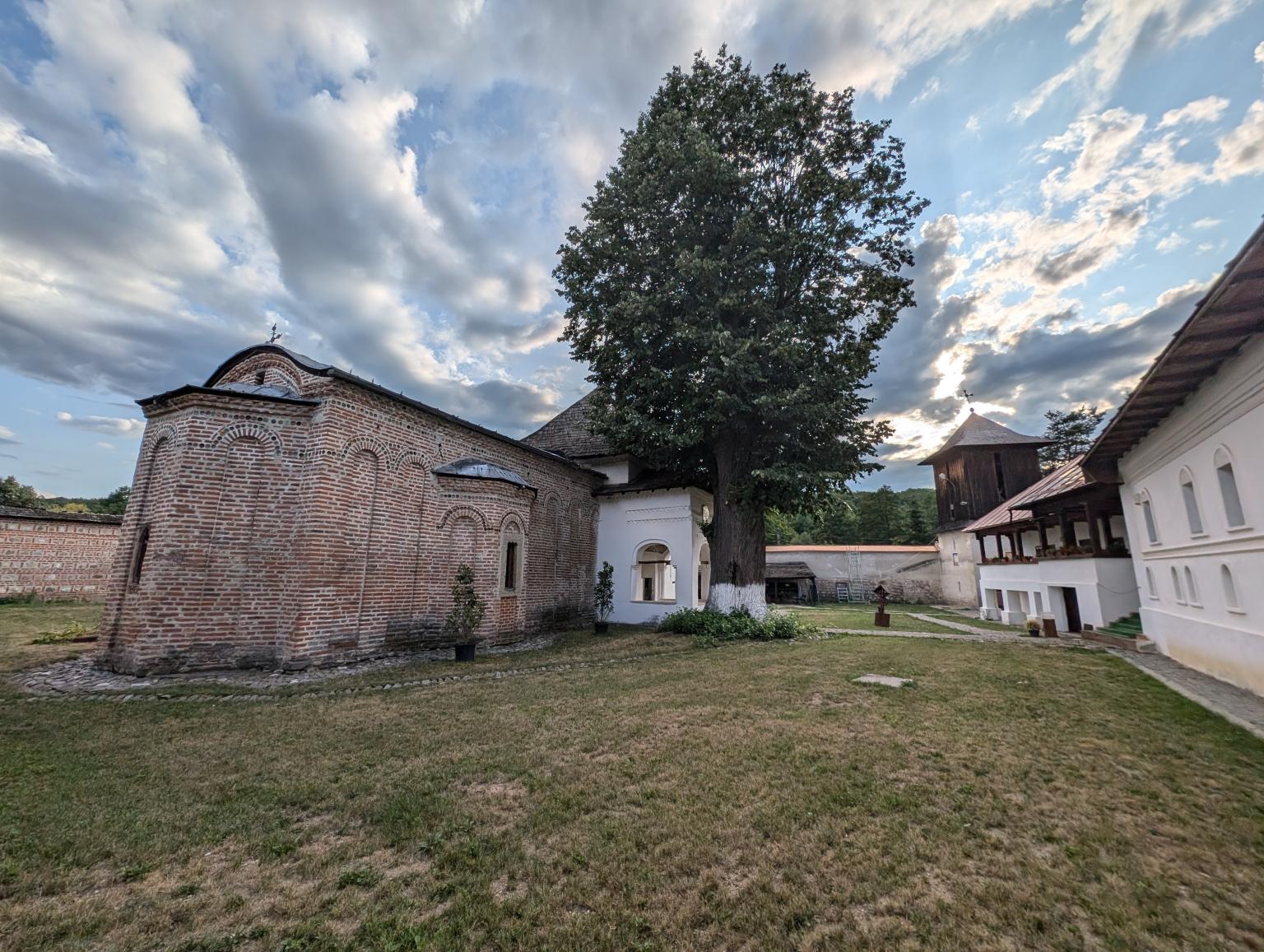
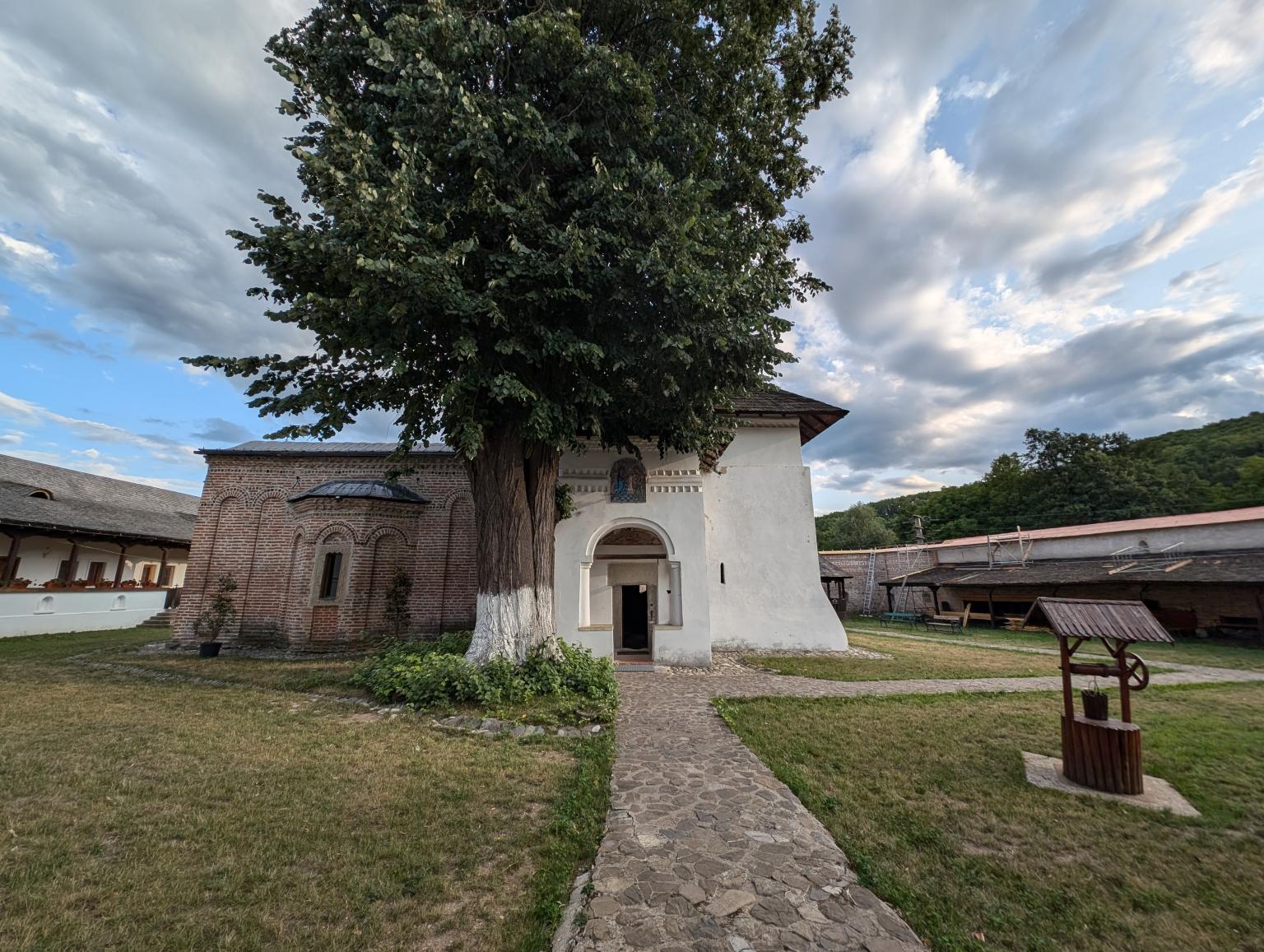
It is remarkable that near the entrance to the church there is a secular lime tree (about 300 years old), recognized as a monument of nature, and on the outer wall of the enclosure there is an ivy almost 500 years old.
The church of the monastery is small, being composed of a single room, with a semicircular altar and two lateral apses. Its plan is similar to that of the church at Cozia, but the lack of towers and the use of a cylindrical vault are distinct elements from the mentioned style.
The facade is entirely built of exposed brick, being decorated with long friezes and richly ornamented with glazed ceramic disks in shades of coffee, yellow and green, characteristic specific to the religious architecture of Wallachia. This form of ornamentation was later widely adopted in Moldova, especially in the monuments built by Stephen the Great.
In the context of the history of Romanian feudal art, the church of the Cotmeana monastery stands out as a singular phenomenon, significantly different from similar monuments erected in that period. It is one of the first Romanian churches with a porch, thus representing an innovation compared to the traditions of Byzantine architecture.
Source: Bucharest-Sibiu (Ministry of Tourism, 1977)
//
The monastery is mentioned by Alexandru Odobescu in the work Mihnea Vodă cel Rău (1508-1510), in the Cotmeana chapter, referring to the refuge of Mircea, the lord's son, together with the Stoica Logofătul.
The Sultan had ordered the Pasha from the Danube to place Vlad the Younger or Vlăduță, the brother of the late Radu Vodă, on the throne. In the autumn of 1509, 3 groups of Turkish troops crossed the Danube, one of which under the leadership of Neagoe Basarab broke into Oltenia before the others.
Mihnea Vodă decided to send his son, Mircea, to investigate over Olt. Afraid to go directly to Râmnicu Vâlcea, he stopped at the small Cotmeana Monastery, a little further down from the beautiful valley of lights, on Topolog, small like a nest between the hills.
Neagoe learning in Râmnic that Mircea would have gone to Cotmeana, rushed with his hunters at midnight. The monks, fearing that they might be harmed, urged Mircea to run away. The young man has scruples saying that running away is shameful, but the wise Logofat Stoica reminds him of the more convincing reverse, but it is healthy.
Pushed by the monks, poor Mircea, barefoot, without a hat, only in his shirt and with his belt dragging, jumps from the window and together with Stoica, they run away through the woods.
Nicolae Petrescu
//
It is believed that the reign of Mircea III is not clear or that he was only a co-lord with his father, but the documents signed by him during the short time he was on the throne show that he was a lord with full rights, using the usual signature of the rulers of the time.
Mihnea the Evil abdicated the throne in favor of his son when Vlad the Younger (Vladuț) was appointed lord in Istanbul, probably to increase support for his family, given that Mihnea was not popular at the time.
The father remained in Wallachia, most likely as a close advisor to his son, until January 1510, when he went to Transylvania to seek help against a new pretender, supported by the Craiovesti boyars and Mehmet Mihaloglu Bey, an influential Pasha of in Nicopole, who was also related to the Craiovesti on the maternal line.
Therefore, in February 1510, when the battle of Cotmeana took place, Mihnea cel Rău was not present among the fighters, because he had been away in Sibiu since January with his wife, Voica, and the other children.
His defeat led Mircea to join the refugees from Sibiu, so that on March 12, the day Mihnea cel Rău was killed on the steps of the Parish Church, he was present there.
He tried to reach his father, who was just leaving work, but he arrived too late to save him, but he managed to kill two of the attackers: Danciu Țepeluş, the son of Basarab the Younger Ţepeluş (Basarab al IV- lea, who reigned intermittently between 1477-1482), and on Albu Vistierul; he also seriously wounded Dimitrie Iacșici de Nădlac, a descendant of the Serbian despots, whose wife had been insulted by Mihnea.
Mircea III made another attempt to regain the throne in the winter of 1511, crossing with a small army from Brașov to Muntenia, but he was defeated at Gherghița by Vlăduț's army, in which the boyar Danciu (Gogoașa) Craiovescu stood out .
Another failed attempt took place in the summer of 1512, also starting from Transylvania, but this time he was defeated by Neagoe Basarab.
In 1514, Mircea is recorded as being at the Baltă Citadel. He apparently died in Transylvania in 1534 (or 1537 according to other sources), the year his youngest son, Petru (the future ruler Petru Șchiopul), was born.
Source: ro.wikipedia.org