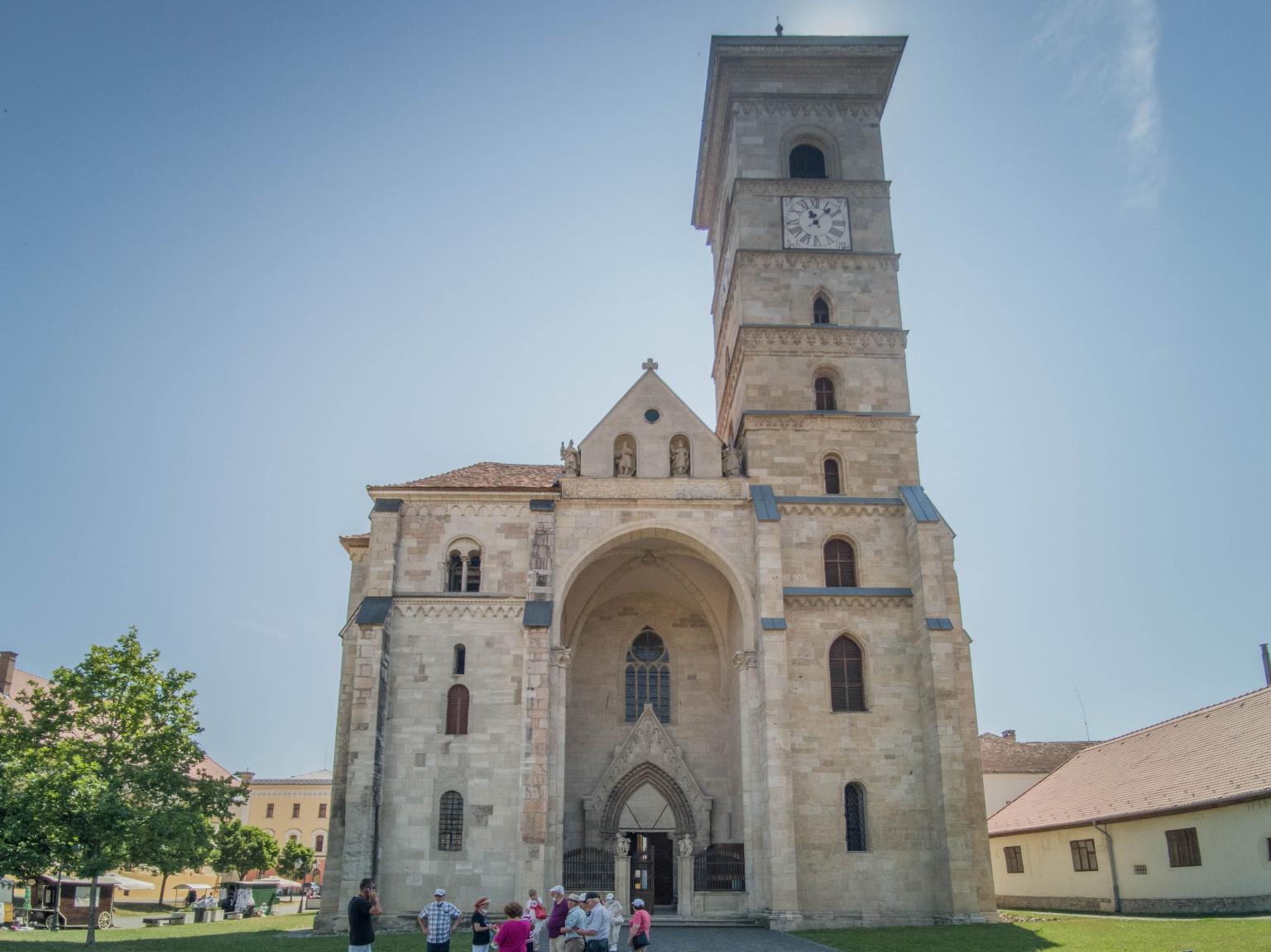
The Roman Catholic cathedral, due to its age and artistic value, is among the most significant monuments of this type in the country. Built in the late Romanesque style with its rich mix of Gothic, Renaissance and Baroque elements, it is an outstanding example of architectural diversity.
In the year 1100, on the site of the cathedral there was a Romanesque church with three naves, a single apse and a circular sitar, destroyed by the Tatars in 1241. The current building was erected around the year 1300, using materials partly from the old church. With a basilica plan that included 3 naves, transept, 3 semicircular apses, 2 towers and 1 tower over the square, the cathedral was a testimony to the mastery of the builders, among them the French woodcarver Johannes de Saint-Die.
In the tumult of the Saxon uprising of 1277, the church was burned and destroyed, costing the lives of 2000 refugees. With the completion of construction in 1300, modifications and additions followed over the centuries, including in the 15th century, when 2 floors were added to the main tower, under the patronage of Iancu de Hunedoara. In the 16th century, an early Renaissance chapel was built north of the church at the expense of Archdeacon Ivan Lazonyus. With its many periods of devastation and repair, including major interventions during the reign of Gabriel Bethlen, the cathedral was brought to its present splendor with the contribution of Italian craftsmen from Lombardy.
The church underwent restorations in two distinct periods, namely in the years 1907-1914 and 1953-1955.
As for the exterior, the portal of the main entrance to the west, built in the early Gothic style, dating from the end of the 13th century and attributed to Johannes de Saint-Die, stands out. The triangular pediment above it was made in Baroque style between 1718-1737. It is flanked by two towers and four statues representing kings of Hungary, together with a frieze bearing the coat of arms of Austria. The towers, up to the level of the cornice, date from the 13th century. The north tower was never completed, being destroyed in 1603 during the conflicts between Moise Secuiul and General Basta.
On the northern side of the cathedral there is a remarkable Romanesque portal from the second half of the 13th century, and another Romanesque portal built in 1906. On the western side, a rectangular portal in the Transylvanian Renaissance style, specific to this gender.
As a whole, on the outside, the sober, solid and elegant buttresses of the Gothic choir stand out, as well as the decorations, bas-reliefs and side pilasters depicting scenes from the Bible, made in the Renaissance style.
The interior architecture of the church impresses with its symmetrical order, austerity and harmony of styles. In the upper part of the apse, there are bas-reliefs from the 13th century, representing the Archangel Michael.
In the southern wing of the side nave, a fragment of the apse of an old church from the 12th century is preserved. On the northern side of the transept, another apse can be distinguished, with columns housing two rows of frescoes, partially damaged, made in the 14th and 16th centuries, representing the most remarkable creation of this kind in Transylvania.
Inside the place of worship, there are baroque altars carved in red and black marble, a baroque pulpit and a double organ (from 1877) with 2209 sound pipes.
The cathedral serves as a necropolis for the Hunedorești family and later, for the Transylvanian princes. Here are Gothic sarcophagi with few elements of the Renaissance, such as those of Ioan de Hunedoara (1456), of his brother Ion (the Younger, 1442) and of their older son, Ladislau (1456). The sarcophagus of Queen Isabella (1559), wife of Ioan Zapolya, and of her son Ioan Sigismund (1571), the first prince of Transylvania, are also noteworthy, all made in the Renaissance style.
Source: Tourist itinerary Brașov - Sibiu - Alba Iulia (Ministry of Tourism, 1982)
//
The Roman Catholic Cathedral of Saint Michael in Alba Iulia is the oldest and longest cathedral in Romania. It was built in the late Romanesque style with Gothic elements and has a long and tumultuous history.
Construction of the cathedral began in the 11th century, but was interrupted by the Tatar invasion in 1241. Work resumed in the 13th century and lasted over half a century. During the Saxon Revolt of 1277, the cathedral was burned and ravaged, and around 2,000 people were killed.
In the following centuries, the cathedral was restored and expanded several times. Ioan de Hunedoara added two floors to the main tower, and Gabriel Bethlen completed the bell tower.
The cathedral is an important historical and cultural monument. It is a necropolis of the Hunedorești family and Transylvanian princes, and houses a collection of frescoes and sculptures of great artistic value.
Here are some key dates from the cathedral's history:
Beginning of construction: 11th century
Invasion of the Tatars: 1241
Resumption of construction: 13th century
Saxon Revolt: 1277
Extensions made by Ioan de Hunedoara: 1442-1450
Extensions by Gabriel Bethlen: 17th century
Reconstructions after destruction by Tartars, Saxons, Turks and armed gangs: 18th century
Restorations carried out in the 19th century
Restorations carried out in the 20th century
Sursa: turism.apulum.ro