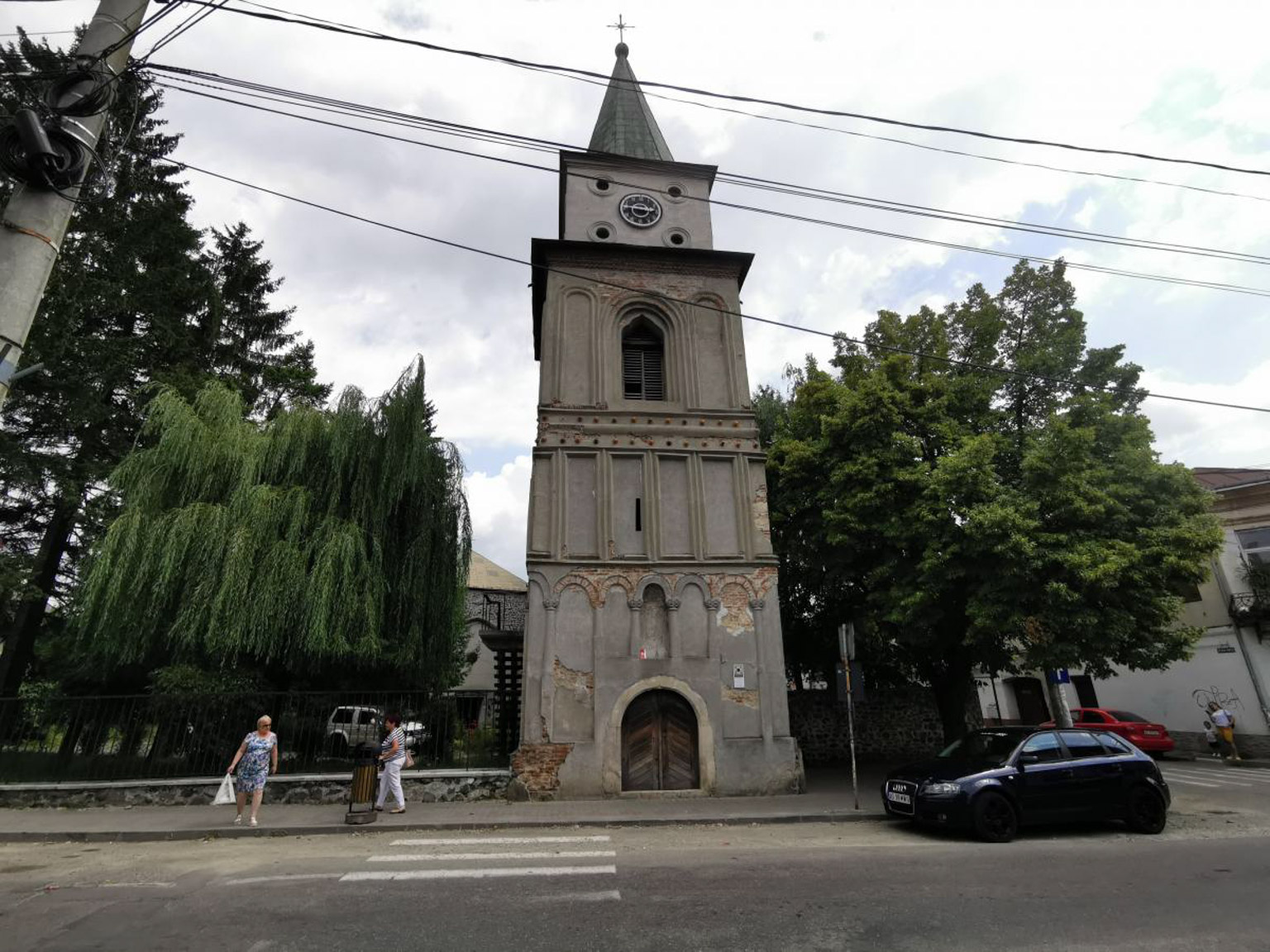
The Bărătia complex includes the Bărătia Catholic Church and the bell tower.
The Bărătia Catholic Church, rebuilt in 1760 in place of an older church with origins in the 13th century, has a rectangular nave without a tower and ends in the east with a polygonal apse. On one of the three buttresses supporting the southern wall of the church is a sundial dated 1706. Inside the church, on the eastern side, there is an open altar, and behind it is a funerary slab of the comite Laurentiu de Longo Campo, with the dimensions 2.10 m long, 1.06 m wide and 30 cm thick, dating from the year 1300. This nobleman, supposed to have held a high position in the city administration, was part of the colony of Saxons brought from Transylvania in the century 12th century, benefiting from the protection of ruler Nicolae Alexandru and his second wife, Mrs. Clara, who was Catholic.
In the first half of the twelfth century, a colonization movement of Transylvanian elements begins in the south of the Carpathians, initially under the protection of the Teutonic Knights (1211-1225), later without this protection. Romanians, Saxons and Szeklers settle in the areas of Câmpulungului, Rucărului, Vâlcii, etc., being gradually assimilated by the native Romanian population.
The bell tower, located in front of the church and having a square shape, reaches a height of 13 m up to the cornice. The exterior decoration, organized in three rows of registers, attracted the attention of artists such as Nicolae Grigorescu and Carol Popp de Szatmary, who left fascinating images of the construction as it looked in the last century.
Source: Bucharest-Brașov on variants (Ministry of Tourism, 1976)