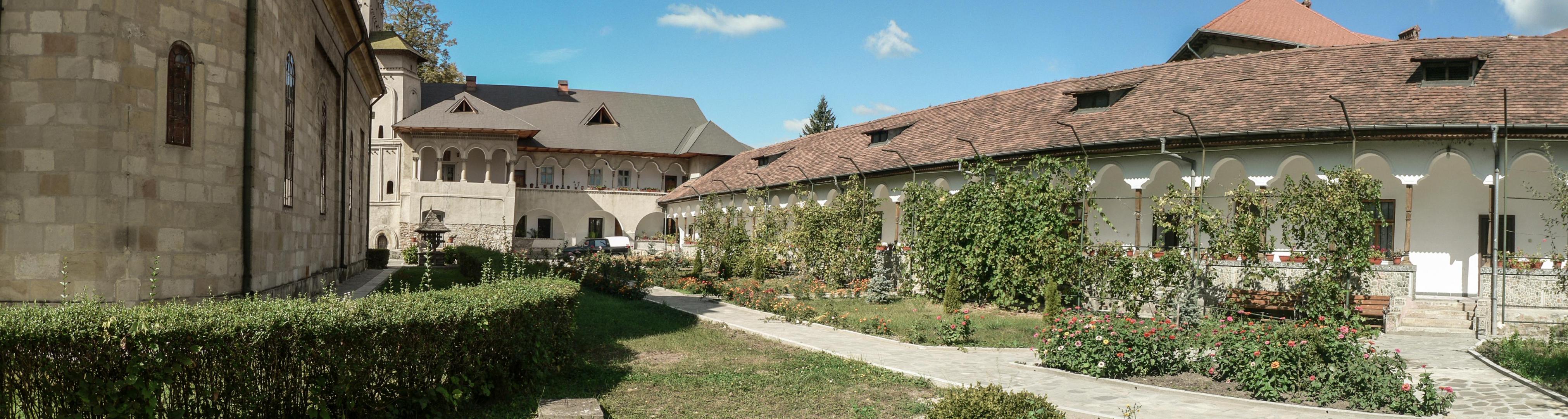
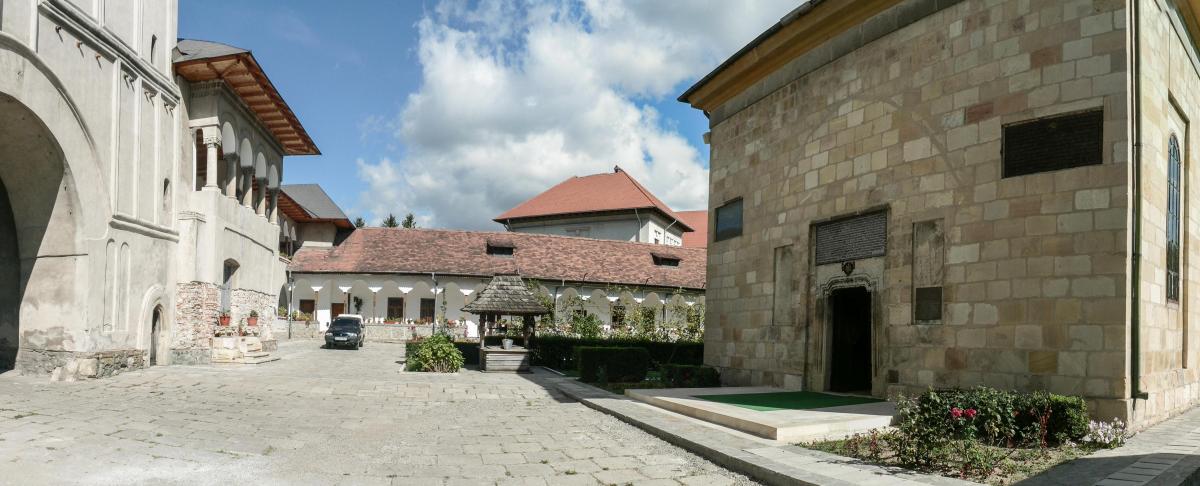
According to the tradition, the Negru Vodă Monastery was founded in 1215, by Prince Radu Negru. Later, it was rebuilt by Basarab I and his son Nicolae Alexandru Basarab.
After the 14th century constructions and the following century transformation, a great earthquake destroyed the church in 1628. Matei Basarab build it again in 1635 on the same foundation using the stones of the initial building.
The edifice has remained unchanged until 1827 when abbot Filaret Beldiman, with the help of Prince Grigorie Ghica, build it for the third time and dedicate it to the Assumption of the Virgin in 1832.
The present-day monastic compound includes the bell tower, the princely chapel, the princely residence and its outbuilding, the abbot's houses, the hospital church (bolnita) and the monks' cells. The bell tower, is the tallest structure of its kind in Walachia rising up to a height of 35 metres. The arched gallery has preserved the massive oak doors mentioning the year 1749
The princely residence of Matei Basarab was built in the 17th century, being known as the place where the first printing press of Walachia functioned. It is here that the first book in Romanian language Teachings for everyday life was printed in 1642. The abbot's houses were built in three stages, between the 17th and the 18th centuries, and finally transformed in Brancovan style.
In 1987 the buidings were restored thanks to the Patriarch lustin Moisescu, a native of the nearby Albesti de Muscel Village. Towards the eastern end of the Princely Court is the Hospital Church, built in 1714 by the descendants of Brancoveant's family. The church is decorated with beautiful paintings made in Renaissance style by Gheorghe Tătărăscu.
The church of Negru Vodă Monastery is also a princely necropolis. It is the burial place of Nicolae Alexandru Basarab. The tombstone represents the oldest epigraphic document in our country written in Slavonic.
//
Negru Vodă Monastery, built in 1215 according to tradition, is the most important and emblematic historical monument of the locality. Originally built by Negru Vodă, it was rebuilt by Basarab I and completed by his son, Nicolae Alexandru Basarab. Nicolae Alexandru's tombstone is the oldest in the collection of praises for our rulers. Under the guidance of Matei Basarab in 1636 and Archbishop Filaret Beldiman in 1832, the church was remodeled.
An inscription discovered after the First World War on the wall of the Royal Church in Curtea de Argeș reveals, in short, that "in the year 6860 (1352), in Câmpulung, the great Voivode Basarab passed away". His remarkable impact in the history of the Romanian nation is evident in the foundation of the principality of Wallachia, and his descendants were collectively called Basarabi, reflecting the similarity with the surname attributed to Stefan, Mihai or Petru, as C.C. Giurescu points out: "A baptismal name, because this is Basarab (Basarabă), just like Ștefan, Mihai or Petru became the name of the entire family, as the names of Caesar and Augustus were then given to all the Roman emperors".
The painting of the Monastery, made at the end of the 17th century by the master painter Pârvu Mutu, one of the leaders of the first painting school in Wallachia, brings him recognition as one of the most important painters of the era. The printing press operating since 1635, brought by the metropolitan of Kiev, Petru Movilă, adds a cultural touch to the monastery.
The 35-meter high bell tower was built by Matei Basarab in 1636 and serves as the entrance to the Royal Court through its carved oak gate. To the east of the courtyard is the Paraclis Church, built in 1718 during the reign of Ioan Mavrocordat, with interior paintings made in 1860 by the artist Gh. Tattarescu.
Source: Bucharest-Brașov on variants (Ministry of Tourism, 1976)