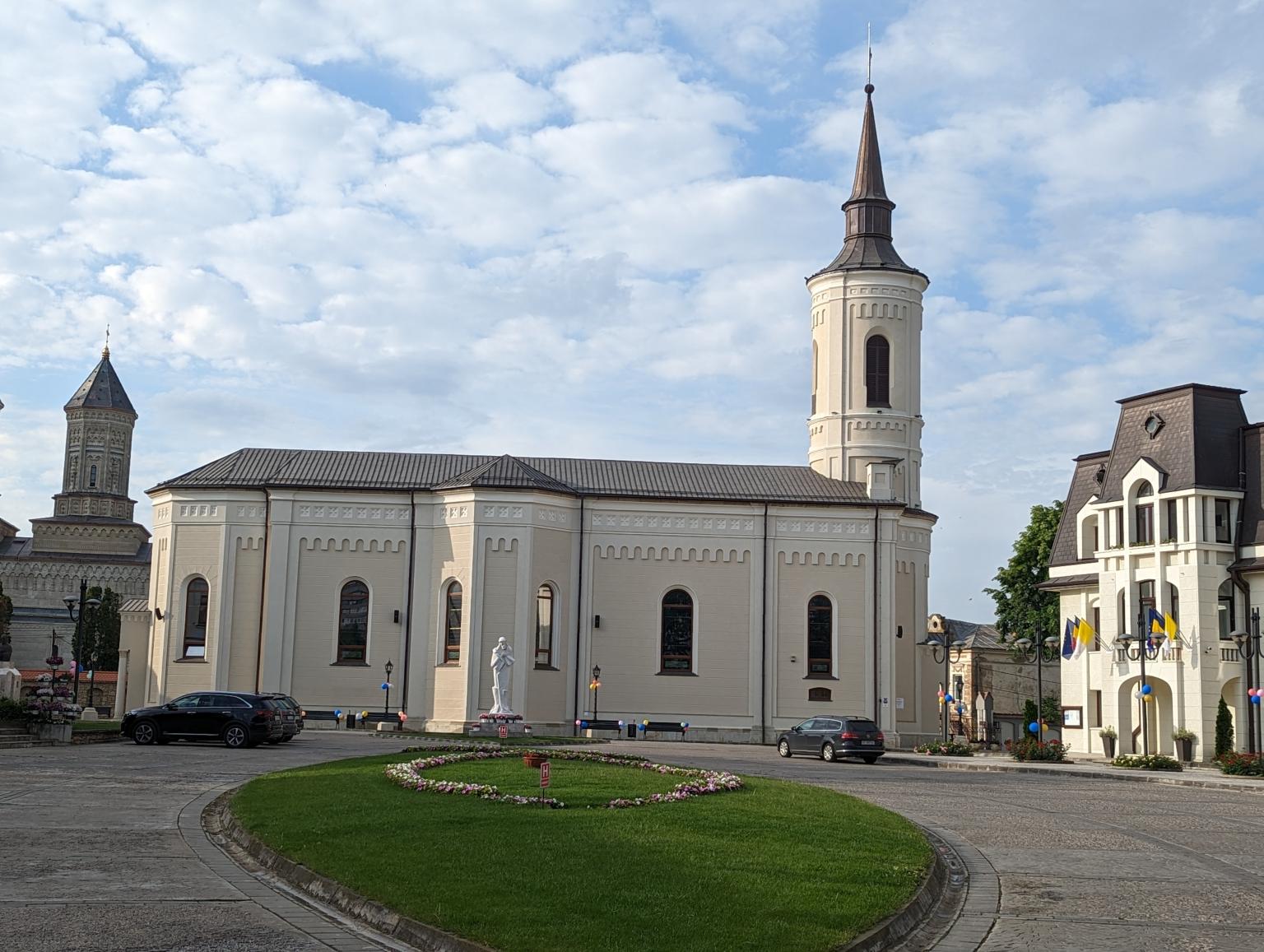
The city of Iași has been, over time, a place with a special attraction for foreign travelers, merchants, missionaries, but also for artists and people of culture. Their impressions have varied from admiration to criticism, but all have noted its special character. Nicolae Iorga summarizes this specific identity by stating that “Iași is, above all, a church, the church of churches for our past”. The settlement, born as a typical rural community, located in a contact area between forest and field, on the lower terrace of the Bahlui River, naturally evolved towards urbanization due to its favorable location. The place became an attractive center for craftsmen and merchants, stimulating a significant demographic development and forming, over time, a stable local market.
The first documentary mention of the city of Iași is found in a list of Moldavian cities in the oldest Russian chronicles, compiled between 1388 and 1391. The second reference appears in 1408, in a privilege granted to merchants from Lviv. Regarding the core of urban settlement in the 14th-15th centuries, the hypotheses are diverse, but there is a consensus that the "guests", namely the colonists of the Catholic and Armenian confessions, were settled on the outskirts of the city at that time. The Catholics would have settled in the area behind the current metropolis, while the Armenians in the northeastern part of the old market.
This conclusion contradicts the idea that the princely court would have been the center of the city from the beginning. Archaeological research started in 1990, around the Roman Catholic church "Adormirea Maicii Domnului" and in other areas on the western edge of the city, supported the hypothesis that this area represented the original nucleus of the urban settlement. Along a distance of 500-600 meters, five churches are found, including the Roman Catholic one, with entrances oriented towards the slope, indicating the existence of the old Ulița Ciubotărești. In the 14th-15th centuries, the settlement extended from the east of the Catholic property inland, without extending towards the "Sf. Nicolae Domnesc" monastery and the princely court. On the southern side of the site, town houses were discovered, but the research cannot determine with certainty whether they belonged to the Catholic settlers, since the southern limit of the site has not yet been defined.
To date, no independent work has been published on the history of the Catholic Church in Iași. References to it appear only tangentially in works on the Catholic Church in Moldavia or in volumes discussing other important monuments in the vicinity, such as the old Metropolis or the "Trei Ierarhi" church. There are no precise dates on the founding of the "Assumption of the Virgin Mary" church, but it is known that the rulers of Moldavia in the second half of the 14th century supported urbanization, inviting settlers from Transylvania, Poland and other European regions affected by calamities.
The Catholics of Iași received, like other settlers, a plot of land in the southwestern part of the city. The tradition regarding the antiquity of the Catholic place of worship is mentioned in documents as early as the 18th century. In 1753, Prince Matei Ghica argued the Franciscans’ right to build a stone church by the fact that they had churches in Moldavia “from the bottom of the country”. In 1815, Prince Scarlat Alexandru Callimachi called this place “of the Hungarian Church”. In 1663, Bishop Rudzinski reported that the Iași church had been built by Margareta. The historian Sulzer attributed its construction to Prince Lațcu Vodă. The records of the University of Krakow, where students originally from Iași appear at the end of the 15th century, demonstrate the existence of a wealthy Catholic community.
In the absence of written documents, archaeology provides important answers. Due to the limitations imposed on research, it was carried out only on the southern and partially eastern sides of the church. The existence of a cultural layer from the last decades of the 14th century and the beginning of the following century, associated with specific urban dwellings, was found. At the same time, the church cemetery was delimited from the mission farm and the townspeople's homes. The oldest homes were identified on the south and east sides, built of oak beams, with deep foundations, typical of medieval Moldavian towns. The discovered inventory, consisting of tiles, pots and common ceramics, along with a coin issued by Vladislav Iagello, confirms the dating to the 14th century.
Therefore, one can talk about a “place of Catholics” since the 15th century. The presence of houses, workshops and shops suggests a stable community of Roman Catholic confession. However, the specialized literature has minimized the age of this church. Written information about the building appears only in the context of the Counter-Reformation, when Catholic missionaries begin to travel to the Romanian Lands. The first internal documents mention the “Hungarian” church in 1629. Therefore, archaeological research remains essential for dispelling myths and confirming the existence of the first Roman Catholic place.
In the 16th century, Iași gradually becomes the capital of Moldova, which attracts craftsmen and merchants from neighboring Catholic countries or from declining cities. This influx reinvigorates the already existing Catholic community. The habitation on the “place of the Catholics” is well documented for the 16th-17th centuries, and the related cemetery was intensively used, with several layers of overlapping graves, dated by the discovered coins. These confirm a large community, religiously active and capable of erecting a new stone shrine, which suggests continuity and stability.
The foundations of this new shrine, with depths between 2.50 and 2.70 m, indicate walls of considerable height. Also, the lower part of the elevation, probably the plinth, was preserved at a height of 35-40 cm. These foundations were used to build a later church on the same site. Although the research is not complete, it can be said, with caution, that this church was built in the first decades of the 16th century.
We have no written information about this building until 1586, when the Jesuit Giulio Mancinelli visited Iași and found the Catholic church desecrated by Lutherans, and the community, devoid of priests, partially converted to Orthodoxy or Lutheranism. In the same year, the apostolic visitor Alexandru Komulovia convened a synod in Iași and obtained the support of Prince Petru Șchiopul and his advisor for the Roman Catholic Church. In 1597, Bishop Bernardino Quirini mentioned that he was hosted in the parish house, which indicates a good state of the parish. In 1606, an Italian monk stated that there were two wooden Catholic churches, but both in poor condition. However, this statement is not fully confirmed. In 1620, the missionary Andrei Bogoslavie noted that there was only one Catholic church in Iași, dedicated to the Holy Virgin.
Thus, the history of the "Assumption of the Virgin Mary" church in Iași is shaped by a combination of oral traditions, fragmentary documentary sources and archaeological research. From its beginnings in the 14th century, as part of a community of Catholic settlers, to its consolidation in the 16th-17th centuries, this place of worship reflects not only the religious history of the city, but also the process of urban formation and evolution of medieval Iași.
Sursa: amdis.ro