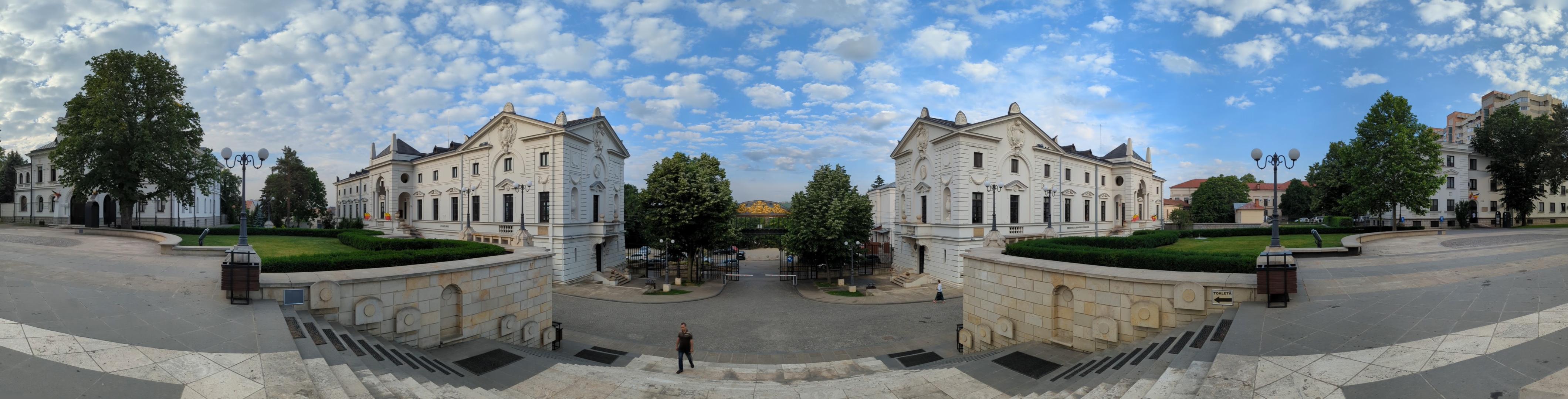
In the courtyard of the Metropolitan Complex, facing the street, the statue of Gavriil Musicescu, created by the artist Milița Petrașcu, and the fountain cast in cast iron, according to the plans of Carol Mihalik de Hodocin, stand out.
On the other hand, the Complex is dominated by the Metropolitan Cathedral, the largest church building in the country, initiated by the efforts of Metropolitan Veniamin Costache, approximately on the site of the Stratenia church, the former Metropolitanate of Moldova in the 17th century.
Veniamin Costache (1768-1846), Metropolitan of Moldavia (1803-1808 and 1812-1842), was a highly cultured personality, supporter of the establishment of schools in the Romanian language and of Eteria.
Work on the Mitropolia building began in 1833 under the guidance of the Austrian architects Freiwald and Bucher, continued with the architect Singurov and was completed in 1887 under the guidance of the Romanian architect Al. Orăscu, with a possible contribution from Gh. Asachi in the first stage.
In 1839, when the cathedral was almost completed, due to a construction error, the great dome fell and vertical cracks formed in the walls. Attempts at repair failed and construction was abandoned.
In 1880, at the initiative of M. Kogălniceanu, the restoration works were resumed, completed in April 1887.
The building, with the interior treated as a unitary space, has a rectangular shape, with a tower at each of the four corners.
The architectural style of the building is eclectic, reflecting the trends in European architecture of the 19th century, but the preponderance of the forms of French school academism is highlighted.
Painted in an academic style by Gh. Tattarescu, the interior of the church was made with attention to significant details. Gh. Tattarescu (1820-1894), recognized alongside Th. Aman, as the founder of Romanian artistic education, stands out for his prolific creativity. He painted allegorical compositions with revolutionary themes ("Deșteptatea României") or patriotic ("Unirea Principatelor"), portraits of notable personalities ("Nicolae Bălcescu"), genre portraits ("țărancă din Vlașca"), as well as landscapes with a strong realistic character ("Dâmbovicioara Cave"), including church works.
In the immediate vicinity of the Metropolitan Church is the Metropolitan Palace, built on the site of the old residences of the Metropolitan of Moldova and completed in 1901. From the old construction, dating from 1794, only the chapel survived.
Next to this building, closer to the street, stands the Church of St. George, built in 1761 on the initiative of Metropolitan Gavril Caliman. Starting in 1766, it functioned as a metropolitan cathedral until 1880, when the current building of the Metropolitanate of Moldavia was inaugurated. Known today as the "Old Metropolis," the church rarely serves as a place of worship, being preserved as a historical monument.
The plan of the church, composed of nave, nave and altar, preceded by a porch, is distinguished by the fact that the lateral apses are integrated into the thickening of the masonry, similar to the Golia church.
Following a severe fire in 1827, the upper part of the church, including the original spiers and vaults, was destroyed. The walls remained only up to the cornice, being covered by a simple and low structure, inside corresponding to a straight ceiling. With the dividing arches between nave and nave lost in the fire, the interior of the church now presents the appearance of a single nave.
The triangular pediments that delimit the roof were made in the 19th century, under the aesthetic influence of Russian classicism.
The facades of the church are richly enriched, presenting a wide variety of stone-built elements: pilasters with Neo-Corinthian capitals, a girdle composed of a twisted rope, and window frames decorated with floral carvings similar to those used at the time both in Russia , as well as in Wallachia. The catapeteasma, in baroque style, stands out for its special beauty.
Source: Iași Municipality and surroundings (Ministry of Tourism, 1980)