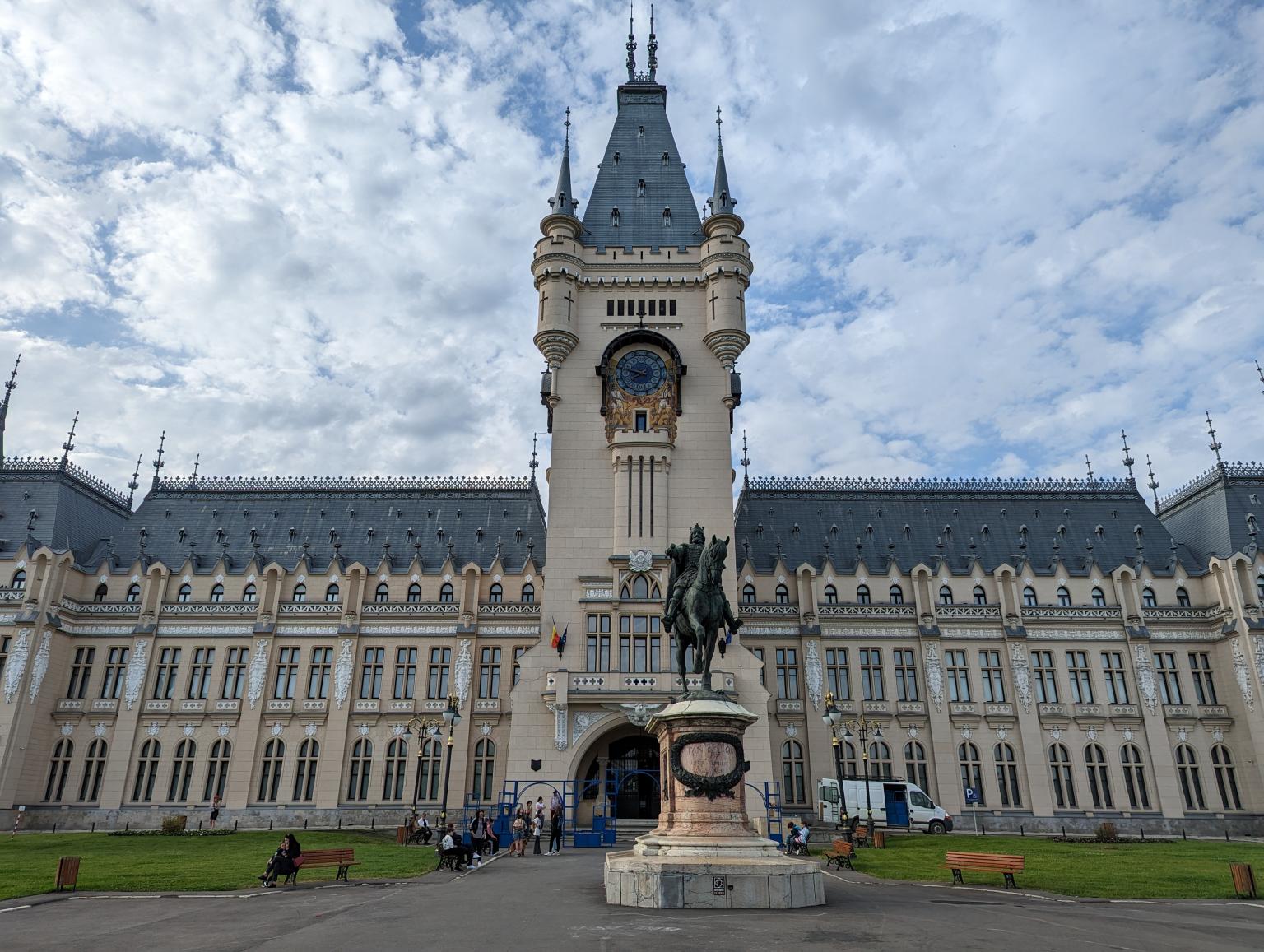
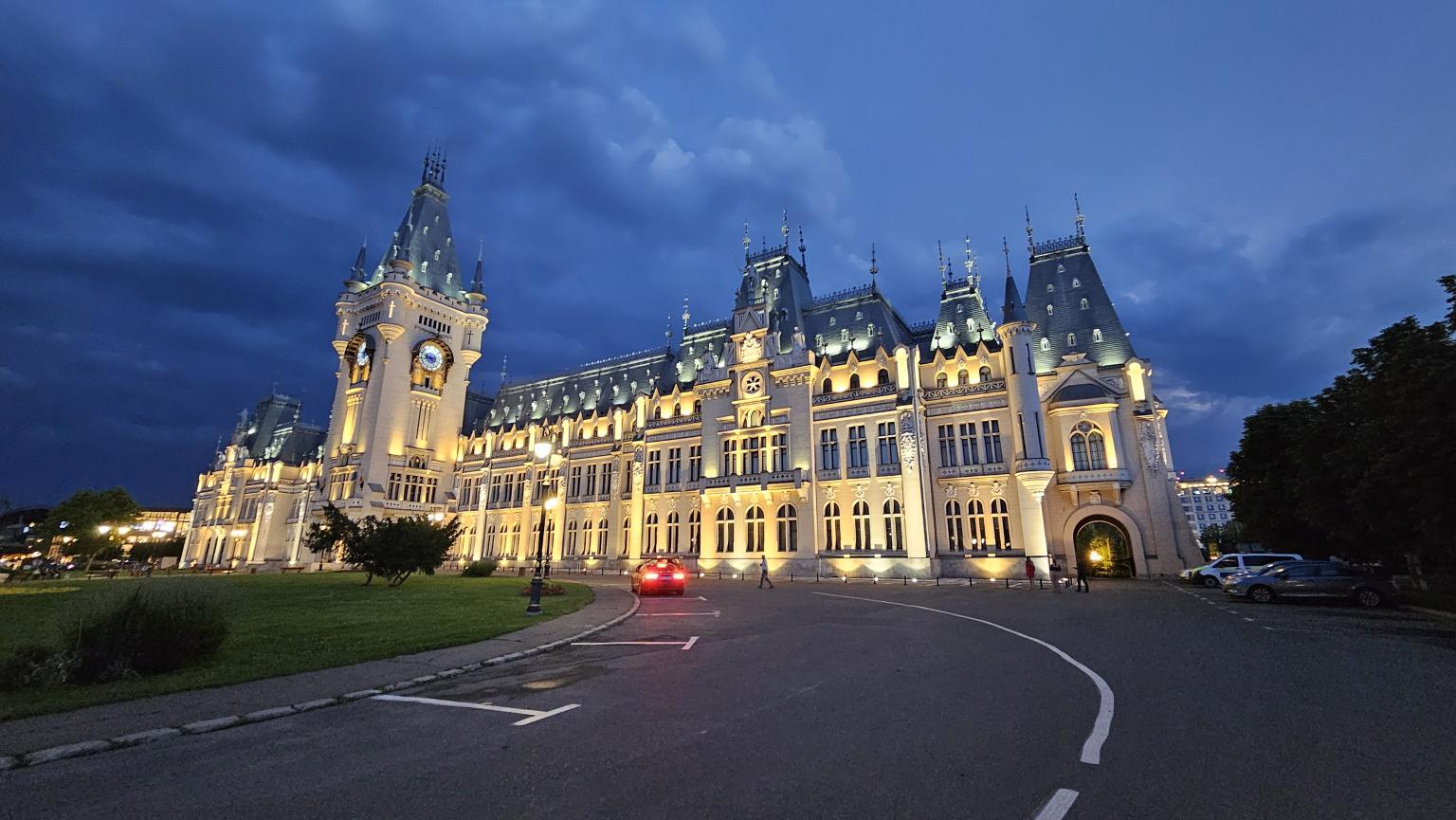
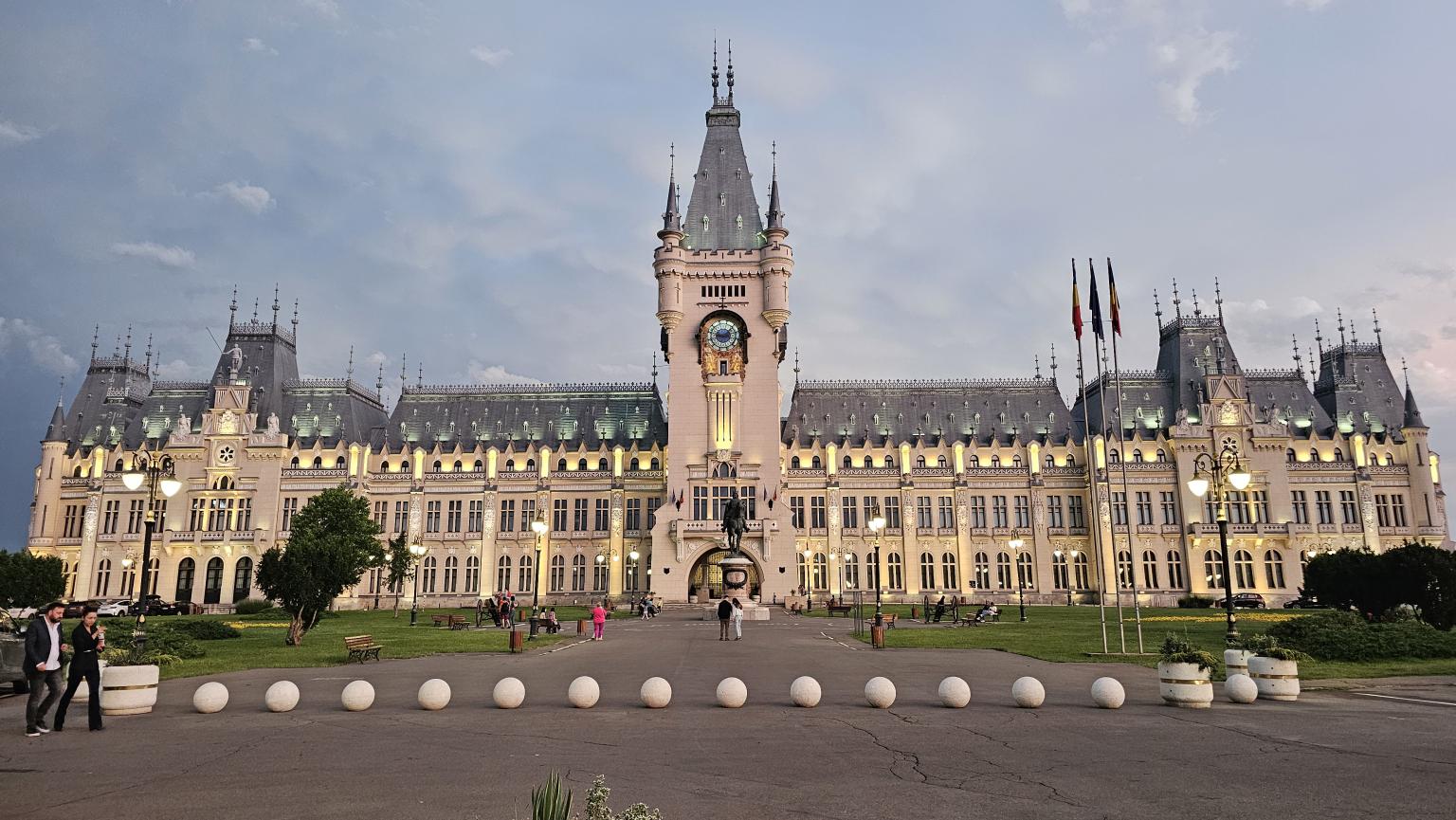
Piața Palatului is located at the intersection of Ștefan cel Mare, Palatului and Anastasie Panu streets. The Palace of Culture, the most imposing edifice of the city, present on the emblem of the city of Iași, was built on the site of the old Royal Court.
The princely court is mentioned in documents from October 18, 1434, there is evidence that it dates from the period of Alexander the Good. The details about the courtyard until the reconstruction carried out by Vasile Lupu are few. It seems to have been surrounded by walls several times, like a fortress, to defend against invaders. On the eastern and southeastern sides, it was accompanied by a pond fed with water from Bahlui, while on the northern and western directions, it was protected by a deep water-filled ditch, an earthen rampart, and a palisade. A connection between the city and the court was provided by boats, later passing over a movable bridge or a fixed one, which, in situations of danger, could be easily defended or opened.
Although it was solidly fortified, the Princely Court was affected by numerous enemy attacks or fires, which sometimes led to its complete destruction. Thus, in 1491, it was devastated by a strong fire, the same happened in 1725, 1753 and 1784.
During the reign of Vasile Lupu, the Royal Court went through an extensive restoration process, acquiring a remarkable brilliance. All foreign travelers who visited Iași at that time were impressed by the beauty of the buildings and the splendor of the courtyard. The chroniclers report that the constructions made by Vasile Lupu were "beautiful and open". Grigore Ghica (1726-1733) continued these works, adding new constructions.
In 1795, Voivode Alexandru Calimachi decided to stop using the buildings of the Royal Court due to their deterioration. For financial reasons, he approved the purchase of the houses of Costache Ghica and Lupul Balas, near the Church of St. Spiridon, to be used in the royal administration. From that moment, the old complex was called "Curtea veche" or "Curtea gospod cel vechi".
Between 1802-1806, under the command of Alex. Moruzzi, the architect Johann Freiwald oversaw the restoration of the Princely Court. Even after this renovation, the Royal Court remained the most important and beautiful building in the city.
However, in 1827 a fire caused significant damage, destroying it almost entirely, along with almost the entire archive.
In 1843, the reconstruction of the courtyard was completed, and the house was kept for the gentlemen and later for the Caimaicans of Moldavia.
On January 5, 1859, Alex. I. Cuza was elected ruler of Moldavia in this palace, now known as "the one of governance".
The palace, properly neglected, suffered damage, including from the fire of 1880. In 1883, a superficial repair was carried out during the unveiling of the statue of Stephen the Great, placed in front of the main entrance. The General Court, the Court of Appeal, the Prosecutor's Office, the Prefecture, the Post Office and the Telegraph moved to the palace.
Another serious fire damaged the building, prompting the decision to demolish it.
The architect Ion D. Berindei (1871-1928) was given the responsibility of drawing up the plans for the new edifice, built in the flamboyant Neo-Gothic style, as it is presented today.
The construction of the new palace took place between 1906 and 1925, being significantly delayed by the First World War.
Stylistically, the current Palace of Culture no longer bears any resemblance to the old palace of the Royal Court, which, despite the changes it underwent over the centuries, maintains traditional characteristics specific to native architecture. Therefore, the construction erected between 1906-1925 should not be seen as a restoration of the old one, but as a completely different construction located on the same land.
It is obvious that, at present, the Palace of Culture in Iasi impresses with its monumentality, admirably emphasized by the surrounding space.
Between 1925-1955, the building was intended as an "Administrative Palace", housing the County Prefecture and the courts.
Since 1955, its destination has evolved, turning into the Palace of Culture, where it houses some of the most important museums of the country, as well as various cultural institutions (Municipal Library "Gh. Asachi", Editorial office of the magazine "Convorbiri literare", etc. ).
The Iași Art Museum represents the oldest state art gallery in Romania.
Inaugurated on October 26, 1860, in tandem with the first modern Romanian university, the Pinacoteca in Iasi is also the oldest museum within the Iesian Museum Complex. At the inauguration ceremony, held in the old university building, ruler Al.I. Cuza himself participated, accompanied by high dignitaries of the state, led by M. Kogălniceanu.
The first director of the Pinacoteca, later named in 1865 "National Pinacoteca din Iasi", was Gheorghe Panaiteanu-Bardasare, a painter and energetic promoter of artistic life in Iasi in the second half of the last century.
Since its inception, the Pinacoteca has been constantly looking for its own location with suitable exhibition conditions. In 1860, it was opened in the old University building; in 1979, it moved to the houses of Constantin Theodor Ghica from Copou, but after 12 years, in 1891, it changed its headquarters again, moving to the place of the former central girls' school on Nicolae Bălcescu Street and then to the former building of the Michael Academy. At the Palace of Culture, the Iasi Art Museum was inaugurated on May 1, 1957.
The History Museum of Moldova, successor of the old Museum of Archeology established in Iași in 1916, offers a synthetic presentation of the history of Moldova, starting from the earliest times to the present day, as an integral part of Romania's history.
The exhibition dedicated to ancient and pre-feudal history brings to the public the main aspects of the evolution of the human communities that lived on the territory of Moldova from the Paleolithic to the pre-feudal period (6th-10th centuries).
The History Museum of Moldova aims to highlight the fundamental aspects of the economic, social-political and cultural development of this historical province, emphasizing its contribution to the unitary history of the Romanian people over the centuries.
The Ethnographic Museum of Moldova, founded in 1943, was opened to the public in 1958 and is today recognized as one of the most distinguished institutions of its kind in the country.
Initially, with a limited collection of about 400 pieces, which served exclusively as teaching material for students and without its own premises, in 1955 the museum received an adequate space in the Palace of Culture, thus facilitating the carrying out of the activity in optimal conditions.
The museum's collections, consistent with its name, come from the entire territory of Moldova and cover the entire province, illustrating specific and interesting aspects of material and spiritual culture. The exhibition is structured on the basis of ethnographic phenomena (traditional occupations, crafts, customs, etc.) presented in their historical evolution.
The Polytechnic Museum of Iasi, established in 1955, was opened to the public on March 1, 1961, debuting with its first "Energy" section. In February 1966, the "Sound Recording and Reproduction" section was inaugurated, which later expanded in 1972 to three times the size, including the "Telecommunications" section.
The "Energetics" section offers a detailed presentation of the evolution of the means of production and use of various forms of energy, from ancient times to the present, with the help of functional models, original exhibits and graphics. The exhibition materials are organized by sector, covering fields such as hydraulic, wind, thermal, solar, tidal, electric and atomic energy.
In front of the main entrance of the palace is the sculpture of Stephen the Great, made by the famous French artist Emmanuel Frémiet. The monument was officially inaugurated on June 3, 1883, amidst the fervent enthusiasm of the participants.
Emmanuel Frémiet (1824-1910) is known for his many famous statues in Paris, including that of Jeanne d'Arc, and in other major Western cities.
The work offered to Iasi by the talented sculptor is full of inspiration, created with love and passion. However, they do not strictly follow dates and traditions; thus, they give the voivode a beard unknown in history, place him on a horse whose type has never been seen in Moldova, and place the crown on his head and the chlamys on his shoulders, items worn by the lord only on festive days, despite the fact that the moment represented is solemn, in the context of the marching band leader's fearless energy.
The statue stands on a red marble plinth, with two carved bas-reliefs on the sides, which illustrate scenes from Stephen the Great's battles in the legendary Red Dumbrava Forest and the White Valley. It is flanked by two cannons used by Romanian soldiers in the 1877 War of Independence.
The event of the unveiling of the statue took place on June 5, 1883. In the morning, the inhabitants of Iași went to the square to occupy seats in the first row. A canopy adorned with red velvet and blue atlas drapes was placed around Stephen the Great's throne on one side of the statue. The unveiling was carried out by four men, while the guns fired 21 volleys. After the laudatory speech of B.P. Hașdeu, the choirs sang the "Soldier's Song" composed by T. Burada, on an old text which, according to the legend, was created by the gentleman himself. Among the crowns deposited at the monument, a wooden one stood out, later cast in bronze and fixed on the statue's pedestal. This is the crown that can still be seen today, engraved with the years of Stephen the Great's battles and the names of the counties that sent representatives to the inauguration of the monument.
Source: Iași Municipality and surroundings (Ministry of Tourism, 1980)