From near Pieța Palatului (located on Anastasie Panu street), this street emerges named after the Moldavian ruler Grigore Ghica III, whose days were tragically ended in the buildings of the beilich of that time, located in this former Iesian street.
The construction of the beilik in Iași had its origin in the measures taken by the reign to accommodate the Turkish envoys sent to Iași or in transit through the city, a considerable number of them appearing starting from the 18th century. Until then, these Turkish envoys and other foreign dignitaries were housed in some noble or merchant houses, and more rarely, in monasteries.
Because of some unpleasant "incidents" that often arose between the Turks and their hosts, the lordship decided to build a special building for them to prevent such conflicts.
Within the walls of the castle, one of the most tragic dramas in the history of Moldova took place: the beheading of Grigore Ghica Vodă by the Turks. This gentleman of Moldavia refused to send wheat and timber to the High Porte, protesting against the violation of the integrity of Moldavia by Austria, with Turkish approval.
The gentleman was summoned to the beilic, cunningly, on the pretext that the envoy of the Turks, Kara Hisarli Ahmed Bei, was ill and could not come to court to convey news from Istanbul to him.
Based on the statements made, the gentleman headed towards the battle accompanied by a small guard. He was captured and killed, and his head was shipped to Istanbul, where it was displayed for three days at the second gate of the Serai, bearing an inscription accusing him of treason. His body, thrown out of the window in the bellic garden, was discreetly recovered by the ruler's wife and his relatives, being buried at the church of St. Spyridon.
The statue of Grigore Ghica Vodă, erected in 1876, can be found in the small park set up on the site of the old houses of the bellicose.
Grigore Ghica III led Moldova in the periods 1764-1767 and 1774-1777, as well as Wallachia between 1768-1769. During his reign, he developed a fiscal legislation and a regulation on the salaries of civil servants, with the aim of limiting their abuses. In 1766, he established a factory in Chiperești.
The ruler's bust, made in marble by Lucretia Filioreanu, is on a marble column bought in Lvov (Lemberg), serving as a plinth. This bust replaces the original, exhibited in the Art Museum of the Palace of Culture, a creation of the Romanian sculptor Karl Störck.
The unveiling of the statue on October 1, 1876 was marked by an emotional ceremony, which was attended by numerous Iesians, personalities from the whole country and foreign delegates.
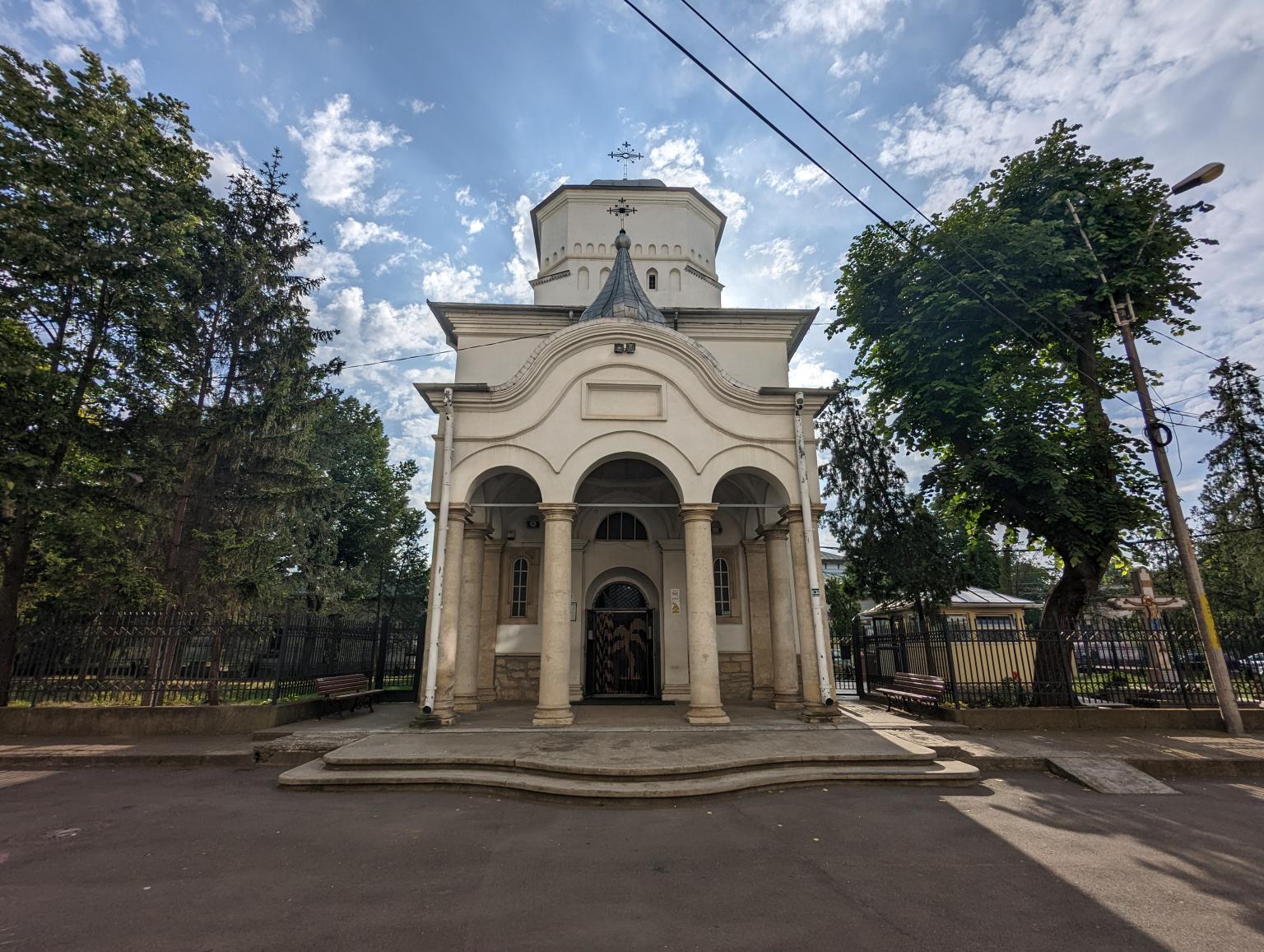
In the immediate vicinity of this small park, at address 26, is the Barnovschi Church, built in 1627 by ruler Miron Barnovschi.
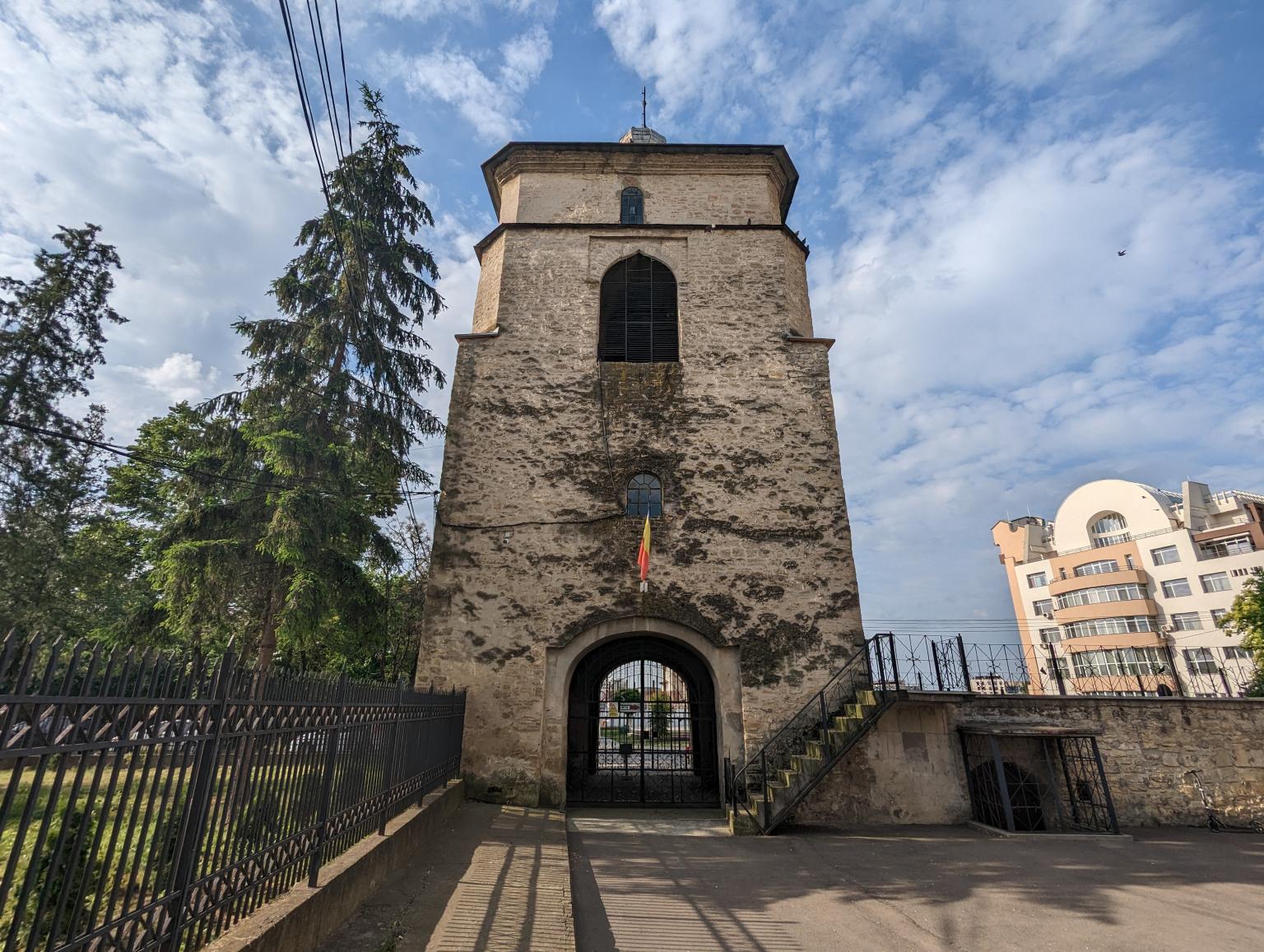
Of the ensemble of old buildings, the only remaining elements are the church and the bell tower. The present parsonage was built at a later time.
Although the architecture of this church resembles that of churches in Moldova, it brings new elements, characterized by the exceptional solidity of the walls and the desire to create a unitary volume, in which only the apse of the altar stands out.
The plan of the monument is similar to that of the Dragomirna monastery church. Originally, the church had an open porch with arches supported on pillars, a vaulted nave with a spherical dome and a raised nave with a traditional Moldavian spire, raised on pied arches.
Later, the porch was closed, a fortified-looking tower was built above it, and a new spire with a large diameter, unusual in Moldavian architecture, was added to the nave.
The external details include two rows of carved bands in the wall, delimiting unornamented areas where the windows were dug, with carved frames according to Moldavian Gothic traditions.
The belfry, the old entrance tower to the churchyard, appears less massive, evolving from a square section at the bottom to an octagonal section at the level of the belfries, where large gaps are opened.
The parish house, according to assumptions, would be the result of the restoration of an earlier building in the first part of the 19th century. The new edifice preserved the old foundations and cellars.
Miron Barnovschi was ruler in Moldova between 1626-1629 and in 1633, having origins in the Movilă family. He implemented social, fiscal and administrative reforms and contributed to the establishment of some monasteries (Bârnova near Iași, Hangu), also completing the construction of some monasteries (Dragomirna) and churches (Barnovschi and St. John in Iași). He was executed by the Turks in Constantinople by beheading.
According to Neculce's chronicles, when the ruler's head was cut off, his horse jumped so much that the rein was released from the hand of the one holding it. After escaping from the reins, the horse fell and died on the spot. The Turks interpreted this incident as a divine sign. They regretted what they had done and decided not to execute any Moldavian rulers in the future.
However, as previously highlighted, the Turks did not keep the promise, killing Grigore Ghica Vodă in the same way, 150 years later.
It is believed that the chronicler Neculai Costin (1660-1712), son of Miron Costin, is buried in this church.
Source: Iași Municipality and surroundings (Ministry of Tourism, 1980)