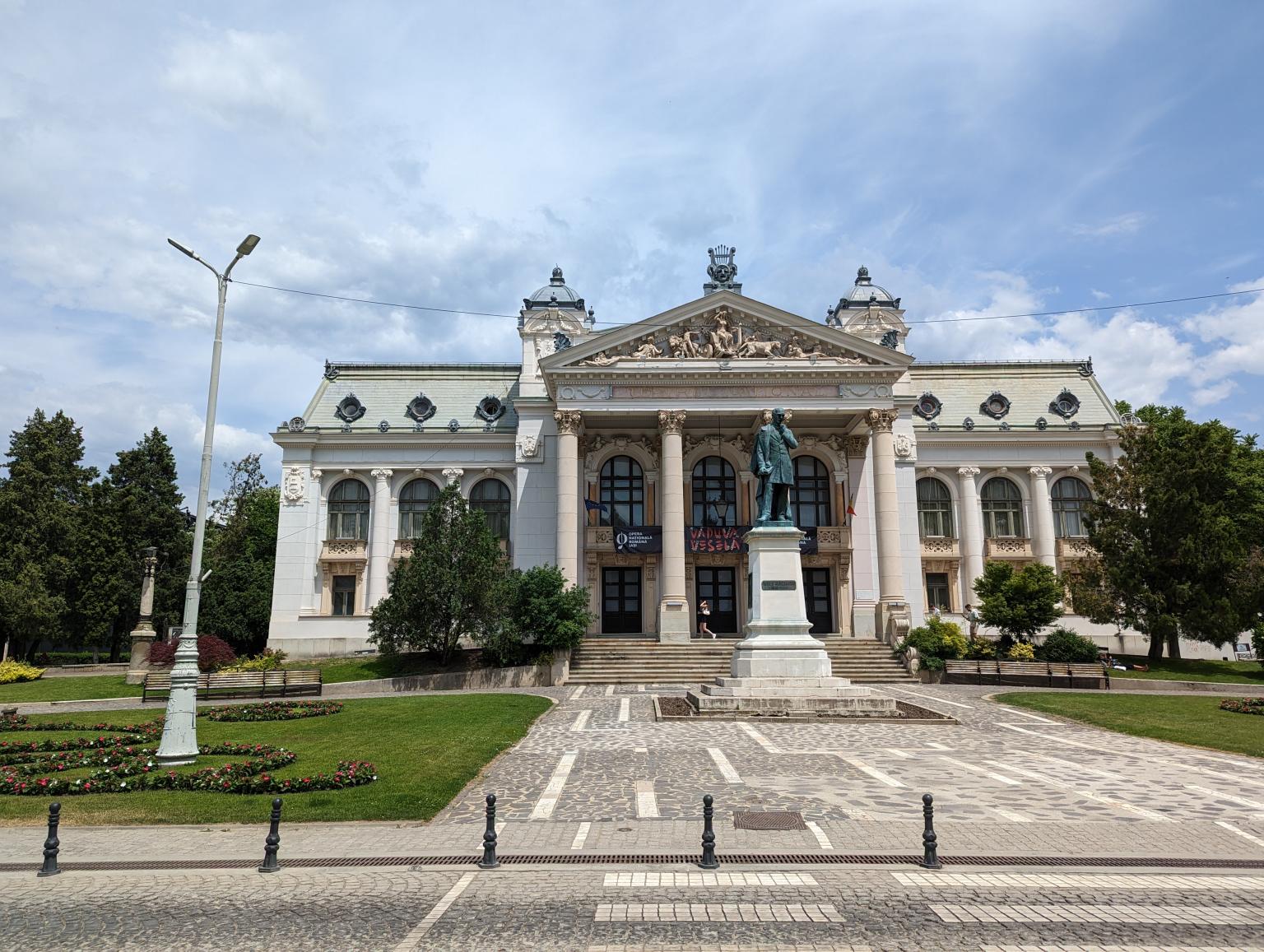
The "Vasile Alecsandri" National Theater was opened on December 1, 1896 and was built according to the projects of the Viennese architects Pellner and Helmer. With a capacity of 900 seats and outstanding acoustics, the performance hall of the theater in Iași impresses with its rich baroque ornamentation, creating an atmosphere of enchantment, elegance and intimacy at the same time, being considered one of the most successful in the country.
On December 27, 1916, Gh. Asachi made his debut in the organization of the first play in the Romanian language ("Mirtil și Hloe", a pastoral in one act adapted by Asachi after Gessner and Florian) in the houses of the hetman Costachi Ghica, located opposite of the Metropolis. This event is recognized as the birthday of the cult Romanian theater in Moldova.
By presenting the show in Romanian, Gh. Asachi introduced a novelty: the actors appeared in national costumes. The traditional language and clothing had the impact of rousing the small public, including notable supporters of Asachi's initiative, such as the metropolitan and scholar Veniamin Costache and the postman Al. Beldiman, one of the first translators of plays into Romanian.
After the debut with "Mirtil and Hloe", young people from Moldova continued to get involved in various occasional performances, and in 1813 the first theatrical events took place. There is evidence of the existence of a theater in Iasi in 1819, probably a private theater set up in a noble house.
For a decade and a half, between 1819 and 1834, there was no information about performances in Romanian in Iasi; instead, there were accounts of foreign bands touring during this period. Iasi was an important cultural center, attracting various artistic formations, from theater and opera to acrobats, trainers and illusionists traveling between Western and Eastern Europe.
In 1834, performances in Romanian were resumed and took place in a theater built in 1832 by the architect Freiwald, at the request of the Fouraux brothers, in the Talpan buildings. This hall was known as the "Théâtre des variétés" (Theatre of Varieties). On August 26, 1834, amateurs under the care of Asachi presented the play "Dragoș, the first sovereign lord of Moldavia" in the Variety Theater, a heroic drama based on historical facts. A few months later, on November 8, the students of the "Quenim" pension staged the "Soldier's Celebration", with the 20-year-old Matei Millo, later a famous actor, as the author and main performer.
On November 15, 1836, thanks to the efforts of Gh. Asachi, the Philharmonic and Dramatic Conservatory was established in Iasi, initially as a more private school, then subsidized by the state. The school's management committee consisted of Stefan Catargi, Vasile Alecsandri (the poet's father) and Gh. Asachi. It was, in fact, the first theater school in Moldova, providing the stage with increasingly well-trained actors. The conservatory operated until 1839, when, due to financial problems, it had to stop its activity.
The cessation of the activity of the Conservatory brought the theater from Iași to a very critical situation, with Moldova close to being left without performances in the Romanian language. In those difficult times for the theater in Moldova, Milcovul passed through Iași, bringing with him the actor Costache Caragiale, a graduate of the Bucharest Philharmonic Theater School. Thanks to his efforts, the Iași theater experienced great success in the 1939-1940 season. Thus, the enthusiasm returned among the students, who gathered around C. Caragiale and founded an association led by Teodor Stamati, professor of physics and philosophy at the Michael Academy.
During this period, comedies, either original or translated, dominated the stage and prepared the ground for the appearance of Alecsandri's satirical theater.
Starting from 1940 to 1843, the management of the Romanian theater in Iasi was taken over by Costachi Negruzzi, Mihail Kogălniceanu and Vasile Alecsandri, who, by contract with the government, united the activities of the French and Romanian theater troupes. In that year, the Romanian troupe, led by C. Caragiale, staged Alecsandri's comedy "The Pharmacist in Hârlău", and between 1844 and 1849, they staged other plays by the same author ("Iorgu de la Sadagura", "Iașii in carnival") or by C. Caragiale ("A Moldovan Rehearsal") and Alecu Russo ("The Ambitious Groceries" and "Jignicerul Vadră").
Since the old location of the "Variety Theater" had become too small and technically unsuitable for the numerous performances staged, on December 22, 1846, the Great Theater of Copou was inaugurated, in one of the buildings made available for this purpose by ruler Mihail Sturza and properly furnished by the architect Costinescu. This marked the period when the Moldavian theater scene, guided and supported by the main leaders of the revolution of 1848, became involved in the revolutionary movement and later in the unification movement.
The building was used as a theater until February 17, 1888, when it was completely destroyed in a devastating fire. During the reconstruction period (1896), theatrical performances in Iasi took place in the Pastia hall (Traian Hotel) or in the Sidoli circus hall.
After the revolution of 1848, for more than three decades, the stage of the Iași theater was supported by two outstanding actors: Matei Millo and Mihail Pascaly.
Matei Millo (1814-1896), playwright and outstanding personality in the theater world, professor at the Conservatory in Iași, is recognized as the founder of the realistic style in Romanian theater. As an actor, Millo shone in the roles of his own plays, performed in travesties in an established way, thus establishing a tradition. The characters were Chirița, Baba Hârca and mother Anghelușa
passed down from generation to generation in the manner created by Millo, and their traditional interpretation has been maintained to this day. In his natural, rich and spontaneous comical genre and talent, some dramatic critics compared him to the great French actors Geoffroy, Lhéritier and Hyacinthe.
Mihail Pascaly (1830-1882), a student of Costache Caragiale, was an important representative of the romantic current in Romanian theatre. M. Pascaly perceived the theater as a continuous battle for noble values, for beauty and for the triumph of noble ideals, dedicating itself to the cultivation of exceptional characters. In addition, he became the first Romanian actor to play the role of Hamlet and established himself as the first performer of the first significant romantic historical drama in Romanian dramaturgy, "Răzvan și Vidra" by B.P. Hasdeu.
The names of many actors and actresses who penetrated deeply into Romanian drama are associated with the stage of the National Theater in Iași, thanks to their interpretive style that created immortal pages.
Mathilda Pascaly (1834-1973), the life partner of the actor Mihail Pascaly, was an actress with a strong dramatic force, performing roles from Vasile Alecsandri's creations.
Grigore Manolescu, one of the great actors of the Romanian theater, along with Aristizza Romanescu, opened the way for modern interpretative art. In Iasi, he performed on stage in 1375 and in the period after the Copou disaster (1888-1899).
Mihai Galini (?-1397), actor and professor at the Conservatory of Music and Dramatic Art, was only present on the Iași stage during his career.
Nicolae Luchian (1821-1893), famous for his unionist contribution, was both an actor and director of the theater in Iasi.
Agatha Bârsescu (1857-1933), a great tragedian, remained in the memory of the Romanian theater as a promoter of the realistic style in interpretation and was a teacher at the Conservatory in Iași.
Aristizza Romanescu (1854-1913), a renowned artist and tragedian, was one of the founders of modern interpretive theatrical art in Romania. In the period 1889-1889, after the Copou fire, she distinguished herself as G. Manolescu's partner.
Aglae Pruteanu (1866-1941), Aristizza Romanescu's follower, created a real theater school, playing over 300 roles at the "V. Alecsandri" National Theater alone.
Writers Mihail Sadoveanu, Mihai Codreanu, George Topîrceanu, Ionel Teodoreanu were directors of the theater, while renowned directors Aurel Ion Maican, Ion Sava and George Mihail Zamfirescu brought new energy to the Romanian directing movement.
The reorganization of cultural life after liberation brought a new impetus to the theater, which became the messenger of the era and the socialist reality, taking over the good traditions of the past. The National Theater in Iași has gone through a defining stage in the last decades, having an improved organizational system, superior material conditions, diversified repertoire, an extensive group of actors, permanent directors and tours both in the country and abroad.
Understanding its importance and its role as an aesthetic and civic educator of the public, the "Vasile Alecsandri" National Theater in Iași has presented, over the years, performances of high artistic and moral quality. Thus, the over 1000 performances of the famous comedy "Chirița în provincie" by Vasile Alecsandri, with the remarkable contribution of the great personality of the interpretation, Miluță Gheorghiu (1897-1971), whose over 50 years of theatrical career have established as an exemplary actor, totally dedicated to the stage and the city of Iași.
A distinct aspect in the structure of the repertoire was given, over the decades, to Romanian classical drama, from Alecsandri to the master of comedy Ion Luca Caragiale ("A lost letter"), Al. Davila ("Vlaicu Vodă"), B.P. Hașdeu ("Răzvan and Otter"), G.M. Zamfirescu ("Miss Nastasia"), Mihail Sebastian ("The Nameless Star"), Victor Ion Popa ("Tache, Ianche and Kadâr").
A special chapter in the activity of the "Vasile Alecsandri" National Theater was dedicated to the promotion of original dramaturgy and what it has more significance. Under the National Cupola, pieces signed by Horia Lovinescu ("Febre", "Petru Rareș"), Al. Mirodan ("Head of the soul sector"), Titus Popovici ("Passacaglia"), Aurel Baranga ("Rabid Lamb", "Public opinion", etc.).
Also, the National Theater was a favorable platform for local playwrights from Iași. On this prestigious stage, Andi Andrieș ("The Rose Garden"), Ion Omescu ("Winter Age" and "The Sagittarius"), Mircea Radu Iacoban ("Tango la Nisa") debuted as playwrights, whose creations were integrated and in the repertoire of other theaters in the country.
Source: Iași Municipality and surroundings (Ministry of Tourism, 1980)