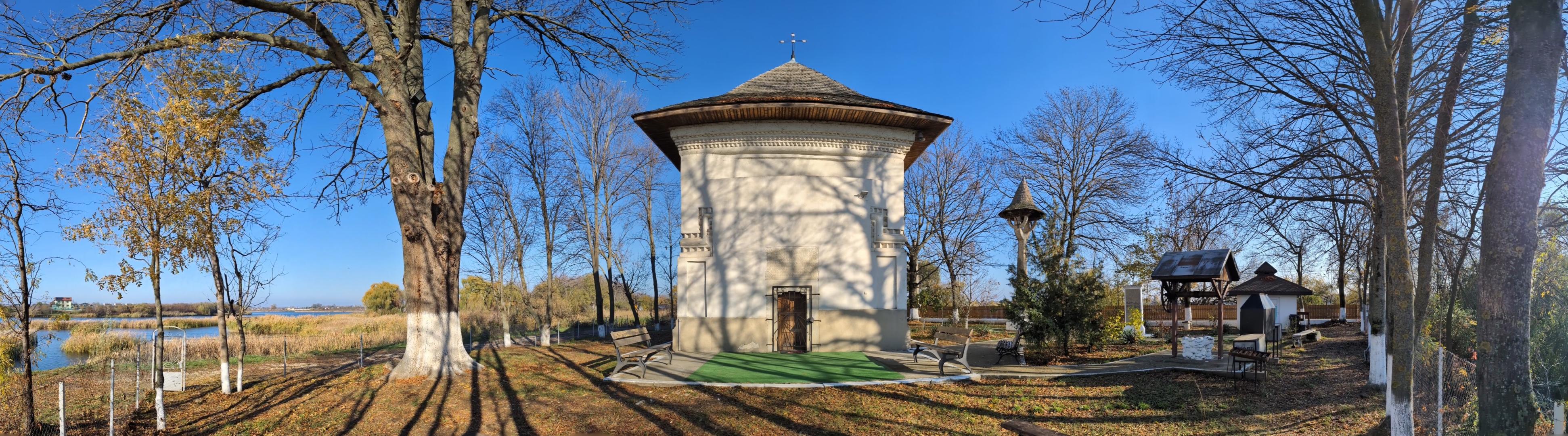
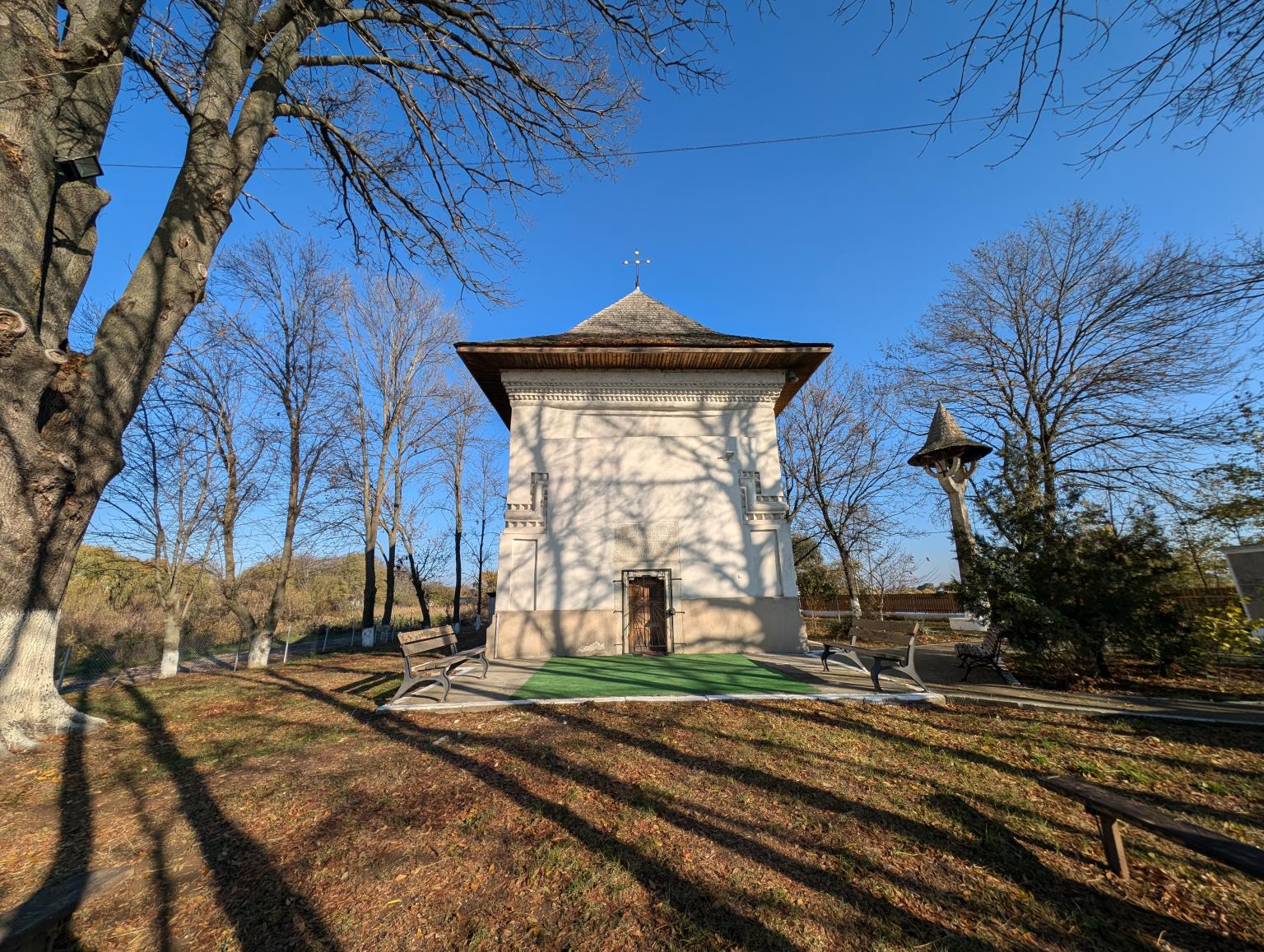
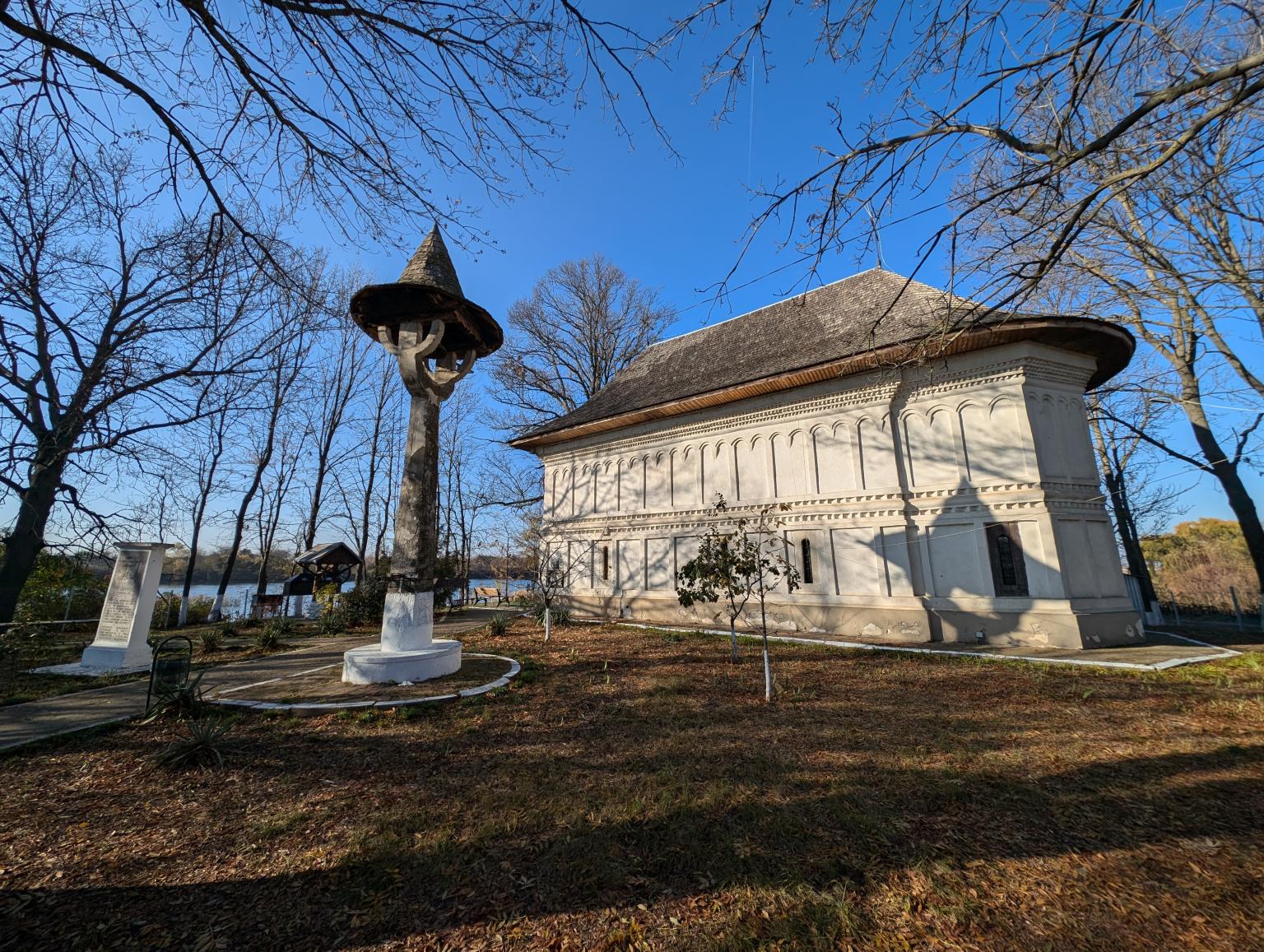
Church "St. Nicolae" from Rebegesti, now Crețulești, Mănăstirea village, Crevedia commune, Dâmbovița county, known as the "church between the waters", is a historical monument erected in 1669 by the great logofatian Radu Crețulescu and his brother Pădure Postelnicul. Located on the dike between Zmeul and Buftea lakes, the church was built to serve the community and is dedicated to Saint Nicholas.
According to the inscription on the outer wall, the church was built in honor of St. Nicholas, by Radu and Pădure Crețulescu, sons of Stan Logofătul, as a deed of alms for them and their parents, in 1669.
The church has the shape of a narrow, rectangular nave, with an apse to the east and a slate roof, typical of Moldovan churches. The windows are narrow and bordered by a pointed arch, and the architectural appearance indicates the possibility that the church is older than the date indicated on the inscription, having been restored in 1669, when the belfry was added.
The naos is separated from the altar by a wall temple and from the pronaos by a thick wall with an access door. This style of construction is similar to the one introduced in Wallachia by Vasile Lupu, and can be found in other contemporary churches, such as those in Târgoviște and Săcuieni.
The interior painting combines Byzantine style with Renaissance and Baroque influences. In the nave, the old painting is well preserved, while in the pronaos, the representations of the founders are of inferior quality. Among those painted are Padure Postelnicul and his family.
The church was one of the first to be raised in Romania, the 3.5 meter rise being necessary to avoid flooding caused by the increase in the water level of Lake Buftea, after the construction of a dam. Historian Nicolae Iorga protested against moving the church, arguing its historical and artistic value, and the solution was to raise it in its current place.
The construction of the church took place between June and October 1935, under the direction of renowned engineers, including Emil Prager. They used a complex technique of reinforced concrete and scaffolding, and details of this work were published in the French magazine "Science et Industrie".
Through these works, the church preserved its mural painting of great artistic and documentary value, managing to be protected from floods without losing its original structure.
Sursa: www.gazetadambovitei.ro