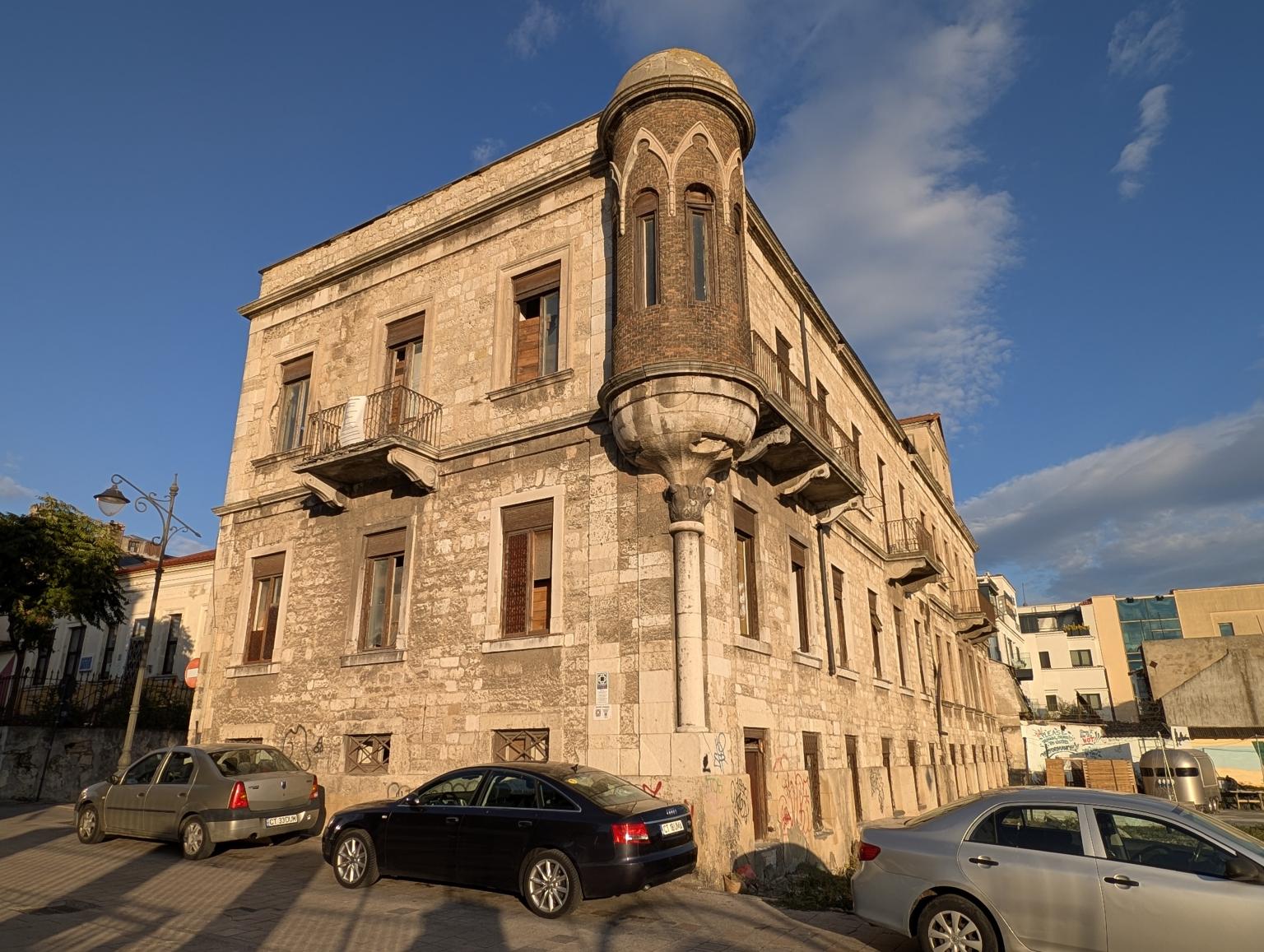
Built between 1882 and 1884, on C.A. Rosetti Street, at number 7, Casa Alleon is one of the most impressive and well-made buildings in modern Dobrogea, a building that once gave its name to the street on which it is located.
This construction represents a unique example of late 19th-century architecture in Romania, and is also a special model of Jewish cultural heritage. The building consists of a semi-basement, mezzanine, first floor and attic, with an eclectic style and a facade made of solid stone. It has two main facades, one facing the sea, on Vasile Canarache Street, and the other facing inland, on Rosetti Street.
The windows are simple, cut in the British Victorian style, and the ironwork elements do not present the detailed work, specific to the late 19th century. A detail that makes the building unique is the corner balcony made in the Venetian style, supported by a Greek column. The stone facades create the impression of a massive, almost Gothic construction, while the wide openings to the outside are reminiscent of the British model of housing. In front of the building overlooking the sea there was a small English-style garden, surrounded by low stone walls, but today this space has remained just a vacant lot.
Inside, the building was partitioned so as to offer a large number of rooms, approximately 40, without having a spacious lounge for receiving guests. The owner, although he had considerable wealth, was not interested in social life or organizing social events, but preferred to deal with his own passions and, in particular, to find places to keep his collections gathered during his numerous travels through Dobrogea.
In 1905, Casa Alleon was bought by the Dacia Romana Insurance Company, being transformed into an office building. Less than ten years later, the company left the building, and the municipality made it available to the Court of Appeal. In the spring of 1914, the court in Constanța became the fifth to be established in the country, after those in Bucharest, Iași, Craiova and Galați. After the conclusion of the Bucharest Peace Treaty in August 1913, Dobrogea expanded with two counties — Durostor and Caliacra — so that the legal institution in Constanța hosted the four regional constituencies in Casa Alleon: Constanța, Tulcea, Bazargic and Silistra.
For over two decades, the building once again became an office headquarters, hosting numerous agencies and companies that were active in Constanța, especially during the peak period of the city’s port, commercial and financial development.
As happened with many other buildings in Constanța, Casa Alleon underwent transformations imposed by various regimes and authorities. In 1944, with the entry of the Red Army into the city, it was used as a dormitory for officers, and later became administrative headquarters. At the end of the 1950s, the local administration decided that the building, being solid, equipped with utilities and located near the port, could be transformed into a dormitory for workers in the area.
Later, in the early 1970s, the building was transferred to the C.F.R. and transformed into a closed-circuit hotel, intended exclusively for railway employees. After 1990, Casa Alleon was abandoned, reaching an advanced state of degradation. For almost a quarter of a century, the building has been deserted and its ruin has been forgotten by the local community and the successive authorities.
Sursa: heritageconstanta.com