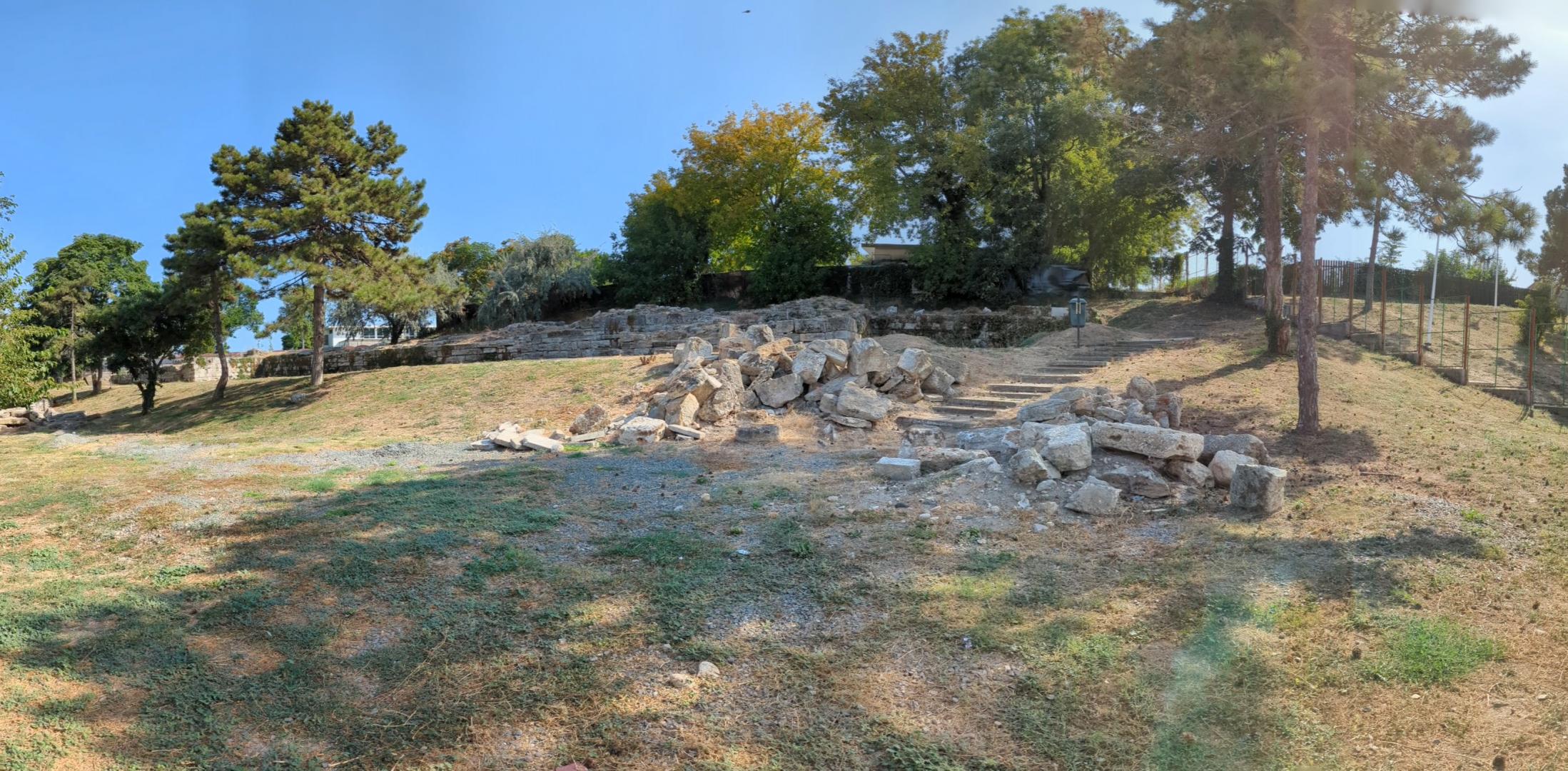
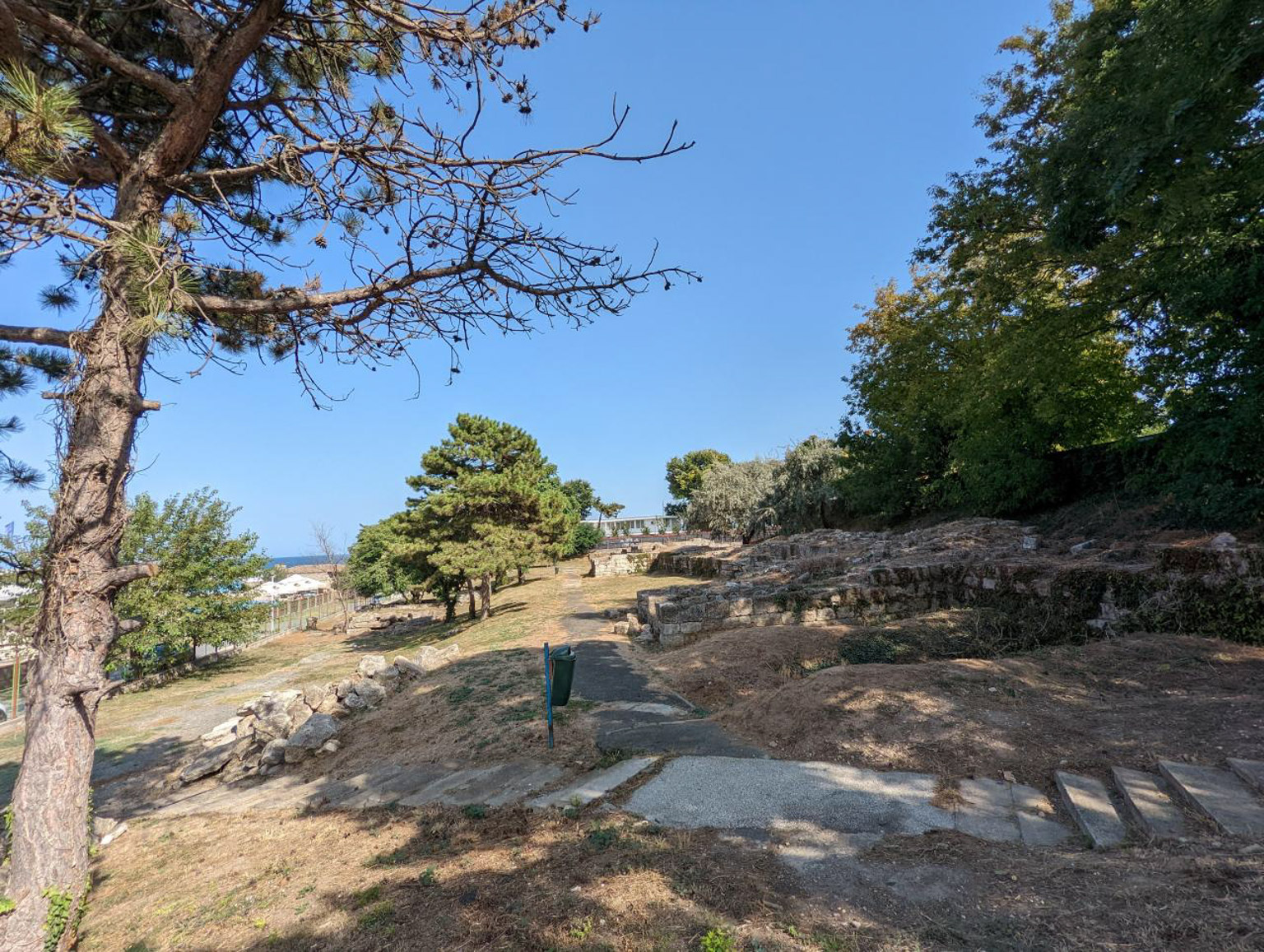
Near the city park are various points of great touristic and scientific interest, such as ancient tombs, fragments of the ancient wall of the Callatis fortress, the ruins of a late Roman edifice and the city's archaeological museum.
Discovered in 1959 under a tumulus, the papyrus tomb is believed to date from the 4th century BC. Located at a depth of 1.5 m below the ancient ground level, the tomb is built of hewn stone blocks, covered with three large slabs and surrounded by a circle of stones with a diameter of 14 m. Near the skeleton buried here, were found fragments of a papyrus written in Greek, representing the first document of this type discovered in our country. Even if the attempts to reconstruct and decipher the document have had only partial results, it can be assumed that it refers to an important character of the Callatis fortress, who made significant contributions.
In the vicinity of the papyrus tomb, cremation graves were identified, framed by an elegant framework of stone blocks. They undoubtedly constitute a collective grave, considering the presence of three burning pyres. Also in this area, another tomb with walls built of tiles was discovered, which houses a treasure that includes alabaster vessels, busts of women, numerous gilded clay figurines, of the Tanagra type, representing dancers, mermaids, winged victories, And so on Dating from the 4th century BC, it is assumed that this tomb belonged to the child of a high dignitary, judging by the value of the objects discovered inside.
The enclosure wall is found in the southern part of the park above the current stadium. The highlighted fragments represent only a small part of the huge defensive wall built during the rule of the Romans in the 1st-2nd centuries. The villages consisted of two rows of stone blocks carved in a parallelepiped shape, joined with lime mortar and filled with boulders fixed with lime mortar. Within this part of the ancient wall, two defense towers from the same period can be distinguished, intended to ensure the defense of the city from the north. The entire length of the Roman wall is believed to have been about 370 m on the northern side, 420 m on the western side and 120 m on the southern side. It was 8-9 m high and 3-3.5 m thick. At regular intervals, it was interrupted by massive towers jutting out of the outer alignment. At the end of the period of Byzantine rule, the Roman wall still stood, subject to the destructive attacks of the Avars.
The Roman building is found immediately behind the enclosure wall. The ruins belong to an ecclesiastical building, built in the late Roman period (V-VI century). Building materials include massive blocks of artistically carved stone bound together with lime mortar. There is a large room with two rows of columns, with a stone slab floor, and three other smaller rooms, with brick floors. The inner courtyard of the edifice was covered with stone slabs, and around it was a portico with a roof supported by marble columns.
The ancient port of Callatis is located in the southern part of the current port, below sea level, at a distance of 70-80 meters from the shore, where the foundations have been identified. We find mentions of the existence of this port in the ancient historiography of Arrian (2nd century CE) or in the writings of travelers from the Middle Ages.
The archeology museum, located on the edge of the archeology park, houses a rich collection of statues, architectural fragments, painted Greek vessels, amphorae with inscriptions, fragments of statuettes, stone sarcophagi, remains of columns, and others. In the courtyard of the museum there is a lapidary.
Source: The Romanian Black Sea Coast (Ministry of Tourism, 1976)