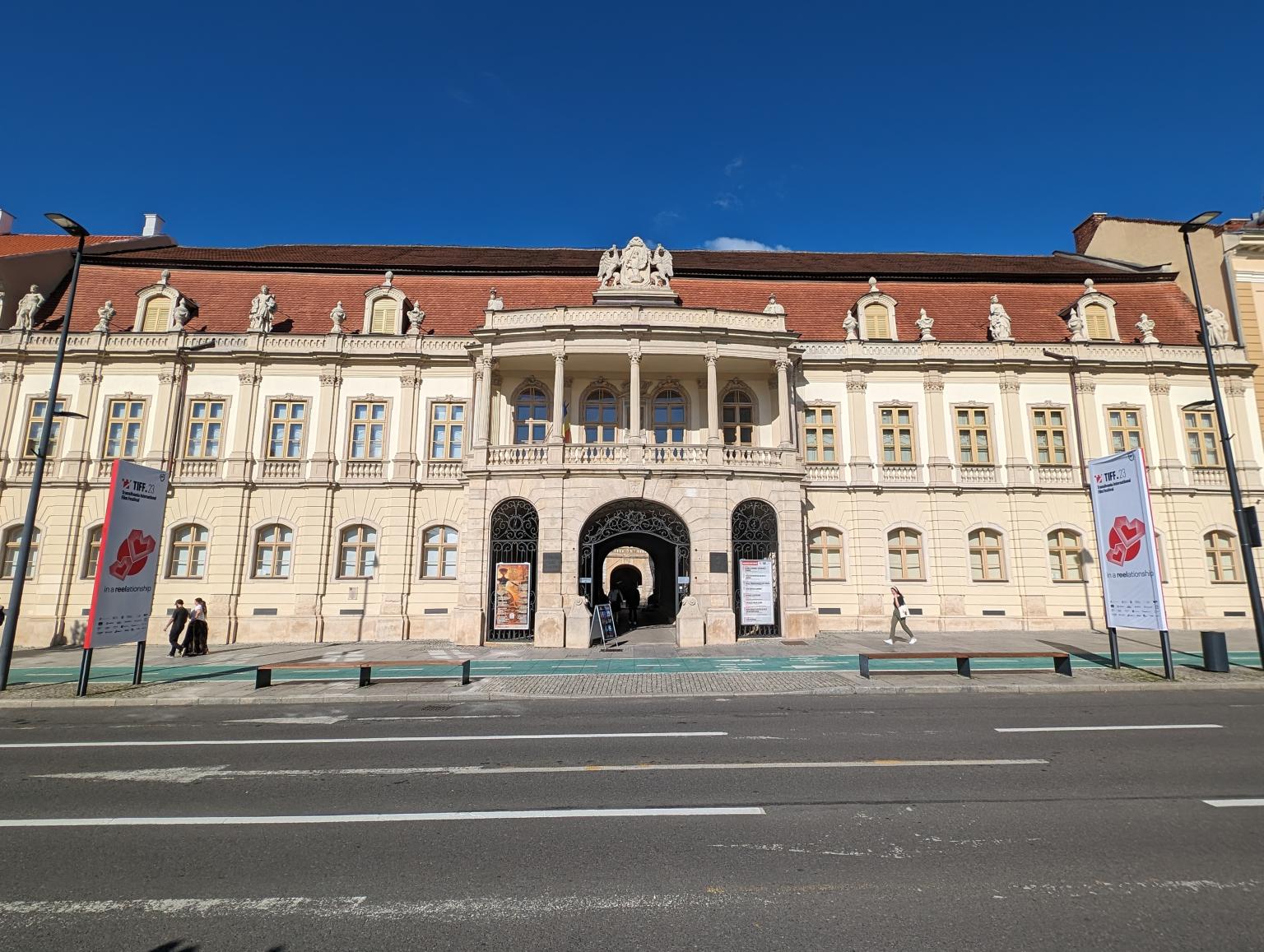
The art museum has hosted exhibitions since 1959 in the former Banffy Palace, a superb and imposing civil construction from the feudal period. In 1790, the capital of Transylvania was moved from Sibiu to Cluj, and Count Gheorghe Banffy was appointed governor. The building, originally intended for Count Gheorghe Banffy and built by the Sibian architect and sculptor Johann Eberhardt Blaumann between 1774-1785, represents a remarkable monument in Transylvania due to the harmony of proportions and the richly decorated details of the two facades.
The palace, an interesting synthesis between late baroque principles and the traditional style of secular buildings, impresses with its rectangular plan, having the dimensions of 66 and 48.20 m. The western facade, with the main entrance, is highlighted by the loggia with fluted columns, composite capitals and architraves, supported by a continuous balustrade decorated with statues and sculptures under the direction of Anton Schuchbauer.
The main facade is impressive and features the coat of arms of the noble family, which includes a griffin crowned with a sword, a heraldic symbol, flanked by two other griffins. This facade is decorated with statues depicting characters from ancient mythology, such as Mars, Minerva, Apollo, Diana, Hercules and Perseus, works by the most famous baroque sculptor from Transylvania, Anton Shuchbauer.
Anton Schuchbauer, Austrian sculptor settled in Transylvania, contributed to the building with works that stand out for their suggestive modeling and neat plastic. The Court of Honor, surrounded by gazebos on the ground floor and garlanded Ionic columns on the upper floor, adds an extra touch of elegance to the palace.
Inside, only the hall of honor enjoys a stucco-decorated ceiling and wood paneled walls.
Among the illustrious guests who visited the palace were Emperor Francis I, Empress Karolina and Franz Liszt.
The first cinema in Cluj was set up in the courtyard of the palace, and since 1951, it houses the collections of the Cluj-Napoca Art Museum.
The art museum was established on the basis of donations, allocations from the state works fund, transfers and successive acquisitions.
Its beginnings were modest, and the exhibits, along with those from other fields, were exhibited after the establishment of the Ardelean Museum Society on November 23, 1859, initially in the building of the current Faculty of Biology. Later, they were integrated into exhibitions of antiquities in 1874, initially presented in the halls of the University of Cluj and, from 1901, in the new premises of the university.
Due to the lack of adequate space for exhibitions, the museum moved its headquarters to several locations until 1913, when it found a more extensive and unitary space for the art gallery, consisting of 12 rooms, where 166 works of painting and graphics were exhibited.
In 1929, with the establishment of the Institute of Classical Studies, based in the current building of the Museum of History of Transylvania, the entire historical-archaeological material was gathered in the same building. The collections donated by Virgil Cioflec were added here, with 72 works, mostly painted by Nicolae Grigorescu (31 canvases) and Luchian (19 works in oil and pastel).
8 Romanian painting and graphic works donated by Anastasie Simu, the University of Cluj and the Institute of Classical Studies, as well as Romanian painting donations made by the Ministry of Religion and Education, as well as the Ministry of the Interior, were added to this collection.
The resulting collection, consisting of 125 paintings and drawings, 2 prints and 3 sculptures, was exhibited in 3 rooms of the Institute of Classical Studies building.
Through the continuous acquisitions made under the guidance of Virgil Cioflec, the art gallery was enriched with new works, so that in 1948 it already counted 325 works belonging to Romanian painters.
These works were exhibited until 1951 in the building of the Institute of Classical Studies, and later, together with the material taken from the Archaeological Museum and the Art Museum of the Republic, they were organized in 1952 in the building of the current Ethnographic Museum of Transylvania, marking the first basic exhibition with works of Romanian and universal art.
In 1958, the museum was allocated space in Banffy Palace, where in 1959 the National Art Gallery was inaugurated, presented in 28 rooms.
Source: City of Cluj-Napoca and surroundings (Ministry of Tourism, 1982)