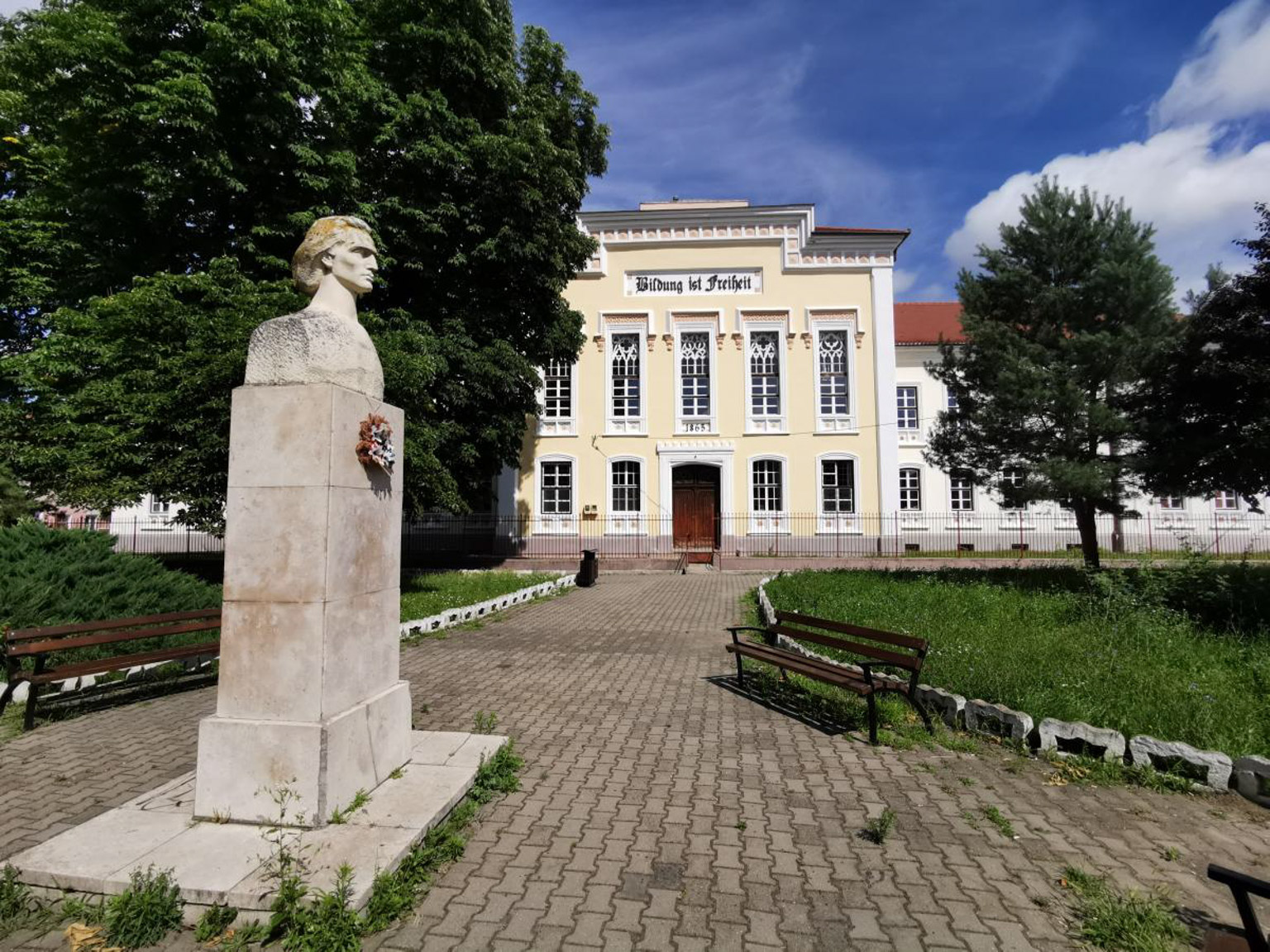
The school has always been a mirror of the educational needs of the community, of the requirements regarding the training of the workforce, but also of the policies promoted by the central leadership. At first, educational activities were modest and took place around the church and various religious denominations. Trained priests, dedicated teachers and the material support of the community contributed together to the development of education for children.
In 1352, a “Latin School” was founded in Sebeș, on the initiative of Johannes, known as “Magister Johannes Scholasticus de Sebus”, being the first teacher with a diploma in Transylvania and the leader of this institution. This is the first attestation of the term “school” associated with Sebeș, and the documents mention Johannes as rector. This is also the first known mention in Transylvania of a “scholasticus”. The school was attached to the Dominican monastery in the city.
In 1724, thanks to the involvement of priest Michael Lang and royal judge Michael Göbel, and under the aegis of the Evangelical Church, the "higher" Evangelical School of Sebeș was founded, known as the "SCHUL-SEMINARIUM" ("seminary"). Also from that year dates the existence of a regulation of the operation of the Gymnasium of Sebeș, which shows that the seminary was a lower Latin school, similar to a gymnasium. In 1784, at the initiative of priest Martin Arz, a new school building was erected north of the Evangelical Church, and between 1863–1869 it was expanded, preserving the inscription BILDUNG IST FREIHEIT ("Culture is freedom"). Over time, the school went through various names, such as the "Latein Gramathical Schule" or the "Lutheran Primary and Gymnasium School" (1780). In 1849, a new educational framework for gymnasiums and real schools in Austria was adopted, according to the project of Franz Exner and Hermann Bonitz, and the school in Sebeș officially became a gymnasium, operating under the leadership of the Evangelical Parish C.A. until 1948, when it was nationalized.
The Evangelical Gymnasium in Sebeș was distinguished not only by its valuable teachers, but also by the students who studied here and who made notable contributions to culture and science. Among the former students are personalities such as Lucian Blaga, Friederich Krasser, Georg Friederich Marienburg, Ioan Neagoe and Dorin Pavel. Among the teachers, names such as Friedrich Wilhelm Schuster, Johann Wolff and Ferdinand Baumann stand out.
In the context of the national affirmation of the Romanians in Transylvania, the Romanian community in Sebeș managed to establish, in 1787, the first Romanian school affiliated with the Orthodox Church – known as the CONFESSIONAL SCHOOL – which initially operated with a single teacher. Between 1807 and 1817, Avram Moga taught here. Later, in 1904, the Austro-Hungarian authorities built a Hungarian primary school on Poștei Street.
After 1919, the Confessional School was transformed into the STATE MIXED HIGH SCHOOL, and the building of the former Hungarian school became the property of the Romanian state, being transformed into the second Romanian school, known as the CENTER SCHOOL. In 1954, this school began to include high school classes, becoming the MIXED HIGH SCHOOL, with offices in several buildings in the city. In the 1963–1964 school year, a division occurred: a general school (which also included the 8th grade, which later became the Secondary School No. 2) and a high school – the MIXED HIGH SCHOOL OF GENERAL CULTURE.
Secondary School No. 2 Sebeș continued its activity in the spirit of the former evangelical seminary, promoting the learning of German as a mother tongue, through the existence of a German section alongside the Romanian one. From the 2006–2007 school year, the Secondary School Răhău became part of this institution. Until August 31, 2015, Secondary School No. 2 operated with two sections: Romanian and German, the latter being attended mainly by Romanian children and children from mixed families, as the number of Saxons had decreased considerably. However, German and Austrian investments in the region have maintained interest in the German language. Starting with the 2015–2016 school year, the German section was closed.
Sursa: scoala2sebes.ro