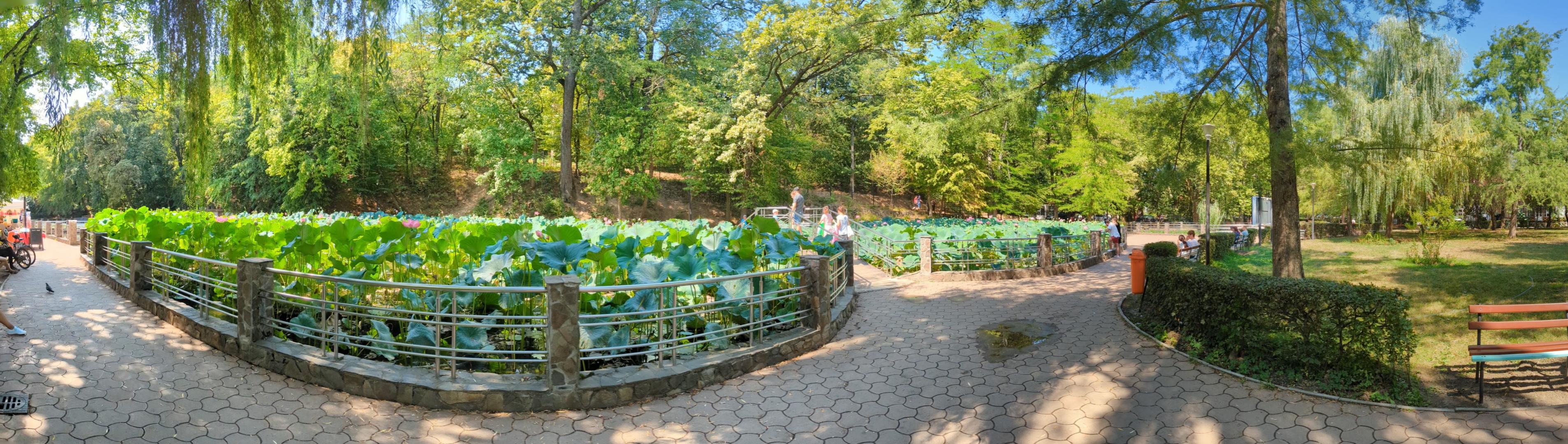
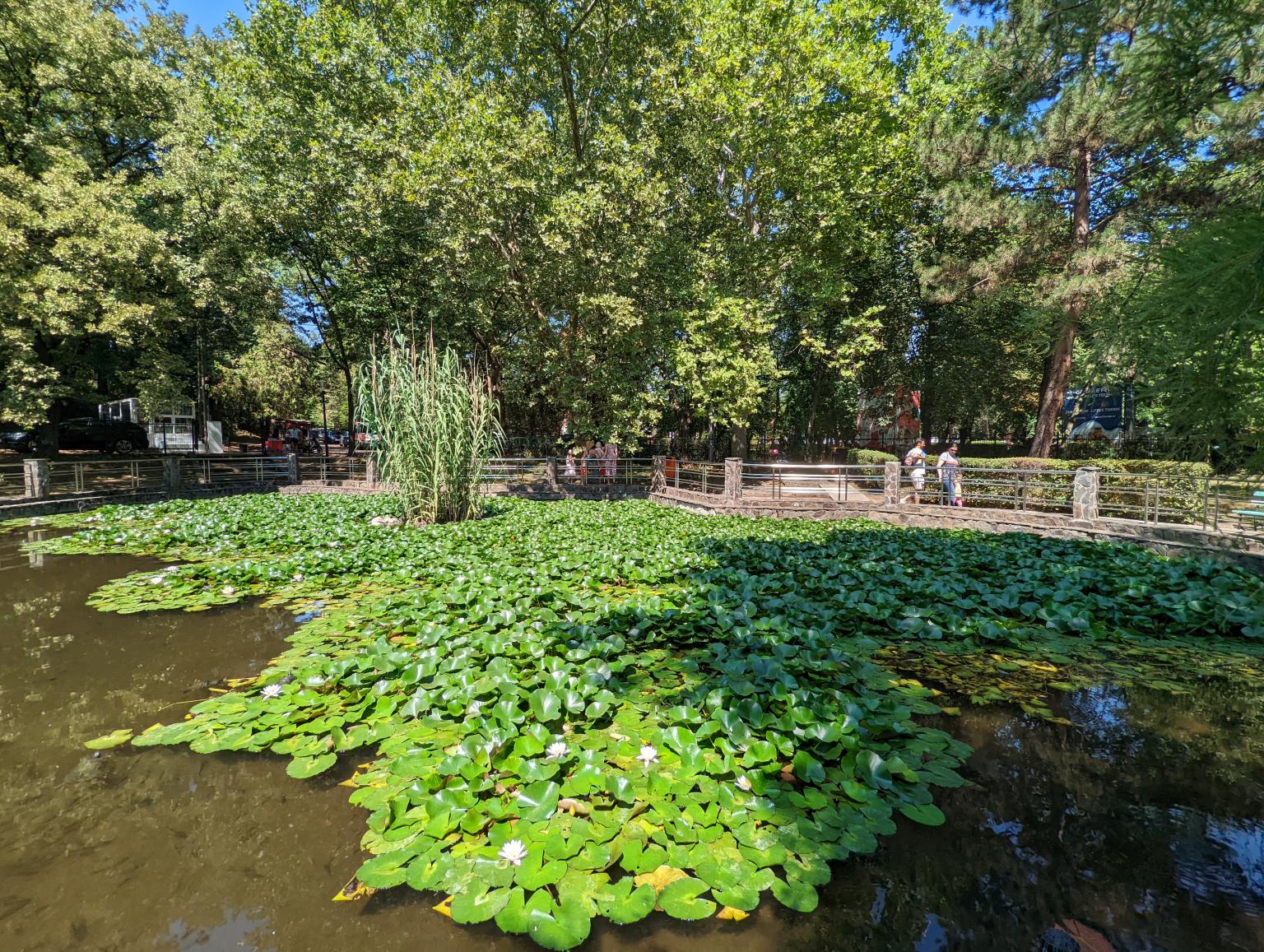
Here, in a unique microclimate in Europe thanks to the thermal springs, grow rare species such as the White Water Lily (Nymphaea Candida), the Sacred Lotus (Nelumbo Nucifera), the Thermal Water Lily (Nymphaea lotus var. Thermalis) and the Balt Cypress (Taxodium distichum).
The white water lily (Nymphaea Candida) is a herbaceous, perennial plant, protected by law, from the Nymphaeaceae family (Nymphaeaceae), widespread in Europe (including Romania), Caucasus, Siberia, Central Asia. In Romania it is a rare species. The white water lily, the best-known species, prefers relatively shallow waters, around 30-150 cm. Its green leaves have a characteristic circular shape and can reach a diameter of 30 cm. Water lilies are the flowers with the most meanings in mythology, symbolizing: creative force, immortality, health, glory or peace of mind. Flowering begins in the first decade of June.
Also a species of water lily is the Sacred Lotus (Nelumbo Nucifera) which has similar flowers, but is distinguished by the shape of the leaf. The Sacred Lotus rises above the water, while the water lily floats on it. The stems are long, contain air and manage to cross the water level to unfurl their leaves on its surface, which are twisted like papyrus scrolls. The leaves are green, circular in shape and up to 60 cm in diameter. The flowers with a diameter of up to 20-25 cm rise a few cm above the water, are fragrant and have a pink or white color. They open in the morning and close in the evening, and after about 5 days they shake off. In addition to the property of keeping itself permanently clean, researchers in the field of biology recently discovered that the lotus regulates the temperature of its flowers, maintaining it between 30°C-35°C when that of the environment drops to 10°C. Another special property of the lotus is the longevity of the seeds and their power of germination after long periods of time. It seems that the germination of some lotus seeds found in a dried up lake in China has been achieved, seeds that have been dated as being several hundred years old. The pink lotus is the most famous and prized flower of all that exists, being associated with the Buddha himself. Flowering takes place between April and October.
The thermal water lily (Nymphaea lotus var. Thermalis) is a species of water lily that lives only in the Băilor 1 Mai area. It is considered that this species is probably a Tertiary relict. The species was discovered in 1789 by the botanist P. Kitaibel, and it received its name a little later, in 1908, when J. Tuzson gave it this name because it resembles the Nile water lily. Due to its uniqueness (the Lake Pețea site is the only area where this species is found), Nymphaea lotus var. Thermalis was declared a monument of nature as early as 1931, following the actions of Professor Alexandru Borza.
The drop in the water level in Pețea Lake led to actions to save the thermal water lily, which were completed in 2015 with the moving of the first plants to the Water Lily Lake in Băile Felix. They have adapted to the new environment and it is desired to populate an entire basin exclusively with this beautiful monument of nature. The thermal water lily appears on the water surface from April to the end of October. The water lily flowers open their yellow-white petals at dusk, and in the morning, between 10-12 o'clock, when the water temperature rises to 34 degrees Celsius, the flowers close in anticipation of the evening.
Balta cypress (Taxodium distichum) is an exotic species, reaching 50 m in height and up to 4 m in diameter. It is native to the south-east of North America, where it has a rather limited range, in the vicinity of the Gulf of Mexico. In Romania, it is cultivated in parks and botanical gardens (Cluj, Timisoara, Simeria, Bucharest, etc.). It is adapted to warm and humid oceanic climates, in Europe it tolerates colder and drier climates. It does not withstand strong frosts and prolonged droughts, and shows great adaptability to the soil (pneumatophores in swamps). It is the longest-lived tree, it can reach up to 6000 years. It blooms in April.
Text taken from the presentation panel