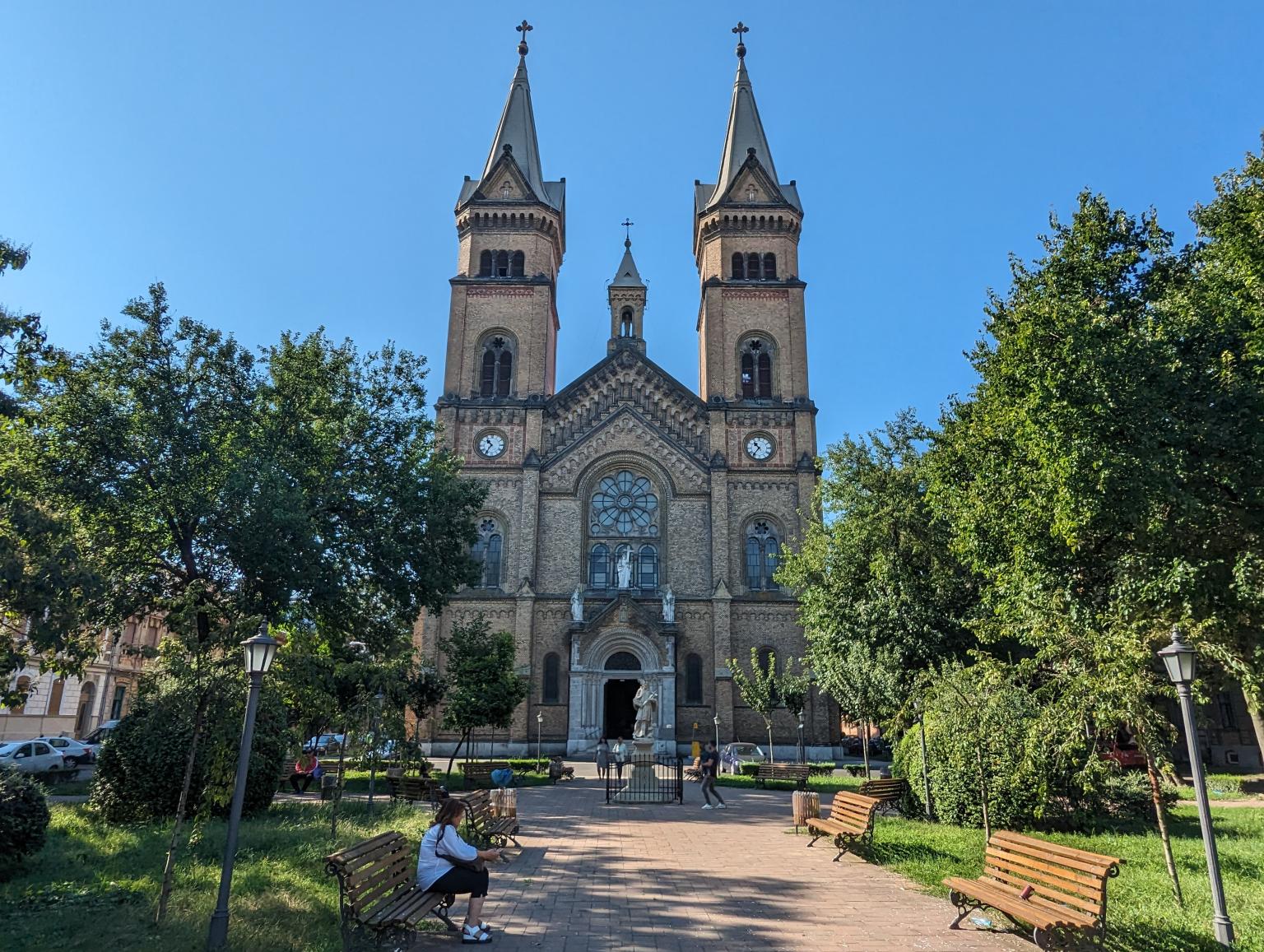
In 1896, at the initiative of the abbot and parish priest Vudy Antal, a commission was formed for the construction of a Roman Catholic church in Timișoara-Fabric.
With the support of the authorities of the free city of Timișoara and its elite, the commission decided that the church, which was to be built, should be named "Millennium", in honor of the 1000th anniversary of the foundation of the Hungarian state in 896.
The chairman of the commission on behalf of the Church was Abbot Vudy Antal, and the lay chairman was Dr. Telbisz Károly, the mayor of Timisoara.
The project of the church was made by the architect Ybl Lajos, and the construction was executed by the contractor Kremer József.
The foundation stone laying ceremony took place on October 4, 1896 and was officiated by the Bishop of Cenad, Dessewffy Sándor.
The church was consecrated on October 13, 1901.
The church is built in neo-Romanesque style and has a facade covered with unfinished brick. The walls of the church are 1-3.64 meters thick. The nave, altar and dome are made of Portland cement. Three life-size statues are placed above the entrance: the apostles Peter and Paul, and in the middle, Christ the Redeemer with the cross. The floor of the church is made of colored tiles on a concrete layer. In the tower on the right is the chapel of Saint Anthony of Padua.
The main dimensions of the church:
Length measured outside: 71.12m.
Width at the front line: 27.5m.
The width of the two towers: 7.5m.
The height of the towers to the main sill: 43.53m.
The height of the octagonal masks on the tower: 18.77m.
The height of the crosses on the towers: 4m.
The diameter of the spheres on the crosses: 1m.
The total height of the tower (from the ground to the top of the cross): 65.7 m. The width of the clock plate is 1.76 m.
The internal surface of the church is 1170.15m², in which a number of 48 benches are placed.
Sursa: www.ro.biserica-millennium.ro