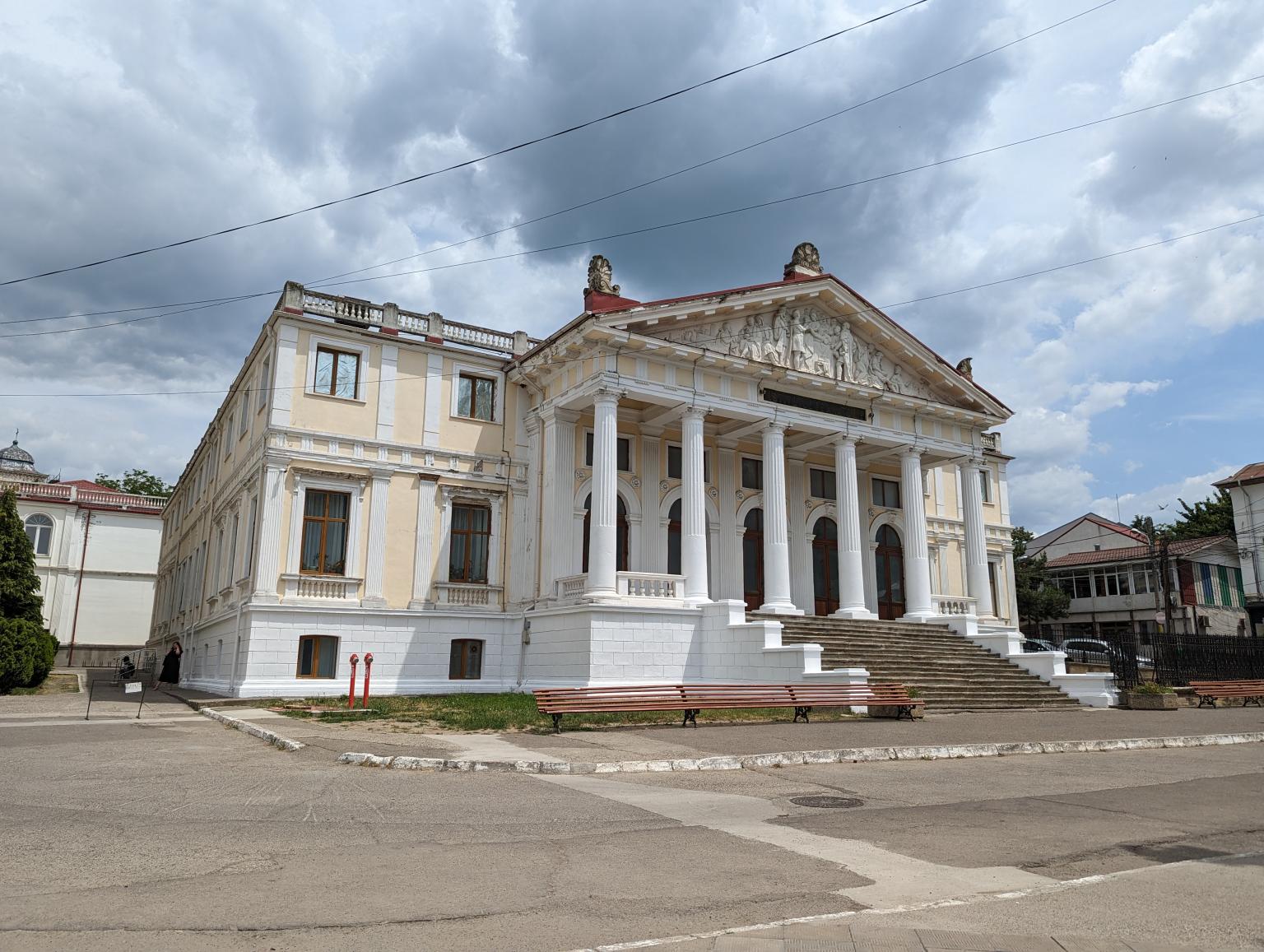
At the end of the 19th century, in the immediate vicinity of the Old University, the Institute of Anatomy was built, designed by the architect Emilian Ștefan. At the time of its construction in 1889, the institution ranked first in Europe due to its modern facilities.
On the facade of the building, you can see a sculpture illustrating an anatomy lesson, made by the artist W. Hegel. The characters represented in the sculpture include notable personalities of the time, such as Take Ionescu - the minister of instruction, Dr. Peride, the former dean of the Faculty of Medicine, N. Culianu - the rector of the University, Dr. Gh. Bogdan and Gr. Ureche, surrounded by a corpse, this being the very sculptor himself.
Until 1944, the Institute of Medicine and Pharmacy in Iasi functioned as a faculty of the University of Iasi. The establishment of this faculty was based on the existence of the Society of Medicine and Naturalists from the locality. Although the idea of establishing medical education in Iasi was included in the Decree of Al.I. The decree of 1860, which concerned the establishment of the University, the Faculty of Medicine became a reality on December 1, 1879, with the appointment of the first two professors for the first 14 students.
Over time, despite the difficulties generated by the authorities of the time, the faculty consolidated its prestige. Among the personalities and fields of national and international reputation is the school of C.I. Parhon in neurology, psychiatry and endocrinology, the school of anatomy and surgery of Grigore T. Popa and N. Hortolomei, the school of microbiology, parasitology and hygiene of A. Slătineanu, N. Leon and M. Ciuc, or the school of internal medicine and cardiology of G. Riegfer and I. Enescu. The renowned professors of Iași medicine firmly supported the idea of anchoring medical education in the realities of protecting the health of the population and opened new directions in original medical research. Many of them were fervent activists for social progress, and the graduates of the faculty and institute made outstanding contributions to the development and consolidation of Romanian medicine.
In 1944, the Institute of Medicine and Pharmacy was established, continuing the tradition and excellence in the medical field.
Source: Iași Municipality and surroundings (Ministry of Tourism, 1980)