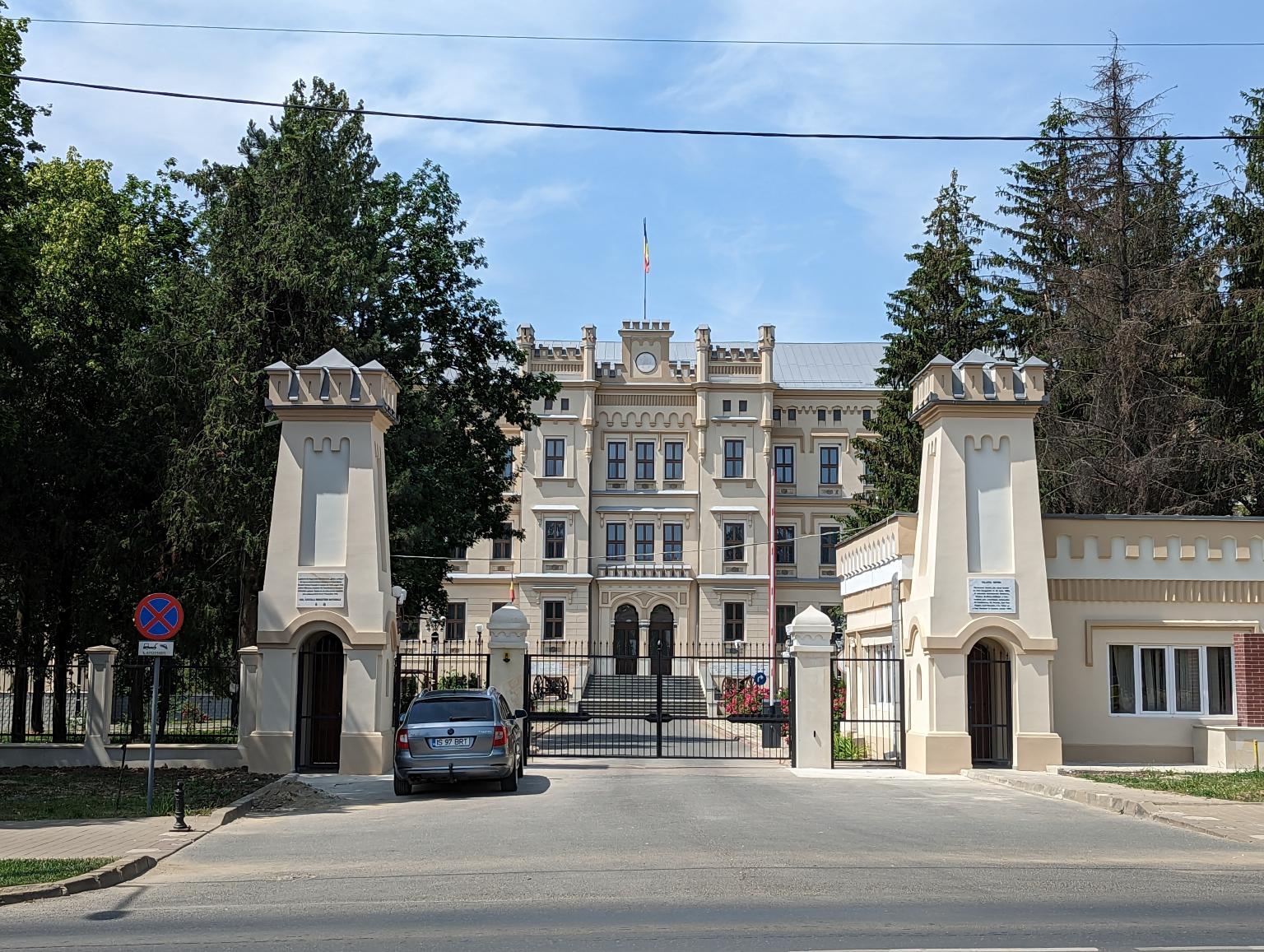
Copouului Hill, the most famous of the seven hills of Iași, is frequently associated with the cultural and social life of the old Capital of Moldova. What Copoul represented for the institutional development of the Army is less known today. And yet, after 1880, one can see a massive presence of military structures in the area, which also marked the spirit of the era. In the War of National Integration, during the refuge from Iasi (1917-1918), numerous buildings and lands in Copou acquired a military destination. The current Exhibition will refer to them in detail!
In 1830, with the establishment of the National Army (Land Militia), the first units were quartered inside the former Royal Court, the fortified enclosure from the Medieval Era. There is a tradition in this sense, because during the Phanariot period, the barracks of the army corps (seimeni, drăgani, fuştaşi, etc.) were located here. The Royal Palace was decommissioned by the great fire of 1827, and the walls remained at the disposal of the army. The barracks of the infantry and cavalry units were rearranged between these walls, where the artillery, the powder room, the stables and the military hospital were also located.
As early as 1845, the reports of the General Inspector of the Army drew attention to the fact that the old spaces intended for casons were insufficient, not providing the necessary conditions and even representing a danger for the soldiers, in case of earthquake or fire. Ruler Mihail Sturdza (1834-1849) ordered the drawing up of the first construction projects for new buildings intended for the army, but nothing concrete could be achieved until the end of his reign.
Ruler Grigore Al. Ghica (1849-1856), the former commander (hatman) of the Moldavian Army, is the one who planned the army's move to Copou, where there was still generous land, on which military barracks could be set up under conditions corresponding to the Modern Era. The same ruler also laid out Aleea Ghica Vodă", an artery intended for public promenade, but closely related to the installation of military units in this area. The ruler started the works on the Palace of the Army, being willing to make a financial effort that exceeded the financial possibilities of Moldova in that period.
However, after the War of Independence (1877-1878), the need to resume and complete the Military Palace in Copou and other buildings with a military purpose had become obvious. It is very likely that the exceptional heroism shown by the soldiers of the XIII Dorobanti Regiment Ștefan cel Mare on the front in the Balkans, at Griviţa and in other battles, determined the high-level decision that the soldiers benefit from accommodation and training conditions adapted to the requirements of modern times. Thus, the barracks of the XIII Infantry Regiment, the 4th Hunter Battalion and the 7th Roşiori Regiment were set up in Copou.
The building has a rectangular plan and is developed on 4 levels. It has an imposing volume accentuated by the presence, in the corners, of 4 massive towers finished in ornaments. It is made in the romantic architectural style (noting the presence of many Gothic elements), characteristic style of Iași in the sixth decade of the last century.
Text taken from the street sign