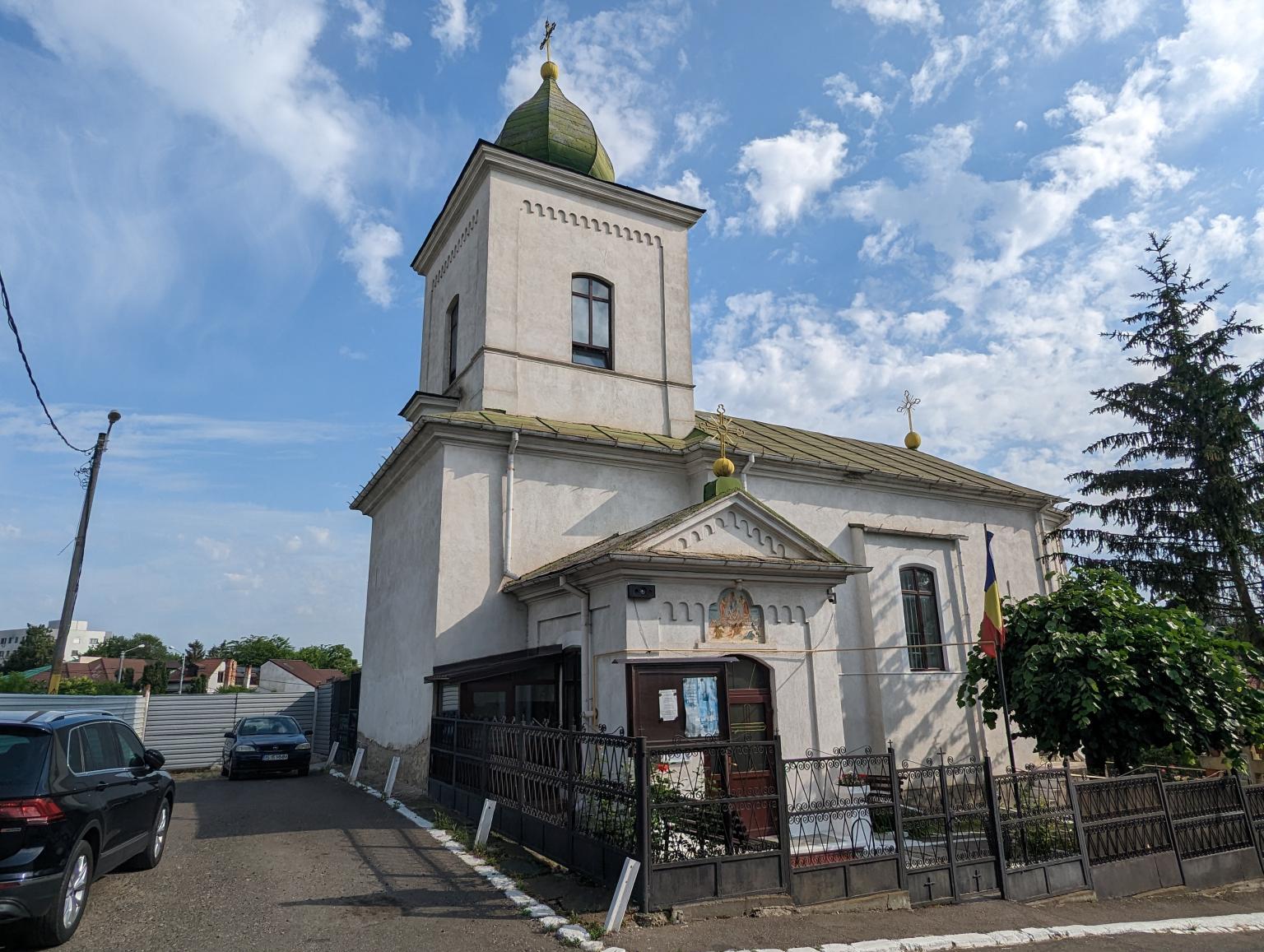
The Church of the Transfiguration, also known as the White Church, is an important Orthodox place of worship in Iași, located in the Târgu Cucului neighborhood, on Albă Street no. 3. The current edifice was built around 1750 on the site of an older church, dating from the 17th century and dedicated to the Nativity of the Lord. This area, located on the edge of Târgul Făinii, where the Salt Road began and the Armenimei Slum ended, experienced significant development with the relocation of the capital of Moldova to Iași.
The first documentary attestation of the church dedicated to the Nativity of the Lord dates back to 1682, suggesting an earlier construction. It suffered degradation over time, being rebuilt around 1750 by Popa Velișcu, at which point it is assumed to have received the name of the White Church, possibly due to the fact that it was completely whitewashed, unlike other churches of the time. At the same time or during later repairs, it is possible that the patron saint was also changed to the current one, "The Transfiguration" (celebrated on August 6).
In the 19th century, earthquakes affected the structure of the church, threatening it with ruin. An extensive restoration took place in 1885, under Metropolitan Iosif Naniescu, with the support of the Iași City Hall and the parishioners. The works, coordinated by the architect Nicolae Bădărău, are commemorated by a tin plaque placed at the entrance to the porch. Before 1887, there was a cemetery around the church, which was abolished, and the remains were moved to the Eternitatea Cemetery.
At the beginning of the 20th century, the White Church was a branch of the Bărboi Parish and had modest income, being subsidized by the city hall. Other stages of repairs followed in the 20th century, being declared a historical monument in 1962 and included in the List of Historical Monuments in Iași County in 2015. Between 1974 and 1978, the church was significantly renovated, being painted in the fresco technique by Constantin Călinescu and Iulia Handragel and equipped with new furniture and religious objects. The reopening service took place in 1982, officiated by Metropolitan Teoctist.
The architecture of the White Church is in the shape of a cross, with a semicircular altar apse. The construction is made of stone and brick, with a decorative belt under the cornice and a frieze of semi-arches above the windows of the porch and the bell tower. The interior is divided into a porch, narthex, nave and altar, with two access doors. Above the narthex rises a square bell tower, and on the western side is the cafas. The current iconostasis dates from 1978, the old one being deposited at the Golia Monastery. The church holds a valuable heritage of 41 icons donated in 1818. In the churchyard there is a cross erected in 1975 in memory of the heroes of World War II and a table with a tombstone dating from 1841, vestiges of the former cemetery. Among the important priests who served here is Fr. Anton Frunză, former archpriest of Iași, who pastored until 2003.
Sursa: culturainiasi.ro