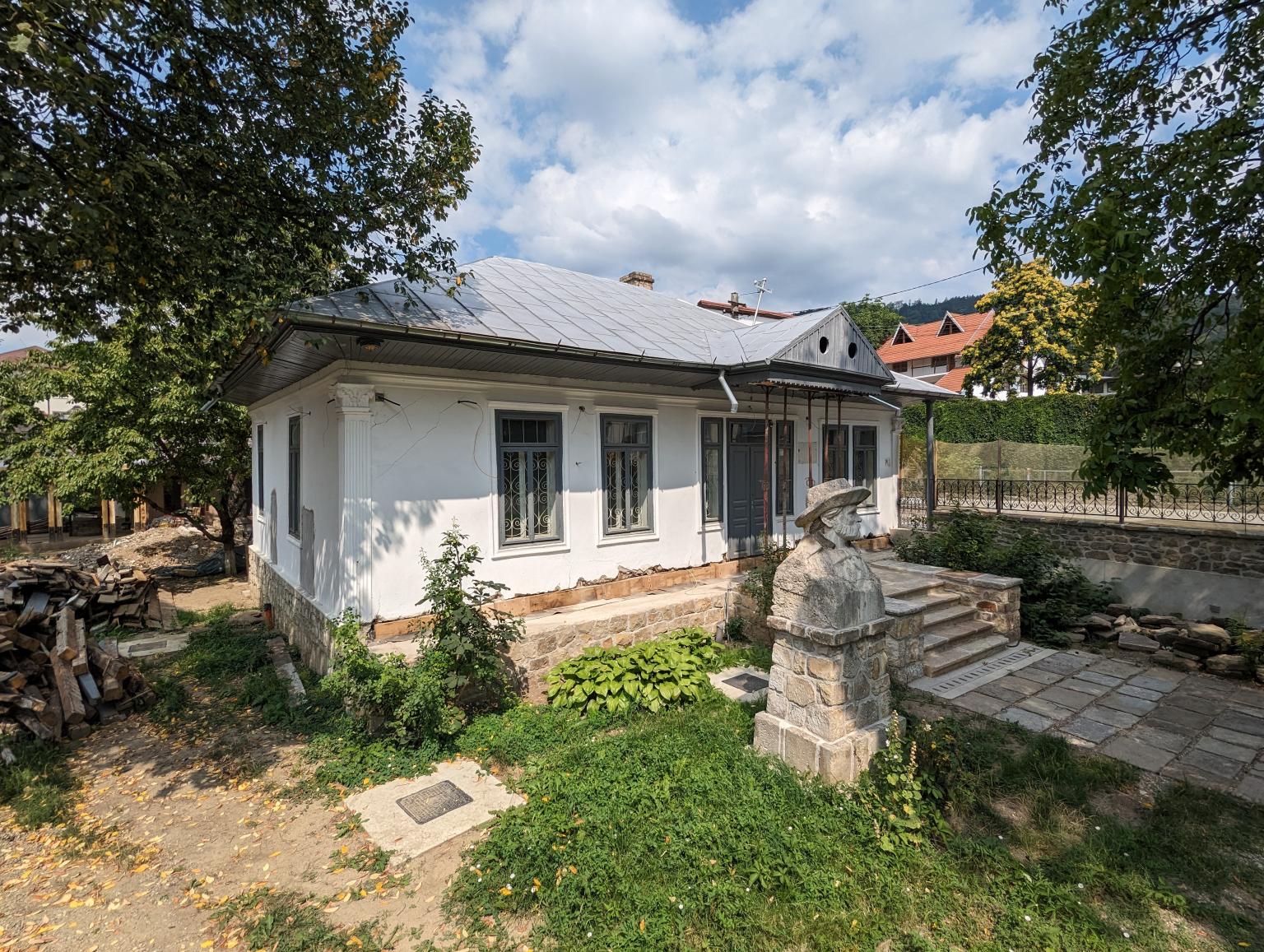
The house originally belonged to Archpriest Costache Gheorghiu, the writer's father-in-law, and came into the possession of Elena, the future "Elencu" Hogaș, as part of her dowry.
Still preserving the atmosphere specific to the early 20th century, the house was opened to the public in 1939, the year in which Sidonia, the descendant dedicated to preserving the memory of Calistrat Hogaș, organized the first exhibition of the writer's personal belongings in one of the offices. In 1967, in order to protect the authenticity of the building, Sidonia donated the entire property to the state, including a summer kitchen connected to the main house by a suspended porch, a garden gazebo and a fountain.
The building, partially rebuilt in 1880 and transformed into the Hogaș family residence, went through two extensive restoration processes: between 1967-1968 and 1990-1994. Then major repairs were carried out, and the house was officially recognized as a historical monument, receiving the code NT-II-m-B-10565.
The museum was officially inaugurated in 1969, and the basic exhibition created in 1994 closely followed Sidonia’s suggestions from her memoir, “Tataia”, faithfully reconstructing the atmosphere of the early 20th century.
The exhibition is organized into six rooms, where visitors can discover numerous personal objects of the writer and his family. Sidonia Hogaș donated over 300 pieces of memorial value, including his hat, compass, cape, a mug specially designed to protect his mustache, period furniture, impressive stoves, original photographs and paintings of Calistrat Hogaș, his family members and his favorite animals, as well as tapestries and carpets, among which a Jubilee carpet dedicated to the establishment of the monarchy in Romania stands out.
Although there are no photographs of "Pisicuța", the mare that accompanied Hogaș on his hikes through the Neamț Mountains, her memory is preserved through an ashtray made by the writer from a hoof.
The memorial museum's storage room houses the manuscripts of Calistrat Hogaș's works, a collection of letters, as well as an impressive number of photographs.
In the courtyard of the memorial house is the bust of Calistrat Hogaș, sculpted in travertine by the artist Vasile Aciobăniței in 1963.
Sursa: cmnn.ro