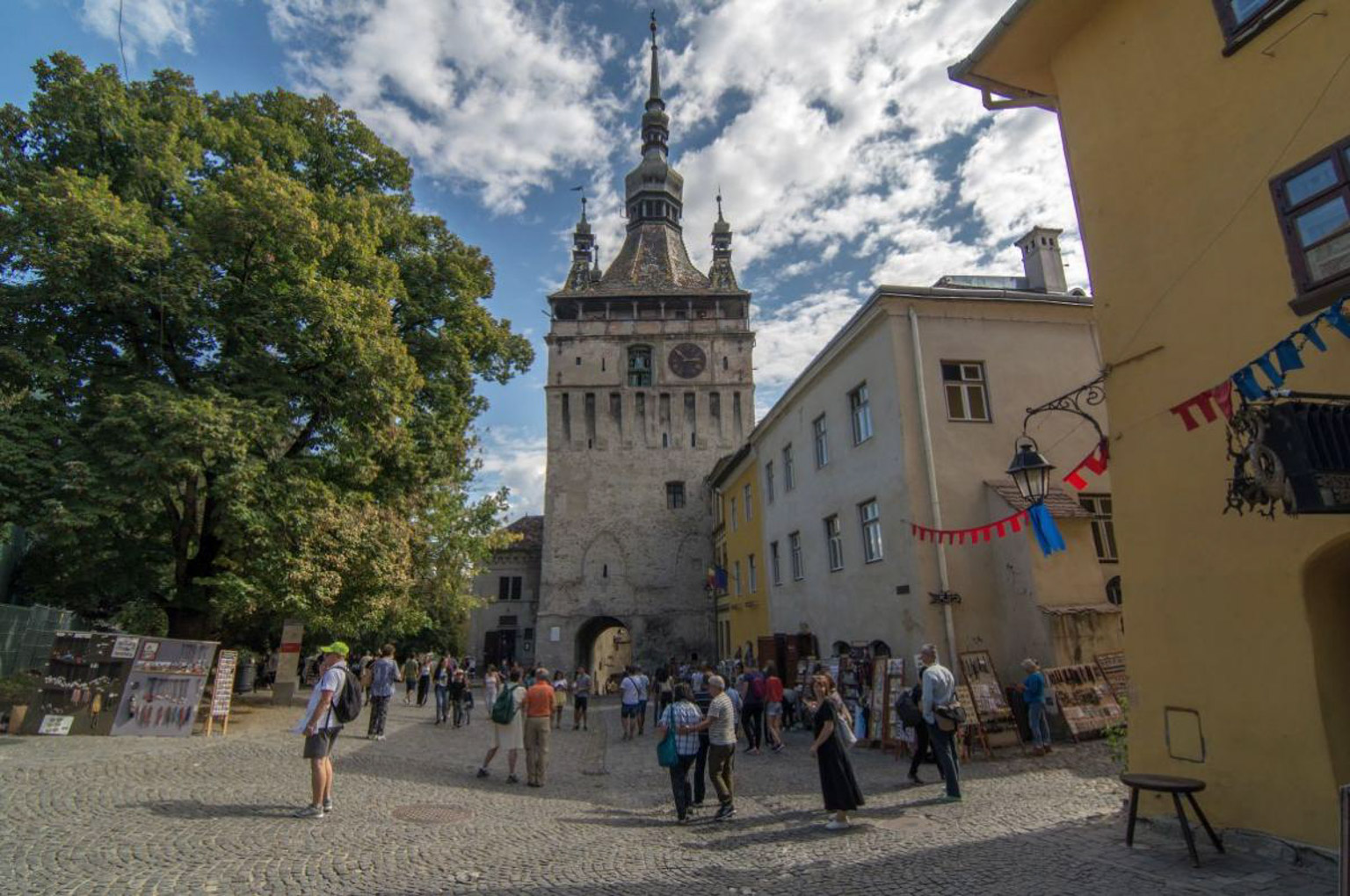
The towers were the most important fortification points. Of these, the Clock Tower, located at the main gates of the fortress, was the largest, most beautiful and most important in the defensive system, becoming a true symbol of Sighisoara.
Built in the 14th century, the tower was built to protect the main gate of the city and to house the Council until 1556. Also here were the ammunition depots, archives and treasury of the city. Consolidated repeatedly, the tower looks like a huge vertical parallelepiped arranged on five floors separated by wooden floors supported on beams above which rises the beautifully decorated and colorful roof. On the top floor there is a wooden gallery that surrounds the tower from the height of which opens a wide view over the entire city, where on holidays the city orchestra sang for which the council purchased musical instruments in 1619.
The following elemnts draw attention to this tower: the clock in the tower, fixed at the beginning of the 17th century to which in 1648, the watchmaker Johann Kirchel added a minute indicator and perfected the sound signaling system to beat the quarters of an hour. The same craftsman also set a mechanism for showing the diurnal movement of the days of the week, being represented by wooden statuettes depicting their patrimonial gods: Diana, Mars, Mercury, Jupiter, Venus, Saturn, the Sun.
The roof with a particularly expressive composition catches the eye through the extended strip that reaches a height of 64 m, occupying more than half the length of the tower. The roof was destroyed by the great fire of April 30, 1676, rebuilt by the craftsmen Veit Gruber of Tyrol, Filip Bonge of Salzburg and the carpenter Valentin, and the current form dates from 1894 when the old roof was replaced with multicolored glazed tiles. At the base of the strip is a polygonal gazebo with a wooden column, decorated with stucco and painted, and in the middle of it is another smaller gazebo. The arrow is decorated at the ends with an imperial straw, a globe and a rooster.
Four turrets, crowning the roof at the corners, were the sign of the city's judicial autonomy, which, through his Council, could apply the death penalty. Few cities in Transylvania benefited from this authority (Jus Gladii or Sword Law)
A double barbican was provided with ramparts and gates that completed the defensive system of the tower.
It is also interesting the entrance to the fortress on Strada Turnului, which is made through the covered corridor, also called the gang of old women, built of wood in 1844 to facilitate the access to the fortress of the elderly in bad weather. Since 1898, the Clock Tower has housed the city's history museum.
The Clock Tower also houses the city's History Museum. Here, on the first floor, are exposed a hearth of sacrifices from the Bronze Age, Dacian pottery, Roman bricks that attest moments of ancient history on this territory, a model of the Sighisoara fortress of 1735, crates of guilds, antique furniture. On the second floor there is a room dedicated to Mihai Viteazul, hardware pieces made in the 17th century, a corner of the medieval pharmacy. On the next floor are exhibited documents on the education of the 16th - 17th centuries, surgical instruments from the 16th - 18th centuries, pieces of silverware and on the top floor there is a small exhibition of watercolors and prints.