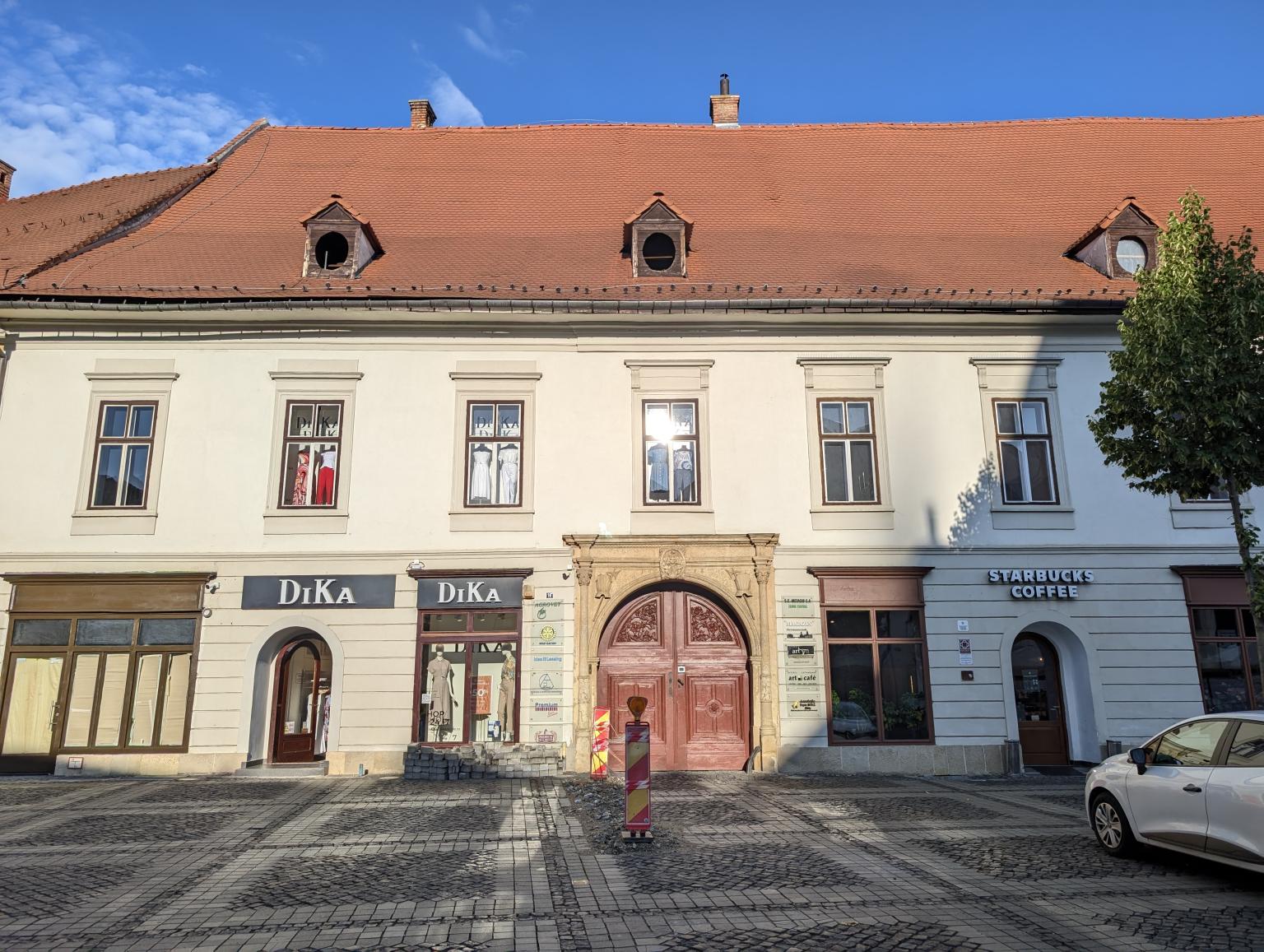
The current house, composed of seven buildings, was in 1875 made up of two buildings. In place of the access gang on the left, a body was erected that unites the buildings. The house with no. 16 has two inner courtyards connected by an access in the body on the right. In the neighboring yard is the body D, extended on the left side of the plot. The year of the last renovation is inscribed on a chimney: 1917.
The current facade is unified, having 3+4+1+10 axes on the first floor, and the ground floor is modified to include large storefronts. The windows are rectangular with decorated parapet and entablature at the top. To the right of the facade, towards the square, there is a steep roof with four rectangular dormers. The building has various vaulting systems: cross vaults on consoles, baroque vault with double curvature and semi-cylindrical vault with penetrations.
Special elements:
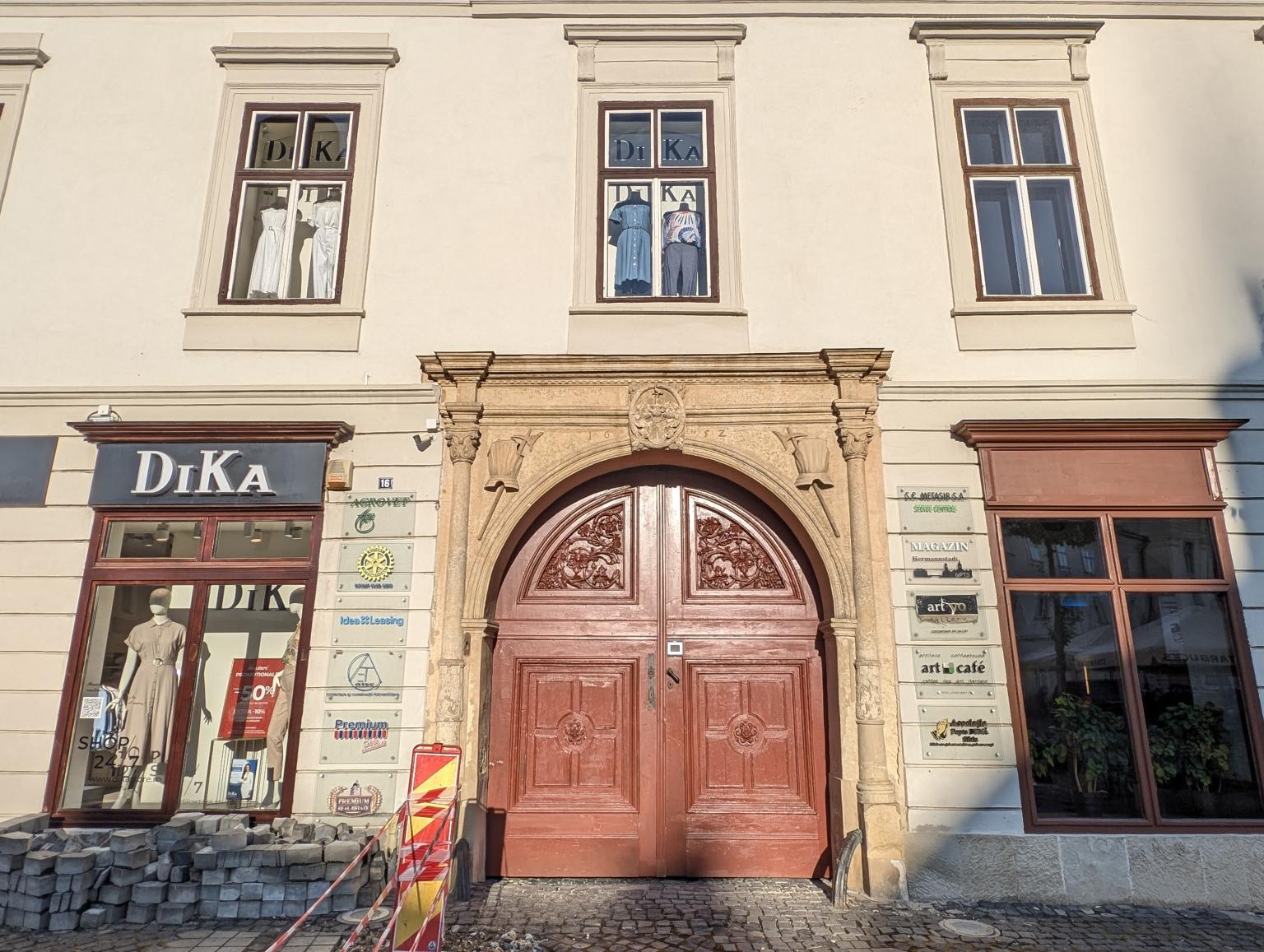
- The main portal centralizes the coat of arms of mayor Johann Reussner jun, dated 1652 and with the monogram EN (sculptor Elias Nicolai);
- Carved stone doorframe with a badge dated 1582 and the cypher CW;
- The mural painting on the first floor (17th century);
- Ceilings with baroque stucco in the upstairs rooms.
The right side, where the portal is located, belonged to the Weidner family and then to Senator Johann Reussner jr., being bought in 1902 by the merchant J.B. Misselbacher. The body on the left was owned by the Czekelius family for about 400 years until 1880, when it was bought by Misselbacher.
In 1902, fragments of a fresco representing the Trojan War, dating from the end of the century, were discovered in the festive hall on the first floor. XVI. On the ground floor of the building on the left was one of Sibiu's great stores, founded by J. B. Misselbacher, originally opened in Sighisoara in 1818 and moved to Sibiu in 1865. In 1918, on the occasion of the centenary, Misselbacher donated 200,000 crowns to the city to help those affected of war and building a trade school.
The first store in the building on the right opened in 1854, housing the business of Friederich Czikeli jr. and Franz Reissenberger until the beginning of the century. XX, when the space was taken over by Misselbacher. After the Second World War, the ground floor was transformed into a row of shops under the name Magazinul de Stat Sibiu.
The painting discovered in 1902 in the festive hall on the floor of the main body covered all the walls of the room and was covered again with plaster in 1903. Partially restored in 2011 by Liviu Ciungan Tudoran, the fresco reveals scenes such as Aeneas' fight with Turnus and the founding of Rome. Despite the partial identification of the subject of the fresco, the painter remains unknown. The main scene of the fresco depicts the victory of Aeneas over Turnus and the throwing of the brothers Romulus and Remus into the Tiber River, referring to the founding of Rome. Other scenes of the fresco have not been established with certainty to date.
Sursa: patrimoniu.sibiu.ro