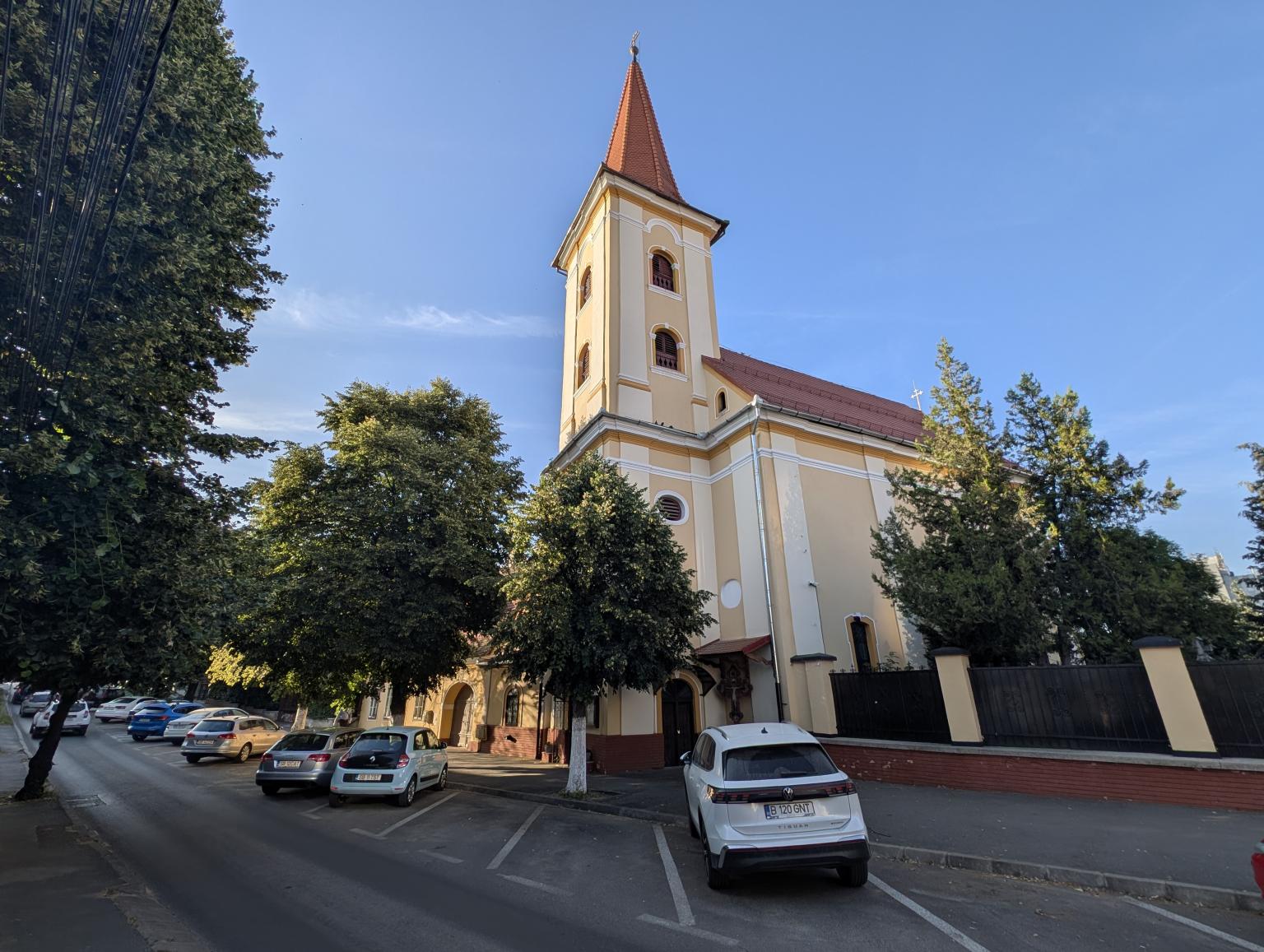
The Orthodox Church in Groapa was built in the first part of the 19th century and has a simple structure, being a hall church with a generous semicircular apse. Supported on three robust arches, the pronaos is connected to the tribune by ornate columns supported by flowered capitals. Without a dome raised in honor of Pantocrator, the church surprises with its architectural details.
On the balustrade of the tribune, three portraits of the founders stand out: Haggi Constantin Popp, Stana Petru Luca and Pagona Haggi Constantin Popp, alongside commemorative plaques fixed outside the apse on the occasion of reburials.
Inside, embedded in the pavement, is a funerary slab, whose inscription can no longer be deciphered. In the church cemetery, several funerary monuments, some with ornaments specific to the era of the mid-19th century, include the graves of the ophthalmologist Ioan Piuariu-Molnar and the writer Ion Codru Drăgușanu.
Born in 1818 in the village of Drăguș, Brașov county, Ion Codru Drăgușanu was a prolific Romanian writer and scholar from Transylvania, dedicated to the Latin movement. Involved in the 1848 revolution as a propaganda commissar in Prahova, he traveled in Europe between 1835 and 1845, leaving travel impressions in the work "The Transylvanian Pilgrim" (1865). In the same year, he published a grammar entitled "Rudiments of Romanian grammar". It ceased to exist in 1884.
Source: Sibiu and surroundings (Ministry of Tourism, 1979)