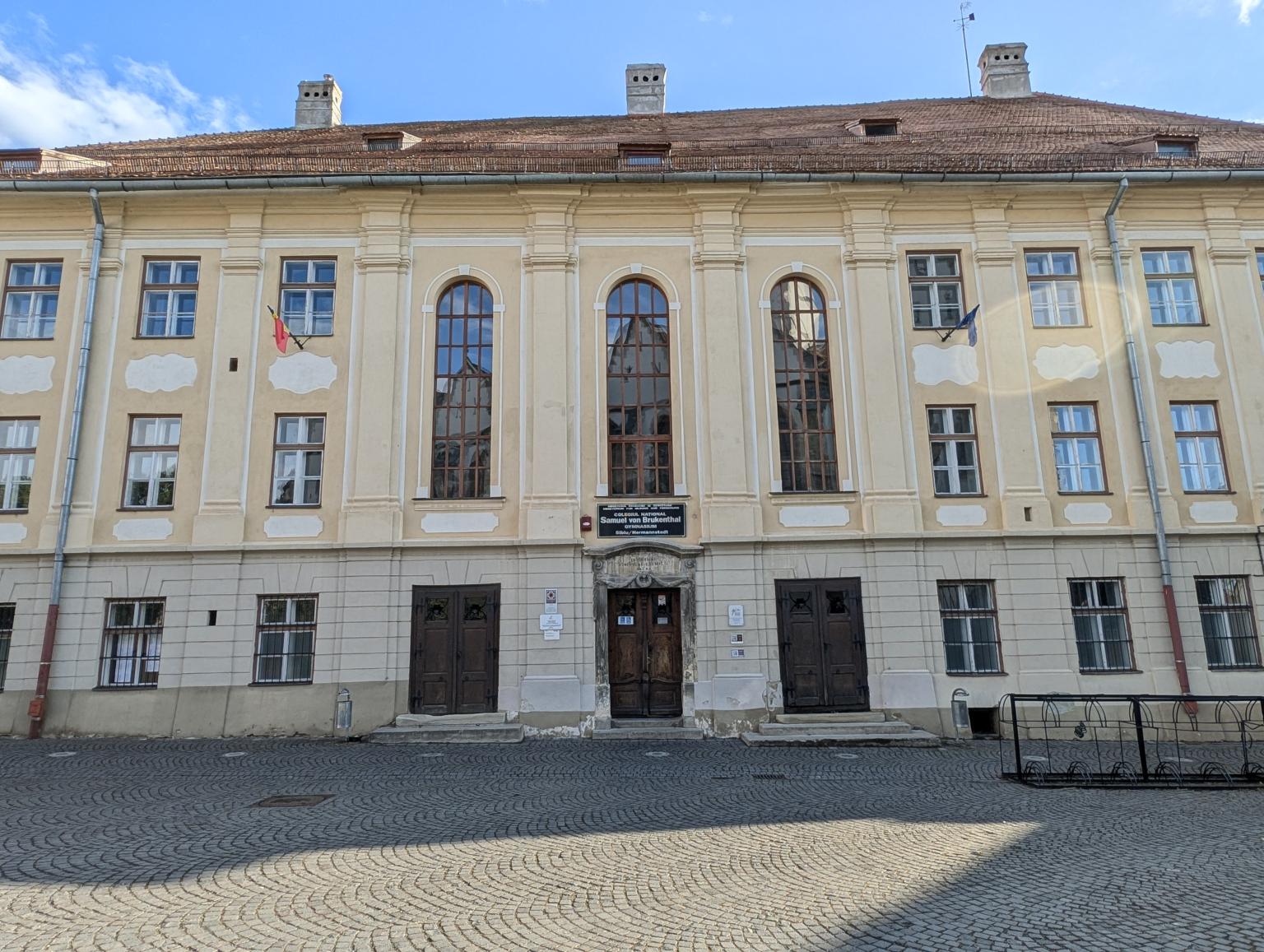
The "Samuel von Brukenthal" National College is one of the oldest educational institutions in Romania, with the first documentary attestation in 1380. Initially, it served the Saxon community and the Catholic Church, but it was also attended by Romanian children. Among the notable students of the school is Nicolaus Olahus, an important humanist.
The adoption of the Lutheran doctrine led the Saxon community to pay more attention to education. The gymnasium established in Sibiu in 1555 included the study of classical languages, and extracurricular activities encouraged civic spirit. "Coetus", the autonomous association of students, had a central role in organizing these activities.
In the 18th century, the school became the most prestigious educational institution for Transylvanian Saxons, surpassing other gymnasiums in the region. The new school building, inaugurated in 1781, has the Transylvanian Baroque style. Baron Samuel von Brukenthal, a former student of the school and governor of Transylvania, left a large part of his fortune to the school in his will.
In the context of the modernization of education, in addition to the gymnasium, a theological-pedagogical seminary and a vocational school were established. The growth of the school population in the 19th century led the Evangelical Church to expand the educational facilities, and the seminary and elementary school separated from the gymnasium.
Romanians contributed to the increase in the number of students, but many of them attended the state gymnasium. The reform of 1849 standardized education in the Habsburg empire, and schools became eight years, with matriculation examination. After 1918, the number of Romanian students decreased due to Romanian legislation and the takeover of the Hungarian gymnasium by the Romanian state.
Between 1918-1948, the evangelical gymnasium became a predominantly German school. Statistical data show that the percentage of German students has increased significantly, while the number of Romanians and Hungarians has decreased considerably. After 1921, the school was renamed the "Brukenthal" Evangelical High School.
During World War II, the school was influenced by Nazi ideology. "Coetus" was replaced by "Deutsche Jugend" and the high school was controlled by the German Ethnic Group. After the war, many Germans were deported and the high school building was occupied by the Soviet army.
In 1948, the high school was abolished by the communist regime, but was re-established in 1954 under the patronage of the Romanian state. The school became co-educational in 1956 and has retained an atmosphere specific to the German spirit.
After 1989, many Germans emigrated, but the school continued to teach in German, offering opportunities to Romanian students, who became the majority. In 2005, the school celebrated 625 years of existence, continuing to be a model of education in the Sibiu region.
Sursa: brukenthal.ro