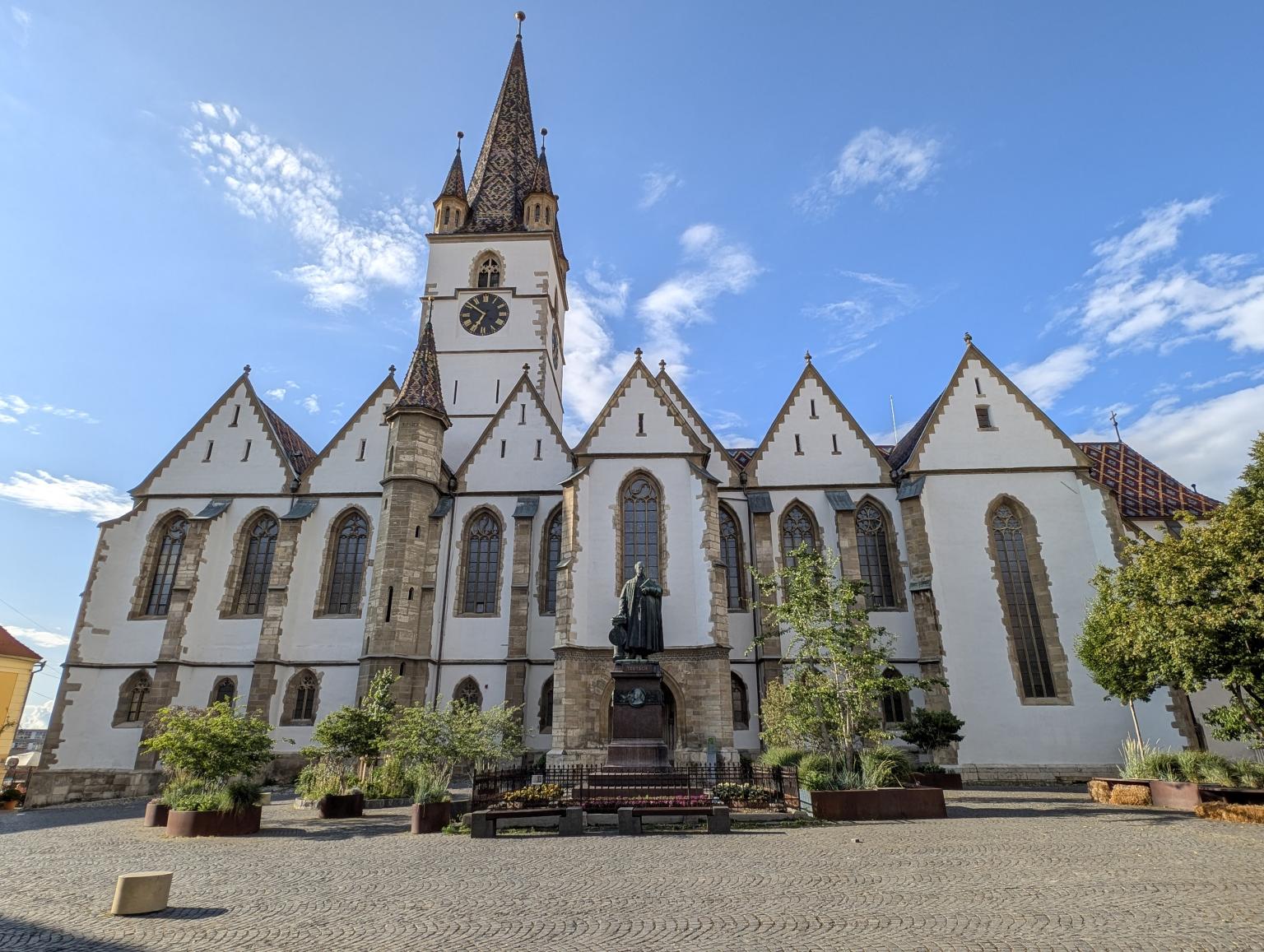
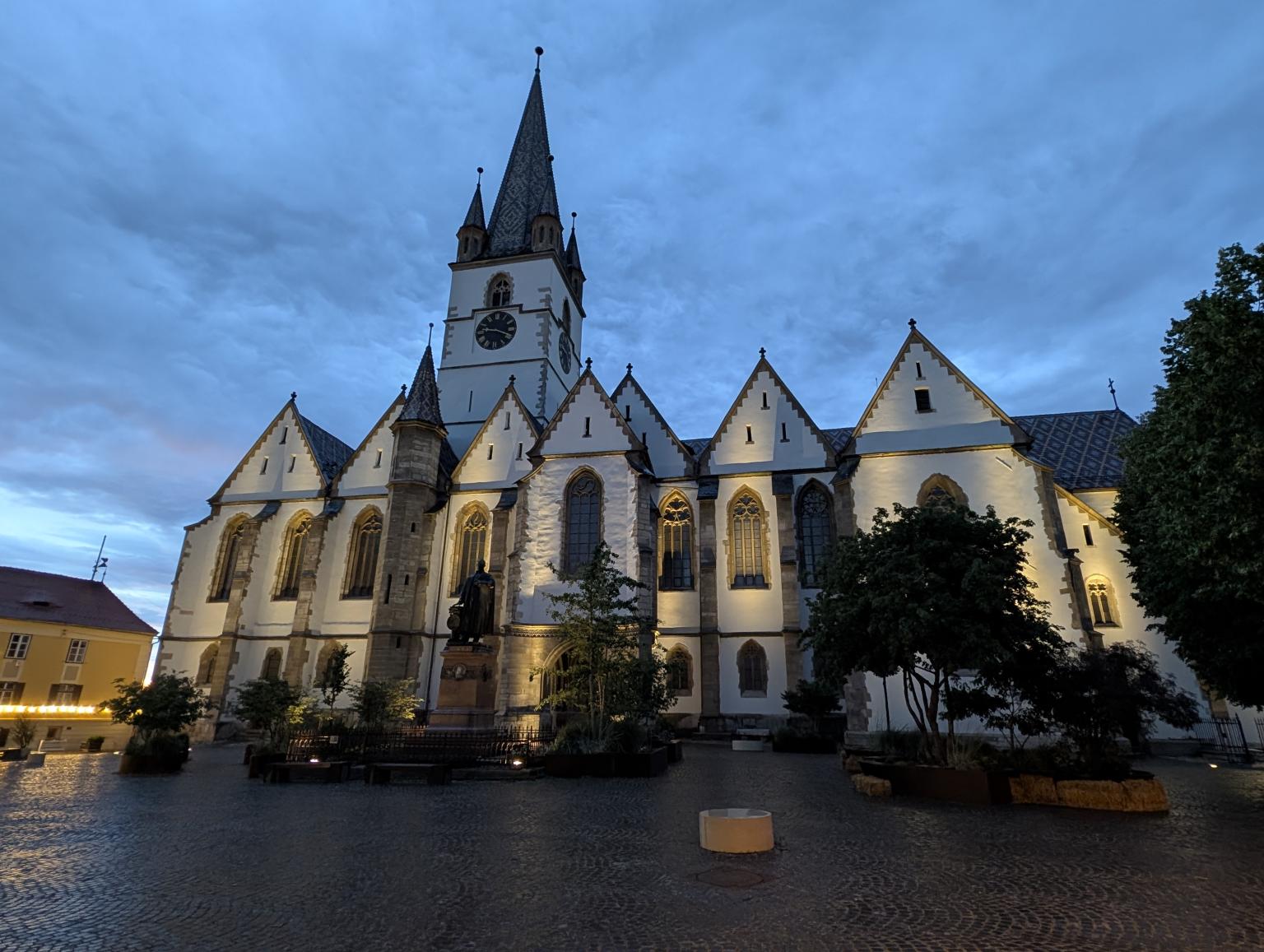
The evangelical church rose on the ruins of a basilica and a Roman construction in the mid-14th century, being completed in 1520.
The original appearance of the Roman construction, with three naves and an apse in front of the central nave, was modified in the first quarter of the 14th century by the demolition of the basilica and the beginning of the construction of the present church. The building of the Evangelical Church still preserves Romanesque features, highlighted especially in the basilica plan of the choir and the central nave.
The older part of the monument includes the half of the sacristy close to the choir and the adjacent transept, and the choir terminates to the east by a hexagonal apse. In the 15th century, the church underwent significant transformations, with the widening of the side aisles and the elevation of the central nave. In 1448, a ferrola chapel was added to the west side, retaining the beautiful portal of the west wall. In 1499, the construction of the belfry was completed, and in the 16th century, the porches at the southern and northern entrances were added, extending the northern route. The bell tower was raised by two floors and received a turret with access stairs in the final phase of the works.
Even if it is not richly decorated, the attention is captured by the elegance of the windows, the ribs of the vaults and the finely carved keystone, among which the one in the first bay of the northern nave, near the transept, representing the Madonna and Child holding a bird stands out.
The fresco on the northern wall of the choir, painted in 1445 by Johannes de Roseanu, is also remarkable, in the style of which the influence of the Austrian school in which it was formed, but also more distant influences of Italian art and from the Netherlands, can be felt. This fresco was remade in 1650 by the Sibian Georg Hermann, including lay figures, shields and coats of arms of Austria, Bohemia, Hungary and Silesia.
Another remarkable work is the sacristy door from 1471, made of wrought iron and heavily butted, fitted with a massive lock. On the opposite wall, the niche intended for cult objects, made by an advanced artist, dating from the second half of the 15th century, attracts attention.
Also worth mentioning is the western portal, with an elegant but weathered Gothic form, and the vault of the southern porch decorated with a shell-shaped motif, and externally, the eastern surface is carved with stone motifs. The upper sill of the outer north door of the sacristy bears an inscription relating to the former royal county of Huet and its coat of arms, dating from 1595 and being inlaid here many years after the church's construction was completed in 1520.
The crucible inside is a bronze work cast by the master Leonhardus in 1438, according to the inscription on its surface. The exterior ornaments include a series of plaques decorated with biblical and secular scenes.
In 1585, the city procured the first organ, which remained in the church until 1672, when Johann West of Neusol, an organ builder, installed a new richly decorated instrument in the Baroque style, still visible today. The organ has 62 pipes, 85 registers and 75 auxiliary registers, being recognized as one of the largest church organs in the country. Baroque elements can also be found in the inlaid epitaphs in the northern wall of the central nave, made by Johann Eberhardt Blaumann, a native of Wurtenberg, in the second half of the 18th century, for personalities such as Daniel Glockner (+1754), Samuel von Dobosi ( +1759), Binder von Sachsenfels (+1768) and Czekeli von Rosenfeld (+1770) from city life.
Initially, the Church was the burial place for administrative, political and ecclesiastical figures of the city. In 1796 these burials ceased, with one exception in 1803 for Samuel Brukenthal. During the restorations between 1853 and 1855, the crypts inside the church were plugged and some tombstones were integrated into the structure of the church.
These tombstones came into use towards the end of the 15th century, becoming a tradition for the city's influential families and prelates over the next two centuries. Initially, these slabs represented only the coat of arms of the deceased, but were later completed with the representation of the buried, occupying most of the surface of the stone.
In Sibiu churches, the type of tombstones constitutes a veritable gallery with 67 pieces, some of which are true works of art. Among the oldest are the graves of Georg Hecht (+1496), Nicolaus Proll (+1499) and Johann Lulei (+1521). The tombstone of Georg Hecht, made of red marble, bearing the coat of arms of the deceased and an inscription mentioning his capacity as mayor of Sibiu during the period in which he held this position, is in the Gothic style. In contrast, funerary slabs such as that of Nicolaus Proll, former mayor of Sibiu, present characteristic features of the new Renaissance trend, while retaining many elements specific to the developed Gothic, especially evident in the rich details of the decoration. Also notable is the cast bronze funerary plaque of Petrus Haller (+1569), which depicts the coat of arms of the deceased and his two wives, reflecting western influences (Nuremberg) where the deceased's family came from. The tombstones of Christian Hirschel, Michael Weiss (+1650) and Valentin Franck (+1648) executed in the Renaissance style by the famous stone sculptor Elias Nicolai, are of indisputable value. Particularly notable is Valentin Franck's slab. In the 17th century, gravestones began to be painted.
A different presentation can be found in the tombstone of Mihnea Vodă cel Rău, former lord of Wallachia (+1510 in Sibiu). The border of the stone includes an inscription in Latin, and the center is occupied by a large cross with trefoil arms, decorated with rosettes. The lower part of the cross ends in the shape of a lunar sickle, covering the symbolic grave of Adam, a motif frequently found in the practice of the time on the graves of the lords and damsels of Wallachia.
Source: Sibiu and surroundings (Ministry of Tourism, 1979)