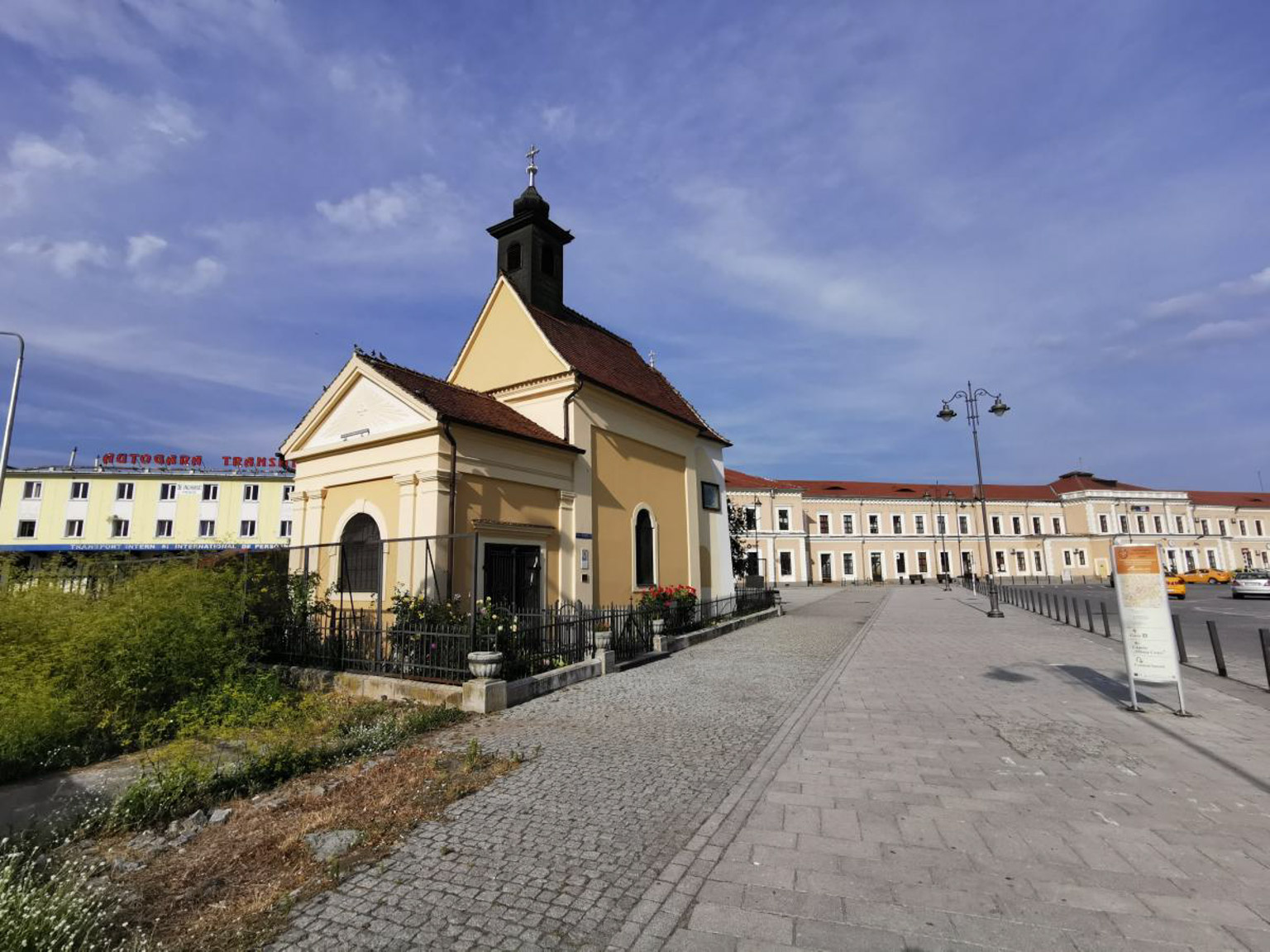
The Chapel of the Cross attracts attention exclusively through the sculpture inside it. It refers to an ensemble that presents a crucifix in its center, and on the sides there are representations of the Mother of God and the weeping St. John the Apostle. Made of stone, this work comes from the former monastery of the Dominican order, located in the same location. It seems that there were Italian influences in the creative process, also present in Austria, the place of origin and where the artist was trained.
Due to a certain disproportion in the dimensions of the three figures of the group, the relationship between the figure of Jesus, presented in a supernatural size, and the two figures at the foot of the cross, not correctly addressed by the sculptor, suggests that the side figures were added later. Also, the relationship between the component parts of the figure of Jesus was not treated properly. At a later stage, the cross was rebuilt, receiving trefoil heads, and in the same context, the figure of Jesus was completed.
On the right side of the foot of the Cross, the inscription "Hoc opus fericit Petr(us) la (n)tregen von Ostereich" (This work was made by Petru Lantregen of Austria) can be read, while on the opposite side is the inscription " Anno Domini milesimo CCCCXVII" (Year of the Lord 1417).
At one point, the statue was painted a greenish-gray shade. It represents one of the significant pieces of Gothic sculpture in Transylvania.
Source: Sibiu and surroundings (Ministry of Tourism, 1979)