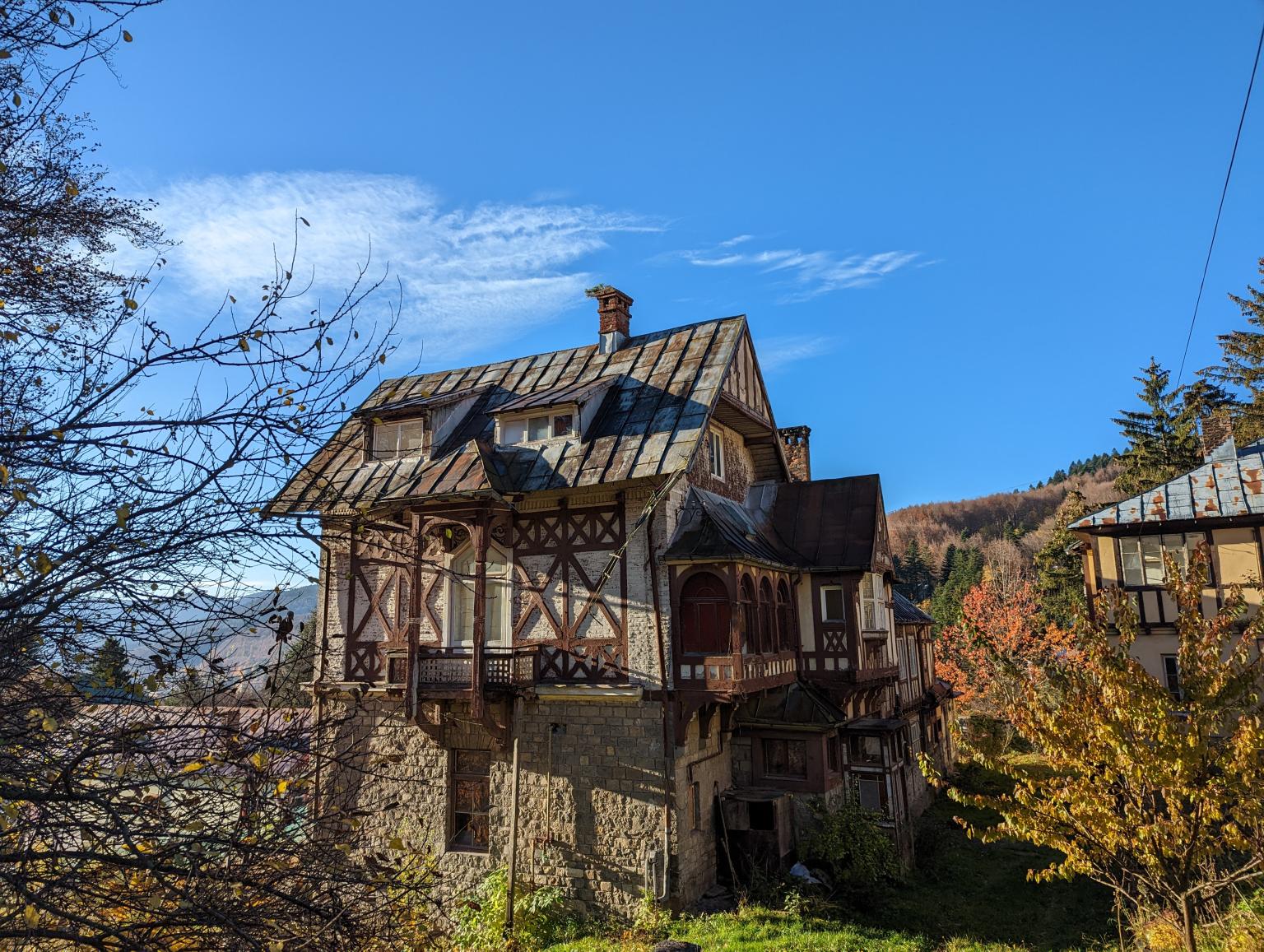
The villa located on Take Ionescu Street in Sinaia came into the possession of the Ionescu family – consisting of Take and his wife, Bessi Richards – in 1893. Starting in 1895, the villa underwent a rehabilitation and modernization process, which transformed it into the form we know today.
The modernization project was carried out by the architect Henri Susskind, a Swiss born in Vienna in 1868. At the end of the 19th century, Susskind became one of the most active engineers in Bucharest and Sinaia. Among his most important works are those carried out for the Society of Grand Hotels, among which the Athénée Palace Hotel (1912) and the Palace Hotel in Constanța stand out, but also, in Sinaia, the Palace Hotel (1911) and the Casino (1913).
The Take Ionescu Villa is made up of several bodies, each with varying heights and dimensions, well defined both in plan and in the roof. Architectural elements such as the main entrance from the veranda, the glass-enclosed galleries, the balconies, the bay windows and the dark wood facades contrasting with the white walls contribute to a picturesque appearance, characteristic of the German Renaissance style. The interior partitioning was done according to the family's needs.
On the ground floor, on the right side of the villa, there was an office, and nearby another, smaller one, intended for one of the secretaries who accompanied Take Ionescu to Sinaia. In the central area there was a spacious hall, which communicated through a glass partition with the main dining room. In 1905, the Sinaia municipal council decided that the street where Take Ionescu lived should bear his name, so the villa received the address “Strada Take Ionescu” no. 2. Also that year, Take Ionescu was named honorary president of the Sinaia Craftsmen’s Philanthropic Society “Vârful cu Dor”, a sign of his close connection with the mountain town.
After the end of World War I, during which the area was under German occupation, the villa entered a new stage of its existence. Take Ionescu was intensely involved in domestic political life, from the achievement of the Great Union until taking over the government at the end of 1921. The following year, 1922, was marked by his death. The villa was inherited and inhabited by his successors for almost thirty years, until 1950, when it was nationalized. The building was then assigned to a children's home, and the maintenance and renovation works were financed from the budget of the School Inspectorate, which allowed the building to be relatively well preserved during the four decades in which it had this destination.
After 1990, the building was removed from the administration of the state and the School Inspectorate and was returned to the heirs of Take Ionescu. The text is taken from Ziare.com, from the article entitled "The story of Take Ionescu's villa in Sinaia, put up for sale by Mircea Rednic. How much does the former coach ask for the historic monument building".
Sursa: ziare.com