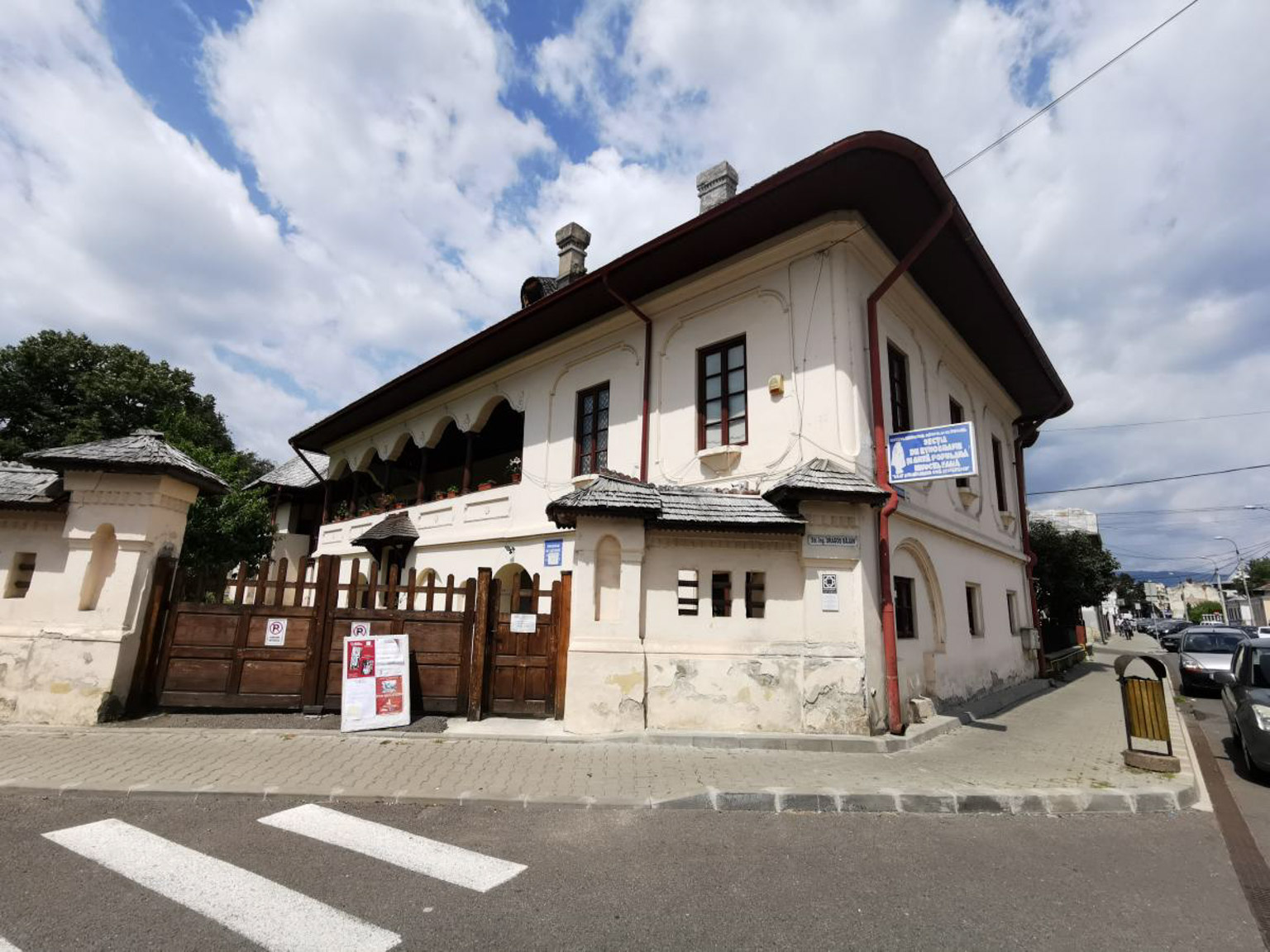
Across the street from the church of St. Nicholas stands a building, built in 1907, the former city hall, which today houses the ethnography section of the municipal museum.
Initially, the Fine Arts Section of the city museum was housed here, organized in 1959 by the donation of the writer Mihai Tican-Rumano.
The museum included works of Romanian painting, sculpture and graphics from the last century, belonging to the artists: H. Catargi, N. Grigorescu, C. Baraschi, R. Schweitzer-Cumpăna, D. Ghiață, T. Pallady, C. Baba, A. Jiquidi , O. Han, Mac Constantinescu et al.
Not far from the museum in the area of the hospital was the Sfânta Troiță church (demolished) built by Jupân Vasilache in 1730 on the site of an older one. Here was buried the outlaw Radu Anghel, the brave "son of the woods", who in the middle of the last century opted for the path of outlawry as a form of protest against social injustices, was Radu Anghel. He infiltrated among the members of the nobility and merchants, and was later pursued by the gangs led by Captain Palada. Finally, he was captured in a monastery located in a hamlet near the city, where he had found shelter. Seriously injured, he ended up in the local jail. On the cross of his grave, as an epitaph, were carved in stone the lines taken from a popular ballad:
"Captain Palada
And little Surcea,
I won't give up
A collared woodpecker
Which puts him under the bed at night
I take them as yellow as I like
With which I buy plows and oxen
To those in need
Poor in poverty
To escape from slavery".
The outlaw Radu Anghel, active in the period 1827-1865, caused fear among the boyars and merchants of Muscel. A portrait of the outlaw made by the painter Mișu Popp (1827-1829) can be found at the Bucharest Art Museum. Valuable folkloric literary creation from Muscel, including the ballad of Radu Anghel, praises the heroic deeds of the outlaw.
Many stories about the outlaw's deeds circulate among the population.
One day, being late with his errands and not being able to reach the forest where his companions met at nightfall, Anghel stopped at the poorest household in a village. The characteristic hospitality of the host welcomed the traveler to wait at table with his wife and three daughters, offering him the food they barely had enough for. He was then given a place to sleep in a modest but clean bed. In the morning, the outlaw got up early and hurried away, leaving a bag of three hundred gold coins under his pillow as a sign of thanks. But, before he went deep into the forest, the peasant caught up with him and handed him the "forgotten" money.
Angel explained that he had purposely left the money under the pillow as a token of gratitude for the hospitality and as a gift for the host's beautiful daughters. Before the man awoke from his surprise, the outlaw had disappeared into the depths of the forest. Only later, when the authorities were looking for the outlaw Radu Anghel in the nearby villages, who had been terrorizing the rich, did the host realize who his special guest had been and was glad that he could be of help.
Source: Bucharest-Brașov on variants (Ministry of Tourism, 1976)