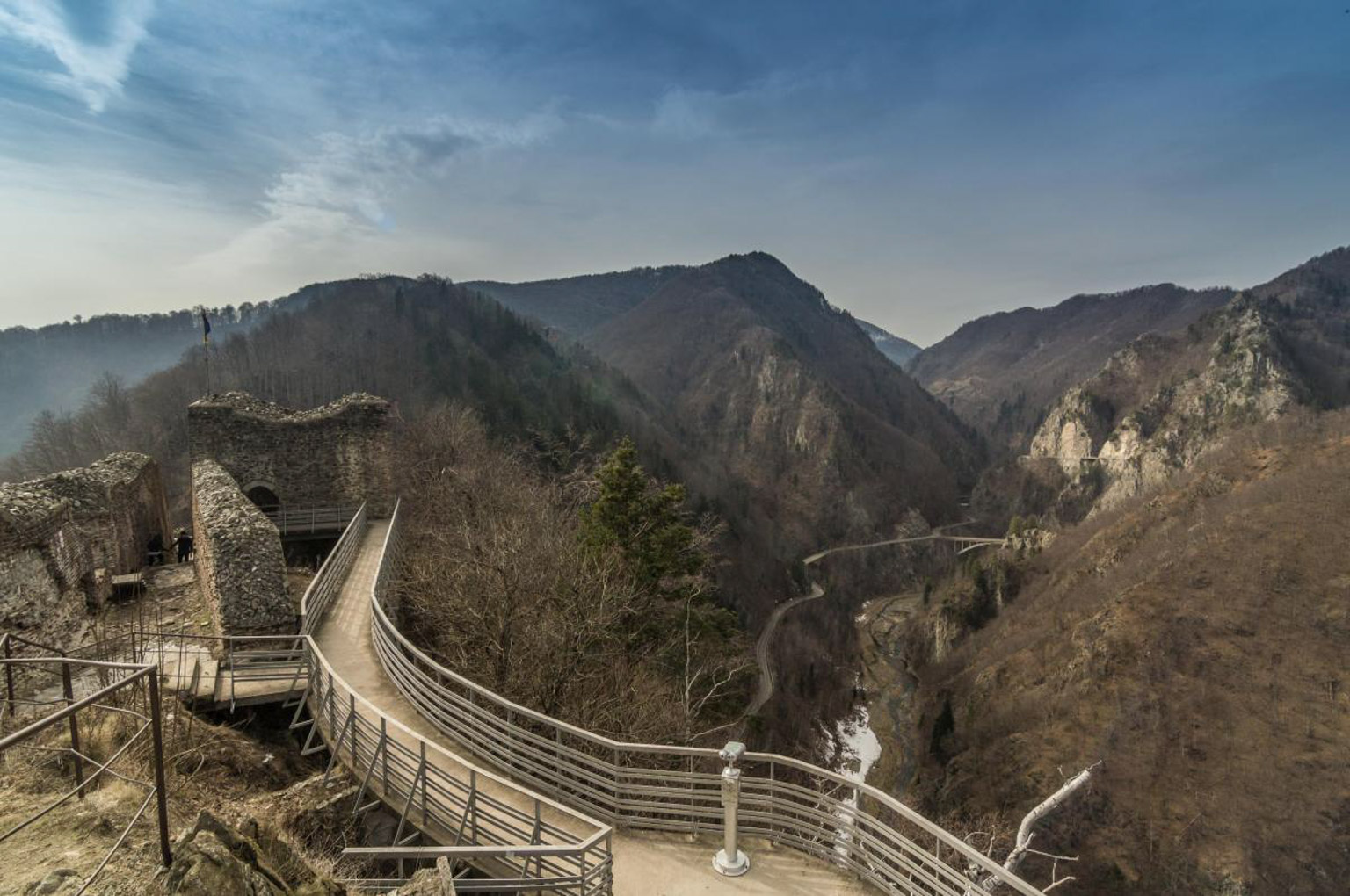
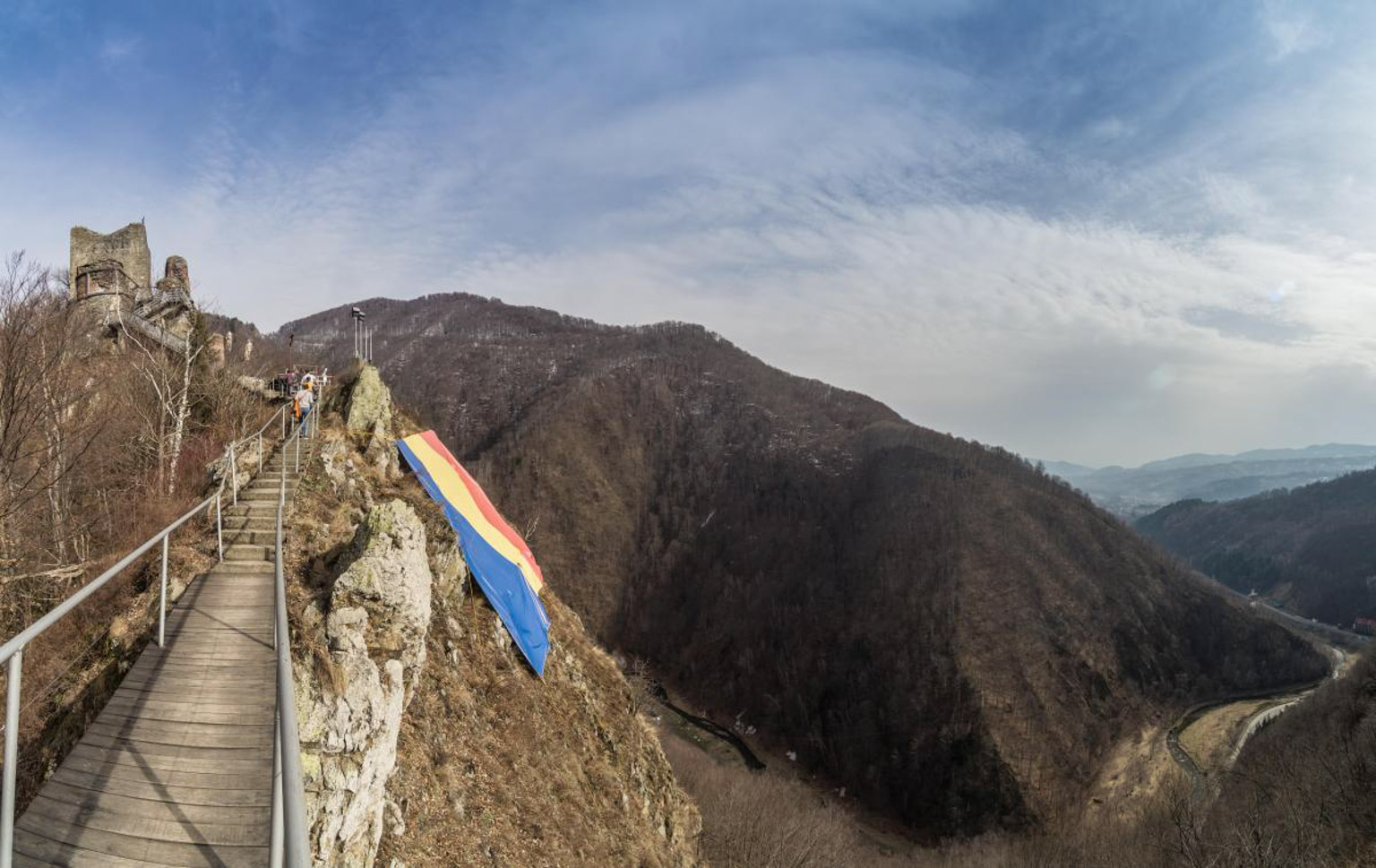
25 kilometers away from Curtea de Argeș, in the gorges of Argeș, there is the "eagle's nest" called the Poenari Fortress. Located at an altitude of 850 meters, on the top of Mount Căprioara, in a place where it penetrates deep into Mount Albina, forcing Argeș to make a detour, surrounding it on three sides, the Poenari Fortress was considered impregnable.
The exact date of the construction of the first foundation stone of the Poenari Fortress cannot be established from the available documentary sources. Researchers, based on the preserved appearance and structure of the fortification tower, suggested a possible Roman origin. However, popular tradition claims that the legendary Negru Vodă was the builder. Some historians, including Nicolae Iorga, believe that this fortification could be identified with "Castrum Argyas", mentioned in a document from 1336, near which, in 1330, the Battle of Posada would have been fought, marking the achievement of independence from to Wallachia following the bloody confrontation with the armies led by King Carol Robert.
A certain aspect is that Vlad Țepeș (April 1456 - November 1462; November-December 1476) made repairs to the fortress. From that period, the fortification was also known as "Vlad Țepeș's Fortress".
Mentioned in a document from 1502 under the name Poenari Citadel, the "falcon's nest" on Căprioara mountain occupied a strategic position to resist external attacks.
The Poenari Fortress played a crucial role in the history of the country's defense against enemies, serving as a refuge during difficult times and often being used to protect the nation's treasury.
Beginning with the final decades of the 16th century, the importance of the Poenari Fortress declines, and it is left in disrepair, with its walls gradually crumbling every year. However, the immensity of the construction prevents the total collapse of the fortress under the influence of the passage of time.
The configuration of the Poenari Fortress was an irregular polygonal one, evolving around a nucleus represented by a tall and round tower, supported by a solid buttress, which watched over the valley. This tower seems to date from the 13th-14th centuries. The main access to the fortification was through a reinforced gate, located to the left of the tower and defended in front of a moat, over which a drawbridge could be lowered, an indispensable element in the construction of any medieval fortress. Other towers, also round but smaller than the main one, were built, two at the ends and the third in the southern part, the longest section of the building.
The enclosure walls, with a thickness of three to four meters, were built of stone and covered with brick in the upper part. To maintain the connection with the outside during sieges, a deep well was dug within the fortress, connected by a tunnel that pierced the rock; the entrance of this tunnel was at the base of the mountain, in a point called "La pivniță" by the locals.
In 1967, the ruins of the fortress were consolidated, preserving its original appearance.
Further, the road passes through landscapes of remarkable beauty, platforms created by blasting in quarries, vertical cliffs whose summits cannot be seen, elegant viaducts bravely thrown over valleys and precipices, abundant forests, four tunnels dug into the rock, and others.
Source: Bucharest-Sibiu (Ministry of Tourism, 1977)