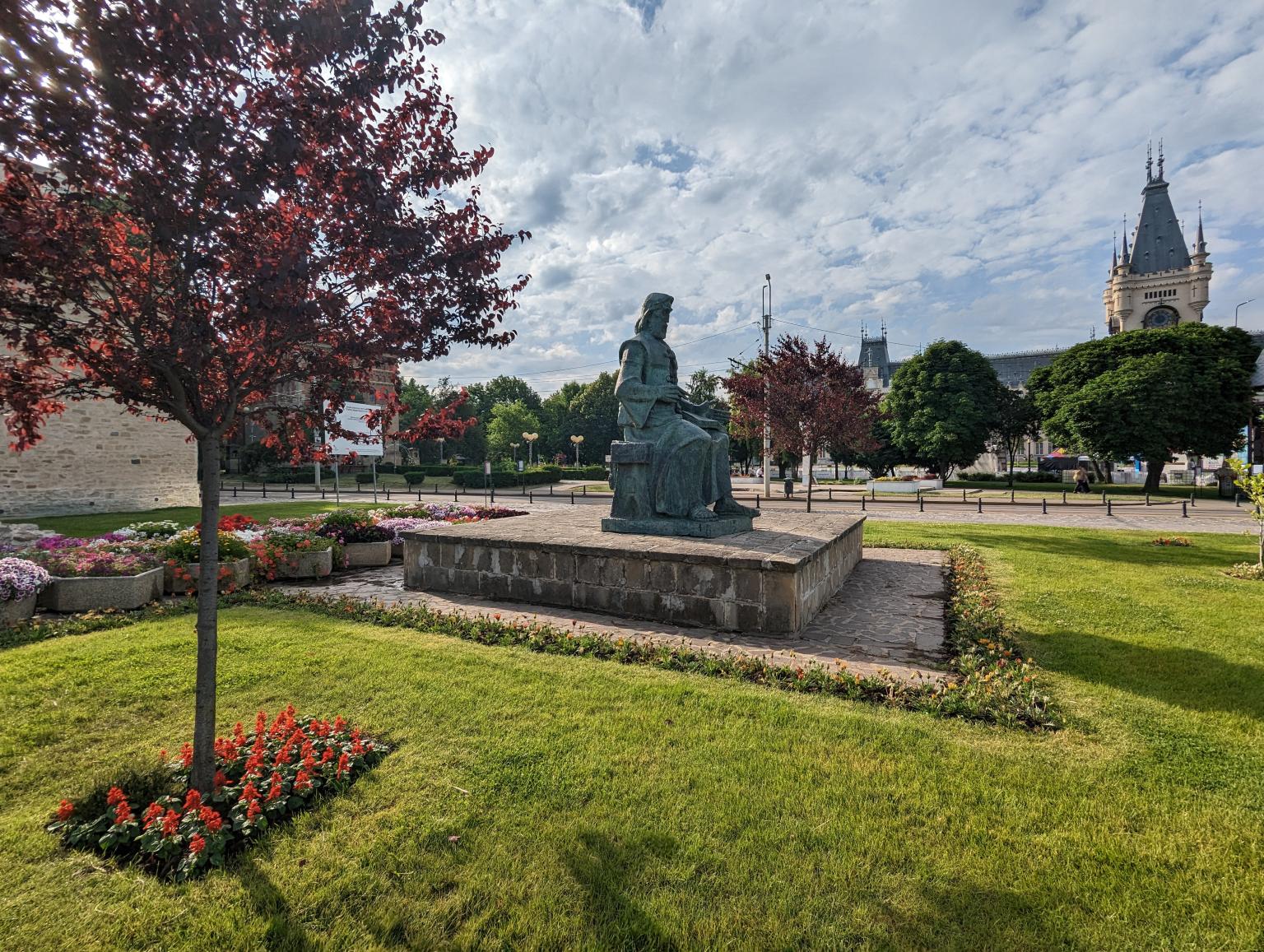
Built in the 18th century, the Dosoftei House, also known as the "Arched House", is the oldest secular building associated with the reign. In the period 1967-1969, it was restored, being located near the wall that once surrounded the old Royal Court. The building adopts the style of merchant houses, with porticos facing the street, specific to Moldovan cities. The simple parallelepipedal volume, covered by a hipped roof, includes two vaulted rooms and a tall portico with five arches facing the street.
The stylistic similarity of the Dosoftei House to the dugheniles of Istanbul, found in Turkish-influenced neighborhoods and other regions near the Black Sea (such as Georgia), is notable. The back of the building serves as a warehouse, while the front gallery, open to the arcades, was used to display goods for sale during the day.
The name "Casa Dosoftei" comes from the fact that it housed, for a time, the printing press of Metropolitan Dosoftei. This printing press, brought from Russia with the support of the Moldavian scholar Nicolae Milescu, became necessary after the destruction of Verlaam's printing press in 1642. Dosoftei, Metropolitan of Moldavia between 1671 and 1686, was a well-known polyglot, prolific translator and the first scholar to promote courageous use of the Romanian language in church worship. Through his reforms, he contributed significantly to the evolution of the Romanian language and culture, being the author of the first work in verse printed in Romanian, "Psaltirea pre vers tocmita" (1673), and of the extensive work "The Life and Feast of the Saints".
In 1686, he went into exile in Poland, where he would end his existence tormented by a deep longing for the country and nation he had served so devotedly.
Today, this building houses the Old Romanian Literature Section of the Museum of Literature of Moldova, which exhibits various works, among them the "Liturghierul" printed by Macarie in 1508, the first print on the territory of our country; "Apostolul", the oldest Romanian manuscript dated 1560, in which the Romanian text alternates with the Slavonic one; "Cazania or the Romanian Educational Book" printed in Iasi in 1643; the oldest copy of Grigore Ureche's chronicle from about 1665, "Letopisețul Țări Moldovei"; a copy from the beginning of the 18th century of Miron Costin's "Letopisețu Țări Moldovai"; an 18th century Chronograph that belonged to Mihail Eminescu; a copy in German (1771) of Dimitrie Cantemir's work "Descriptio Moldaviae"; didactic manuals, among which the "Patriotism Manual translated and added" by Iancu Nicola, printed in Iași in 1829, etc. stands out. In the museum, there is also a model of a printing press from the 17th century.
In front of the museum building, you can admire the statue of the scholar Dosoftei, made in bronze by the sculptor I. Bârleanu in 1975.
Source: Iași Municipality and surroundings (Ministry of Tourism, 1980)