From Piața Palatului, you can reach the street dedicated to a notable Romanian personality, Costache Negri. Born into an old noble family in Iasi in 1812, Negri was a student of Victor Cuénom alongside the young M. Kogălniceanu, V. Alecsandri and Al. I. Cuza. Due to his age and wisdom, he was nicknamed "Grandpa" and "Uncle". Costache Negri stood out in the movement for the union of Moldova and Wallachia in 1848, having an active role in the elaboration of the Moldavian revolutionary program. He was close to Al.I. Cuza and supported his reformist policy. Through his work, Negri contributed to the shaping of modern Romania and is considered a forerunner of the current times, dedicating his activity to the struggle for social progress and the unification of the Romanian people in a unitary national state.
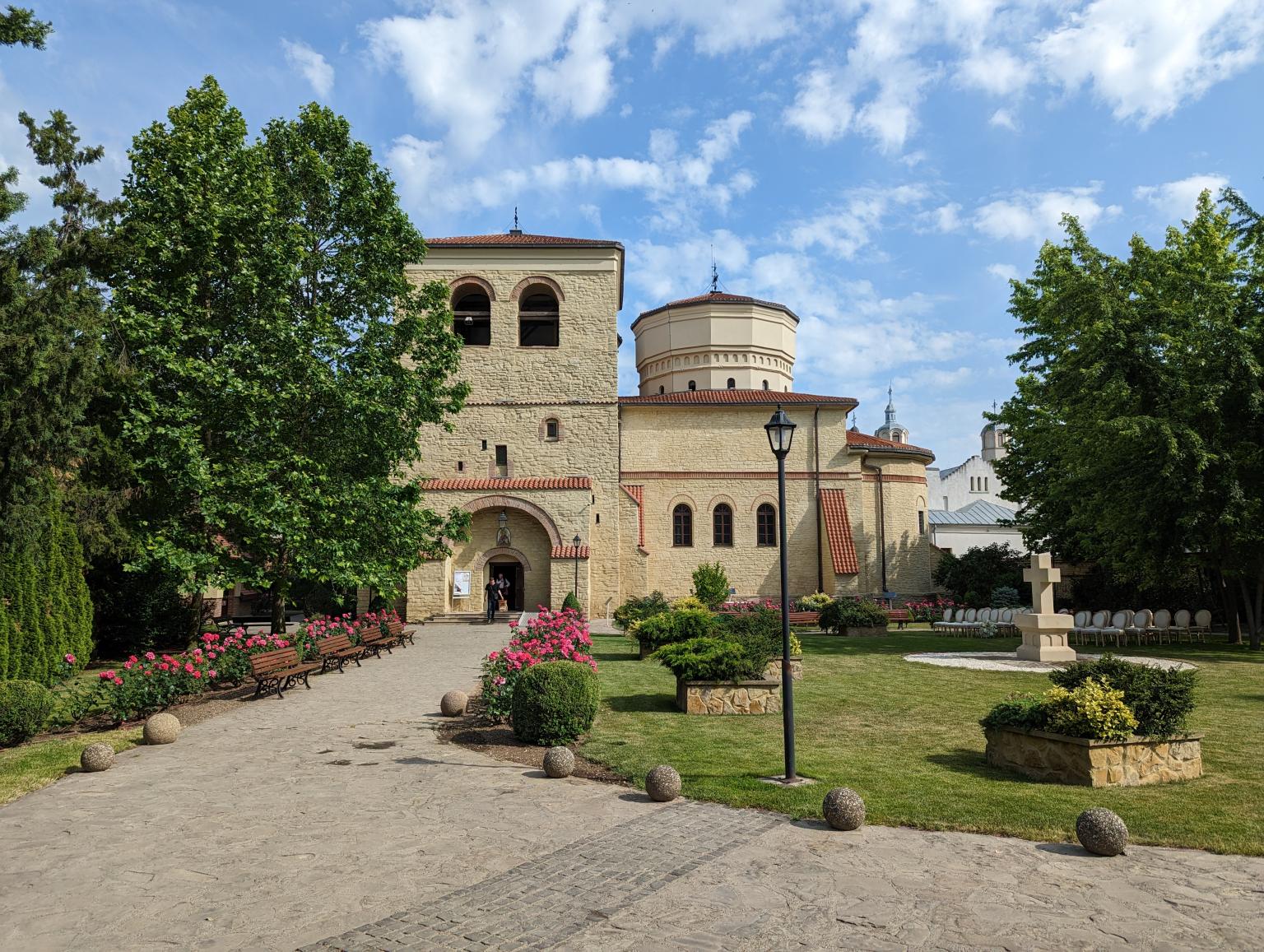
The Church of St. Sava was built in 1583 by craftsmen brought from the East by Greek monks from the monastery of St. Sava in Jerusalem. Later, it was restored twice, the first time in 1625 by Protomaster Gheorghe from Constantinople, with funding from the postman Enache, and the second time in 1820, by Archimandrite Grigorie. During these renovations, the original form of the church was carefully preserved.
The general appearance of St. Sava Church is completely different from the monumental plastic of Moldovan churches, reminiscent of the architecture of Ottoman buildings. The monument combines Byzantine, Oriental, Gothic and even Moldavian features, which do not fit harmoniously into a single architectural type.
St. Sava Church did not serve as a model for any other subsequent Moldovan church, being considered, from an architectural point of view, unique.
Built of stone, the church impresses with its generous dimensions, height and brightness, having a rectangular plan, a semicircular apse and two large domes raised on a low cylindrical drum.
On the south side, a porch was later added, and above it rises the belfry, a square structure in which are suspended five bells, the largest of which, with a vast circumference, was cast in Denmark.
On the outside, the walls are completely smooth, showing only a series of cornices around the turrets.
Inside, the entrance door attracts attention, beautifully ornamented on the inside, with a border decorated with Gothic mouldings, framed in a rectangular branch accentuated by a braided rope, specific to the Moldavian ornamentation of that period.
In 1625, due to rapid degradation, the church of the former monastery was rebuilt from the ground up.
Source: Iași Municipality and surroundings (Ministry of Tourism, 1980)