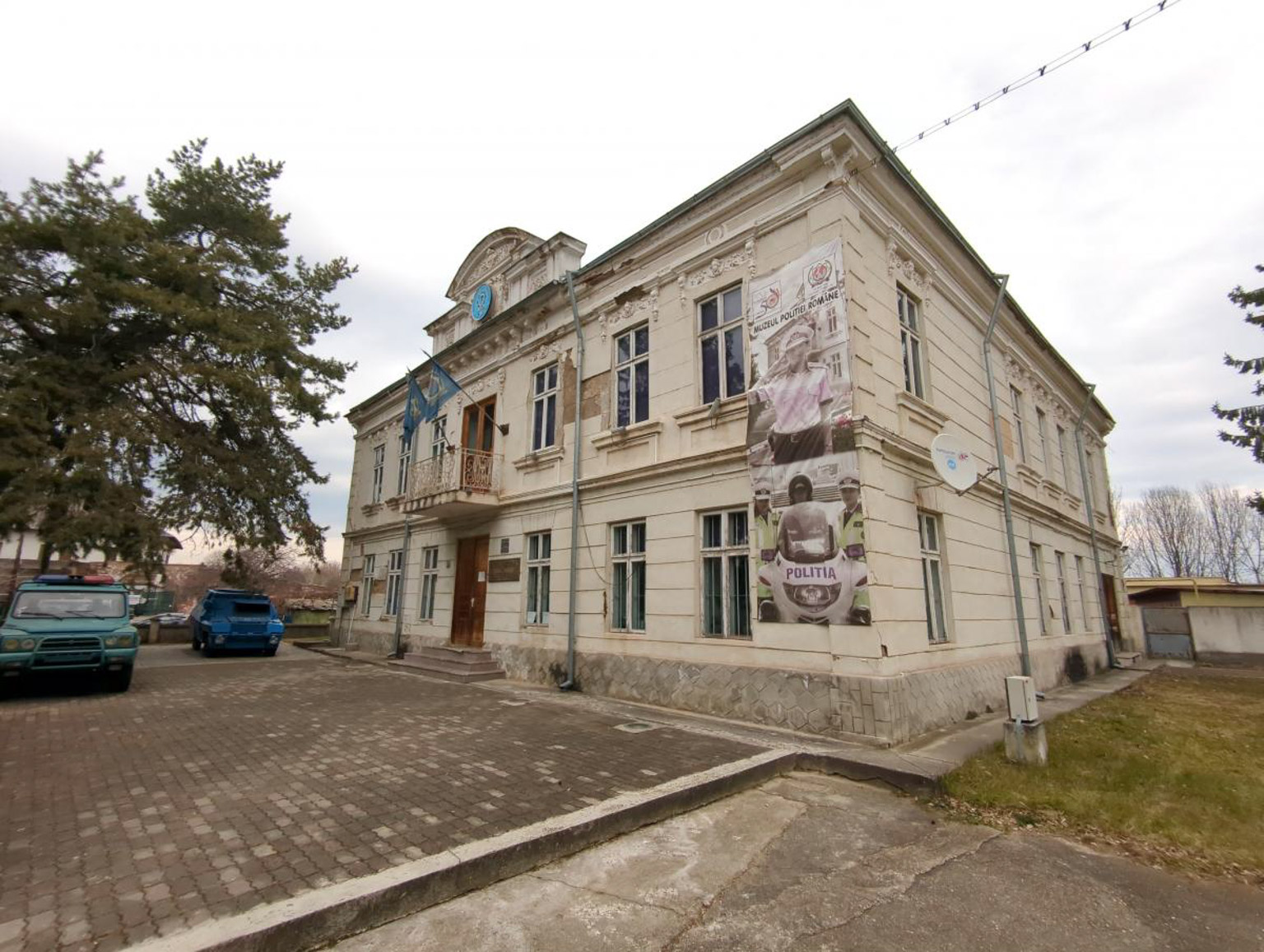
The National Museum of the Romanian Police is located in a building of artistic and historical value, restored in neoclassical style between 1867 and 1893. Initially, the house was built in 1701, at the initiative of ruler Constantin Brâncoveanu, on the site of an older house that had belonged to Grama Stolnicul. It was called "Casa coconilor" and was intended for the ruler's sons, being located near the Sfânta Veneri church, mentioned in a document from 1630.
From the chronicle of the logofatian Radu Greceanu, we learn that in 1712, a big fire affected the city of Târgoviște, partially destroying the "House of Cocoons", but it was quickly rebuilt under the ruler's supervision. The documents show that next to the house there was also a church, "Sfânta Vineri a coconilor", which was demolished in 1847.
At the end of the 17th century, the "House of Cocoons" became the property of Scarlat Hiotu and later of his son, Nicolae Hiotu, who bequeathed it to his wife. According to a census from 1829, Nae Hiotu lived in Bucharest, but he also had houses in Târgoviște and Bucharest. The house in Târgoviște was used for a school, where it is assumed that the poet Grigore Alexandrescu studied. Mircea Bodeanski's drawing, based on Szathmary's photographs, shows a house with a high ground floor and gazebo with a shingled roof.
After serving as a school, the house housed the County Council during the Organic Regulation period and later came into the possession of the Austrian engineer I. Külle. In the late 19th century, the building was altered to become the Prefecture, now having a square plan and two levels. The ground floor has three rooms, and the first floor houses a long hall and the museum's core exhibition.
The building's cellar, preserved from the time of ruler Brâncoveanu, has a specific structure, with four vaulted compartments and a central stone pillar. Light enters through small windows on the north and east sides.
The cellar and other similar structures have kept administrative archives since the 19th century. In recent years, the building housed the Dâmboviţa County Department of Labor and Social Protection, but after its move, the "Coconior House" was abandoned, although it is a historical monument that requires urgent conservation work.
Sursa: www.politiaromana.ro